michael-dean-k/

On Monday 6/15, I'm hosting a workshop to kick off a reading group for classic essays: RSVP here.

Group

Virtues

68 pieces

In search of side doors

I published 38 "essays" in June, averaging at ~600 words, totaling at ~22,800 words (that's a pretty good month for me; I usually go between 10-30k). That same overall output could also be spliced up as four long form essays at 5,700 words each. The question here, can you count these small things as essays?

If you look at Montaigne, and especially Bacon, they each had some shorter one around 500 words. I have other contemporary essay book that feature writings that are exclusively 2-3 pages each. So historically, yes, there's a case for short non-fiction musings to be called "essays," but is it really about shortness?

It's more about formality and effort. In recent years, I was set on writing "unitive essays," ones that integrated all the known patterns, ones that went through many rounds of editing, ones that would be timeless. I still, of course, value that and aspire to it; I'm just currently in a phase where time is more burst-like. Such is life with a 5-month-old daughter. Deep flow states are hard to come by, and so instead, I'm logging little ideas all day, and whenever I get to the computer, with the mental space to write, the goal is to pick one idea and articulate it fully. Can I write and publish this idea, here and now?

It's an approach void of editing, which feels right for right now. I've thought so analytically about the craft, and the goal now is to see if I can weave in patterns on the fly. This doesn't mean I can successfully scope and prose every idea to a 5/5 on a single go. Most ideas—including probably this one—are started pre-maturely, and have limits on what they can become without scrapping it all and restarting from a new frame. Of course, the point is for ideas to mature through writing, but a great thesis can be so cognitively reorienting to nullify a draft's whole premise. But maybes that's the thing to build towards?

I didn't have this idea before I started this essay, but maybe an essay should contain an earnest shock, something in the moment that negates, inverts, and breaks the structural logic above. Wouldn't there be a thrill in witnessing a live epiphany, and then watching the writer clarify how everything previously covered may be true/false in light of the revelation?

You may have noticed, every paragraph so far has ended with a question. I suppose I'm playing with this idea to start with a clear question, and then continuously drive forward until a spontaneous question triggers something new, and I can fold back into that original question with an answer from a different dimension, a side door I never knew existed. An essay is less about the length; whether it's 300 or 30,000 words, it's more so about the value of what's discovered.

I was looking at my archive earlier, at everything I published in the last year. There are 363 "essays" (most of which are expanded logs), averaging at 370 words each. Of those I have about 22 essays flagged as "favorites," meaning, they've elevated to a special section, and earned the formality of cover art. This means that only 6% of the ideas I write in a given year are worth carrying forward. With time, that will probably atrophy even further. Even 1% of output per year is high: if you can write 3.6 timeless essays per year, that's prolific. DFW, if you look at what was anthologized over his career, only put out 1-2 per year. One approach to this is to pick be very selective, only chiseling a hand few of ideas; the other is hyper-publishing, trusting that curiosity will bring you to unexpected places, and the emergent "winners" are not ones you could ever predict. What makes something a winner?

It must be a fusion of things; again, quality is the transcendence of categories. This gets into what-makes-something-the-best-essay territory. The originality and nature of the subject itself matters, which is part of why I like the idea of reading and writing wider. But the essays I like most are the ones that also fuse in most or all of the compositional patterns around that thesis. There's only one I wrote in the last year that comes close. Maybe all of them have some personal experience peppered in, but the best ones, I feel, are ones where the writer is deeply immersed in a place, and all the things about them become allegorical. So you can read and write, quick or slow, short or long, but what you make is shaped by how you live, which is why it might be worth capturing your daily thoughts in prose.

Where to put the portals

Some thoughts on containing complexity in personal website design

· 1204 words

Sometimes the coolest website is the least readable.1

I recently came across gwern.net and quickly sensed it would be a personal-website-as-labyrinth that I'll venture into for weeks. It has an alien feel to it, or at least foreign relative to the optimized and foolproof UIs you find across templated social networks. He is a Wikipedia editor with 34,569 edits (on English Wikipedia as of 6/1/26) and so naturally his personal website is a personal wiki, documenting his self, his site, his links, his tech stack and writing, each adorned with hierarchical outlines on the left (1, 1.2, 1.2.6, ... ). I sense him to be something of a techno-Montaignean, capturing his mind and culture, interweaving quotes, and pseudonymously appearing on the Dwarkesh podcast as a real-time avatar.

So yes, lots of diving and mapping to do, but I need to note one observation of my experience here, which I want to be careful not to recreate on my own site. Most of my time is spent marveling at the structure and navigating what exists, but I'm presented with so many hyperlinks that I can rarely ever focus on and absorb a single page. There are 53 links in my current view. Maybe I'm exposing myself as someone who reads linear essays a lot more than I read Wikipedia articles.

I suppose there are two ways to know a person, in breadth and in depth. Technically this site has both; once you wade through the peculiar structures and get a gestalt of the person, you do find linear essays that are well written. But even those are nested in scaffolding; 60% of the opening view is dedicated to metadata: nav links, title, tags, a summary, ratings of completion, certainty, and importance, links to similar notes and a bibliography (many of which, if clicked, opens a pop-up with more information), and then an opening quote, all before the opening sentence.

Even if I think this meta-data is misplaced, I personally love having it all accessible. I get frustrated by a popular online writer (/marketer) who refuses to date the essays on his website, probably from the thought that datelessness is timelessness, or the fear that the median reader will see something dated 2019 and think ugh, that's old, and click away. Marketers want a simplicity that's legible at scale; I am a complexophile. A personal website (or anything, really) should be as dense as can be contained, for that gives the super-reader the ability to grok you at a resolution closer to reality, but only as long as it can be progressively revealed, giving the first encounter an on ramp into the beast.

I'm now arriving at what I think I believe: if your website contains a collection of essays, then drop the reader directly into prose, and withhold structure until the end of an experience. "Prose before portals" could be a simple, multi-scale maxim. A standalone essay page should have a header of only 15% metadata, and even the frontpage, instead of providing a traditional orientation, could drop you directly into a stream of recent essays (a design decision I haven't committed to yet, but am leaning towards). Perhaps portals could exist minimally at the beginning, but maximally at the end. An essay's footer should be entirely portals.

Another debatable decision is that an essay should rarely include internal hyperlinks. Contrast this to Justin Hall's links.net of the mid-90s, whose whole website was a hyperlink maze. Gwern's site, much like Wikipedia, is also maze-like. These are conceptually neat, and of course native to the Internet, but I always catch myself skimming rather than reading deeply. I am astonished at the size and grandeur of the park, but I am distracted. Essays demand depth. My ideal would be to fuse the medium of physical reading with the navigation of the web: uninterrupted prose, bookended by optionality. Maybe you could refer to this as "extrastitial" instead of "interstitial": the internal modules aren't connected, but the wholes are connected end-to-end. (This actually mirrors how ChristopherAlexander structures his chapters in A Pattern Language, the original wiki: the beginning and end points out to other chapters, but the body is uninterrupted.)

A final note on skimming: I catch myself doing "Inspectional Reading" a lot here, the second level of Adler's How to Read a Book. There are many possible causes for this. To start, it could just be my fault: right now I'm reading as I write this essay, and I have much to do this morning, and so to some degree I'm reading to the level that it enables me to write, for if I read everything full, all the tabs, I could become absorbed for hours and get nothing else done before it's time to watch my 5-month-old daughter for the rest of the day. But aside from self-blame, there's a FOMO that comes with any thriving website: when you're aware of a sprawling network of high-quality information, it becomes hard to sink into any one piece because you're too aware of what you're missing. And so there might be something to intentional concealment and revelation.

I want a reader to come to my site and experience flow, not analysis paralysis, but this opens a new question. Who is a personal website for? The answer is in the name. The reason I'm shifting from Substack back to a site of my own is because I want to write in a place where I set the rules. And so there's a risk of leaning too far into becoming a self-archivist, where I try to convey to you the totality of myself, the full hyper-object, instead of letting you compile me one file at at time. If the full extents of my writing are something like a national park, I need to make sure you get on the curated trails and experience nature, instead of presenting you a network of maps.

Ironically the first essay I read by Gwern was on Tools for Thought, a wonderful takedown or Rome, Zettlekasten, and networked thought:

"Most people simply have no need for lots of half-formed ideas, random lists of research papers, and so on. This is what people always miss about “Zettelkasten”: are you writing a book? Are you a historian or Teutonic scholar like Niklas Luhmann? Do you publish a dozen papers a year? Are you the 1% of the 1%? No? Then why do you think you need a Zettelkasten?"

A rule I've had to set for myself is to never link my notes; they should live scattered in an epiphany swamp of atomic ramblings, only to be given name, date, and tag at the moment of publishing. Most won't make it out of the swamp. So many writers suffocate themself in PKM hell; instead they should open the pipeline to get finished prosed onto their website. And now, I find myself reaching for heuristics on how to present essays, a whole body of work, and the very self behind it. I think there are similar risks with public hyperlinked structures, along with ways to let the atomic nodes of a network speak for themselves, without severing from the hive.

This is all just first wind from second impressions, but as I understand Gwern more deeply and build out my new site—after existing only on Substack for 3.5 years—, I'm sure I'll come away with something useful.

Footnotes

  1. I added this hook after reading (skimming) Gwern's First, Make Me Care.

3D essays

· 200 words

What would a 3D essay look or feel like? The "video essay" is a format, but that's really more like a performed/spoken essay with picture and video over it. I'm curious what it could be if we keep reading prose as the core mode.

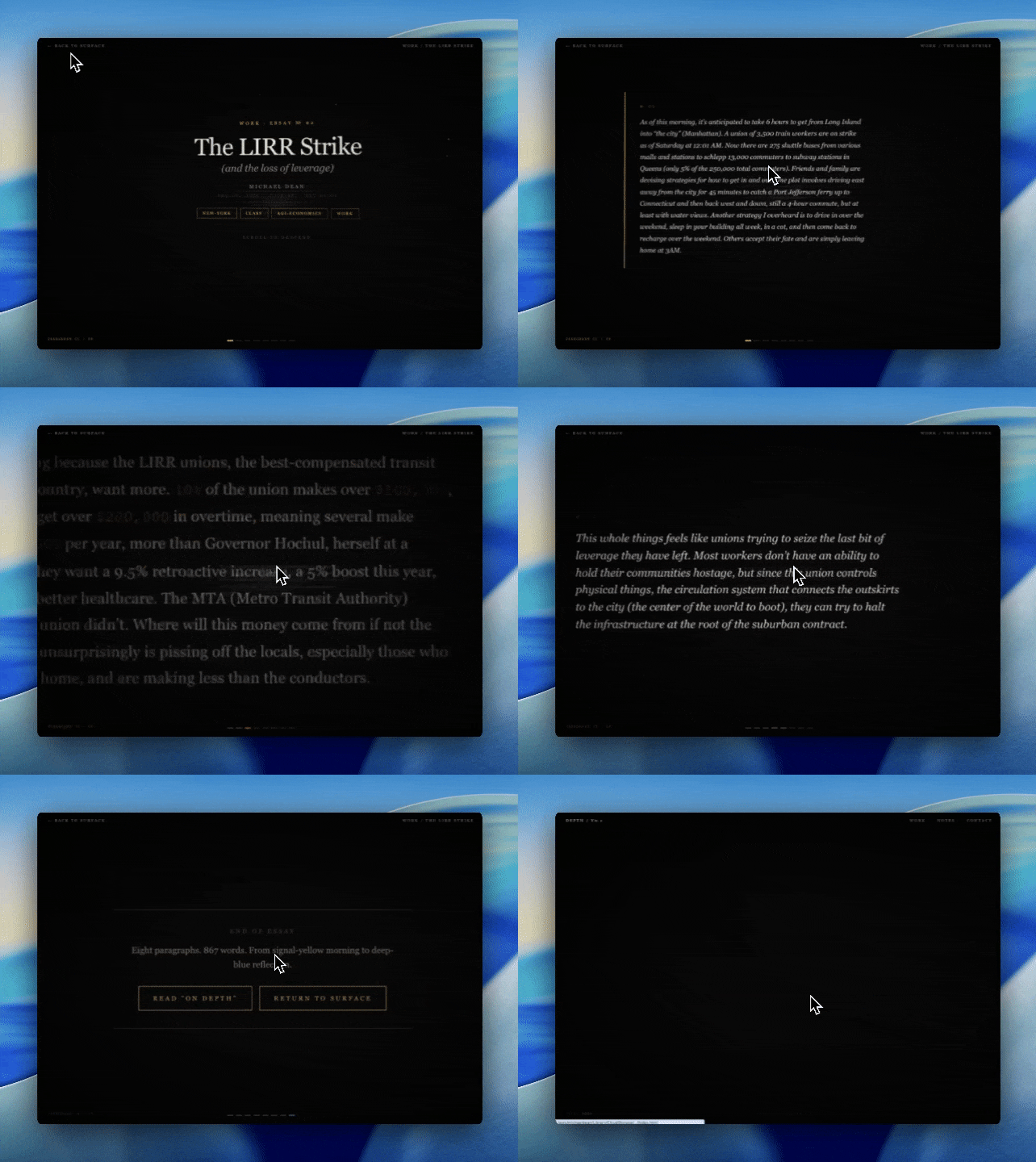
Here's a prototype where scrolling brings you in instead of down. Instead of feeling like you're just reading a wall of text, it feels like you're moving forward into a series of spaces.

This breaks the essay into paragraph blocks, where you only see one at a time, which works something like focus mode (and I suppose there could be a way where you could preview the paragraphs behind and ahead). There's opportunity for each paragraph to have unique color, imagery, a distinct vibe to match the content. Additionally, each paragraph can have portals to jet out from this essay into different ones, making it something like a choose your own adventure.

Is anything gained from this? Or is it just a novelty? Best case, it's a new medium to bring prose into the short-form video era; it's much less intimidating to be presented with a single screen of text than a whole wall of it.

Your ideas matter!

· 363 words

You’re Ideas Don’t Matter? This take always irks me, though I do love the closing line: "You can [...] spend your life [fighting over] golden eggs [...], or you can learn how to become a goose who lays golden eggs." I love the abundance mindset; just be prolific.

But I don't love the "fuck originality" attitude. It feels like a node in the creativity-for-beginners canon—along with The Taste Gap and All You Need is Vibes—a consolation to prevent a new artist from quitting. And I suppose that is worthwhile. You can't be terribly concerned with technique or originality if you don't have momentum, the general contours of a practice.

But to say that creativity is only "remixing, rearranging, reimagining, and recombining" is to plant a meme that can constrict creativity long past its usefulness. I don't totally disagree—yes, all ideas have a lineage of influence, and most big ideas are reframes of old ones for a new context—but the issue is in being too conscious about it. To see creativity as the controlled combination of elements is to see the creative process like a mechanical assembly line. It ushers in factoid harvesting and Frankenstein stitching. This kind of recycling is halmark slop, the kind of thing that LLMs do.

And again, that is totally fine for L1 or L2 or whatever, but the goal—or at least, my goal—is to transcend that. Originality isn't an old virtue to shed, it's the thing to strive for. It takes a lifetime to get there, decades of dedication, and that is a hard promise to make to a reader who has a time horizon of next week. But what is it that you should strive for if not originality? Instead of combining ideas in an A+B=C kind of way, you want to melt and fuse them all in your subconscious, in an unpredictable, high-voltage kind of way, to create an output that is incalculable, one that of course has nods to works from before it, but one without a formula, and one that could have only been crafted from your own mind. Is originality not the same thing as make the thing that only you can make?

How should an essay writer read?

· 1510 words

What and how you read should heavily depend on what your goal is. Outputs shape inputs. When someone insists you go back to read The Great Books, in order, in their entirety, they're giving you bad advice. It's not that those books aren't great—I hope to read Paradise Lost and Dante's Inferno and Finnegan's Wake and the Odyssey before I die— the problem is it's too generic a suggestion. To spend thousands of hours deep in the canon will obviously change you, but that's equivalent of throwing a beginner into the depths of the Atlantic Ocean, hoping they'll figure it out, with no sense of what their goals are.

If your goal is to write essays (every day, week, or month), then you're reading diet should look very different from a philosopher, professor, or researcher. You might not need to be a professional reader, but you should still strive to be a serious one. 3-4 hours a day might not be feasible, but 30-60 minutes per day through an intentionally selected list of sources will slowly build maps of material to fuse into your work.

If you're an essayist, you read so that concepts, forms, feelings, and words are always within reach from an idea of your own. It's no use quoting Aristotle from memory if you can't bend Aristotle to augment an original idea of your own.

It's time to make a syllabus. I've been guilty my whole life of haphazardly reading books and essays as I come across them, but now that I'm over 5 years into writing essays, I feel it's time to be more intentional. This essay is the artifact of me mapping out what, why, and how I'll be reading in the next 2-3 years. I've broken it into four practices: reading for ideas, reading for craft, reading for words, reading for feeling.

Reading for ideas

Since essays are so personal, it's very possible to draw from nothing else than the bank of your own life experience. Memory is absolutely one realm of material, but also, it helps to pull concepts from the world around you, in your time and in all times before. Anyone is exposed to some sliver of culture, and I suppose you could just rely on that. But there's another path which involves actively educating yourself.

Before I dive into the details of philosophy or history, I'm going to build a map. I want to go wide, not deep, because my existing maps are too fuzzy. ie: Who was Thomas Aquinas? Who influenced him, who did he influence, and could I hand write an essay on three of his big ideas? Until I can do that with 100 figures from antiquity to now, all interconnected in a web, I'm not prepared to dive into any Great Book. It would be a tremendous waste of time, for me at this moment in my life, to read The Leviathan by Hobbes in full, especially when I could read 30 pages on it from Alan Ryan, a philosopher-curator, whose prose is 400 years more modern, and who can contextualize old ideas into the full history. In the time I could finish one book from Hobbes, I could read Ryan's entire textbook and know 30 different thinkers at much higher resolution than I know now. By the end, I'll have an updated index on the history of political philosophy, and maybe I'll know that—based on my current writings—it makes more sense to dive into Rousseau in full.

How would my mind be different if I found and read the best curator across every field?

There's a specific kind of book I'm looking for to update my maps. It's not a textbook. It's similar in it's encyclopedic range, except it is slanted by a thesis, animated through a fervent voice, and concerned with the psychology behind the person known for an idea (instead of just biographical facts). Each chapter focuses on a figure for 25-50 pages, which feels like the right level of immersion. It might take 2 hours, compared to 20 hours for the source, and 20 seconds for Claude. While AI can surface historical ideas perfectly suited for your working draft, the problem is you outsourcing your recall. The recommendations are mechanical, impersonal, and worst of all, disembodied: you can't do it in your own head. By reading a sharp longform essay on Aquinas, his ideas will crystallize in my head and load into my subconscious; I'll know when he's relevant to my ideas at the layer of thinking itself.

The nudge to read all of Aquinas from scratch, on principle, is like asking a software developer to derive Internet standards from scratch instead of using libraries and plug-ins. For any thinker that matters, there's at least one person who spent a good deal of their life deeply understanding the source and distilling the concepts for you.

I'm going to share my working list, but the main caveat here is I'm not going in any particular order, and it's not necessary to read cover-to-cover. In any given month I'll be reading 1-2 chapters from 10 of these 24 books. In 45 minutes per day, I can get through most of this by the end of 2028 (2.5 years from now). Everything was published within the last one hundred years, and the whole thing costs $327.

You'll notice that all the links above are Kindle. This is because I want to have my highlights as atomic markdown files. The goal is not to read, but to write! Mapping and reading is just the setup so that I can read through and find highlights that spark original reactions. Montaigne's whole idea was to talk to his library, to be in conversation with the past through his books. And so the goal here is not to finish X books per year, but to produce original material. This is close to sounding like a Zettlekasten, but I should clarify that I don't plan to meticulously arrange my private highlights. A highlight is simply a prompt for an original paragraph that will immediately live on my website.

Other ways to read

I haven't spent as much time mapping out the other three modes, so I'll cover them briefly below, knowing I'll expand them later.

  • Reading for craft: If you writing essays, then reading them is how you learn through osmosis. It's where you pick up on the patterns on form and voice, consciously and subconsciously. My thinking here is to pick one essayists per week, read as much I'm inspired to, and move on. It's important to cycle here, because hanging too long on any one writer might lock you into a particular influence without realizing. I'm planning a summer syllabus for Essay Club so we can do this as a group.
  • Reading for words: Two years ago, I got really into reference books: dictionaries, usage dictionaries, the thesaurus, etymology, and even specialized dictionaries (on architecture, philosophy, scientific concepts). Sometimes I'd read cover to cover (futile), and others I'd practice words in ANKI. Expanding your vocabulary is seen is a pretentious thing to do today, when so much is geared towards simplicity and accessibility. Won't a rare word alienate the average user in your audience? No, because in the right context, ambitious words can increase the resolution in how you describe something. There's a joy in searching for words, but again, this comes back to returning to them repeatedly until it's actually coming through your prose.
  • Reading for feeling: Novels and poetry are less about collecting bits to synthesize into your work. This is more an act of expanding your understanding of how words can make you feel. Less about analysis, more about immersion.

The vitality of a vital person vitalizes

On finding and prioritizing The One Thing

· 1306 words

It’s amazing how many tricks the mind can play to prevent you from picking and prioritizing The One Thing. I can declare I’ll do one thing per area, which is pretending to focus when I’m 9x overbooked. I can say “one hard thing per day,” but if each burst moves in random directions, then the average of those vectors may leave me where I started. I can write, print out, then pin it up and pray to a single 3-year goal each morning, but if every task can loosely ladder up to it (through some round about way, because everything relates to everything), then there’s no hard decision being made.

A few months ago I wrote that my one goal was to hit an ARR target through “mission-driven creative work” by 2028 (via Essay Architecture). If something didn’t directly support that, I’d have to cut it. If you achieve your One Thing, theoretically, then most of your other problems are solved: my wife could stop working to spend more time with our daughter, I’d have more space to work on creative projects, we’d be closer towards getting a house, etc. This makes it easy to say no to personal projects that are obviously unrelated (ie: record an album, read the dictionary, hike 40 mountains), but even within what seems like the limited scope of “a writing business,” it is tricky to define the arrow from which everything else follows.

I am in many ways over-extended. On the business side, I have a curriculum, editing software, an anthology, and a community of practice. Then there’s of course my own essay practice. I’m able to juggle these five things, but each is held back from the sprawl. I focused on The Best Internet Essays from November 25 - March 26, and in that time I couldn’t iterate on the software, I couldn’t grow Essay Club, and most of my writing revolved around the prize & anthology. And, importantly, the decision to juggle meant that the core thing (the anthology) was probably executed at only 50% capacity.

So why am I resisting prioritization? I see as Essay Architecture as a “micro-institute,” a range of inter-connected pillars that work together towards a civic and personally-aligned mission. Software without a curriculum feels unanchored in learning science. Software without the literary prize angle could easily turn mercenary. Software without community loses the personal touch. If I’m not writing myself, how could I even know what the software needs to be? If I really wanted to double-down on the software, I’d raise money and build a team, and the incentives would require me to make software for knowledge workers, which would turn it into an auto-complete tool, my anti-mission.

I have been part of and observed companies where the personal writing practice of the founder was slowly neglected until total abandonment when empire building hit a certain velocity. This warning feels etched into me. The core reason I started Essay Architecture in the first place was to create something that was aligned with my own essay practice. I’d much rather be writing essays for 50 years with a modestly growing company than build an extremely successful and impactful company that doesn’t let me write until I retire in 50 years.

If everything should be in service of my own essays, shouldn’t that be my One Thing?

The reason I haven’t given myself permission to do this is because true, self-driven essay writing is hard to monetize. So it comes down to financial anxiety. But I don’t think I’ve honestly doubted my premise: is financial growth actually necesasry for me right now? Between the ARR I already have, a new part-time consulting gig I just started, and my wife’s income, we’re actually not far from my goal. It also turns out that my wife now enjoys her job after maternity leave (because she’s working part-time, not overtime), so even if my business took off, she might still want to work.

This feels selfish for at least two reasons: selfish because I’m not taking the path to best support my family, and selfish by putting my own needs over what paying customers of the Essay Architecture system might want. However, if you are focused on the Right thing, and are properly prioritizing and focusing, then you become a gravity well and matter bends in your favor. Paradoxically, but obviously, you can only build something useful for others (and, thus a company), if you are selfishly operating in your zone of genius. For me, that is not marketing, but essay writing itself. When I dial into and optimize for attention, growth, and revenue, it strips me of my vitality, and it doesn’t seem to work; might I get objectively better metrics if I were locked in and oblivious to the stats?

Craig Mod is a good example here. He’s a writer/photographer known for 300-mile walks through Japan, and runs a successful membership program that’s in serve of his personal work. A few lines from his rules stand out: “you are building a community,” but not managing it, instead “you must have faith that the work itself is strong enough to be a binding agent,” and “if the work isn’t strong enough, work more on the work.” This inverts how a traditional business-builder, or even solopreneur might think. It is you, the artist, at the middle; you are obsessed with your craft, but opening different pathways so others can work alongside you. There’s a way in which every part of my micro-institute benefits from doubling down on my own essay practice. If I write inside my own software, the software will naturally evolve. If I’m trying to become a master, then the curriculum is just the trail of what I’m already learning. If I’m publishing each month, then Essay Club is the tribe I do it with.

A friend and fellow acolyte of The One Thing, Matt Svarcs-Richardson, recently shared a paraphrased line from Joseph Campbell that resonates: “the vitality of a vital person vitalizes.” 1 You will not inspire anyone into action unless you are operating at the edge of your flow, a flow that is very distinct to you, a secret flow you can get lost in for 10 hours where others don’t even know how to enter. This doesn’t mean to burrow into longform essays and ignore Essay Architecture. This means that my own writing is the spearhead from which the institute follows (even Emerson said that an institute is the shadow of one man). The software, the curriculum, the club, and the anthology are not separate businesses to grow and optimize for, but critical components of my One Thing, my essay practice.

This inverts the typical time-scale. Usually you focus on growing a business and then decades later, assuming it works, and assuming you still have the fire, you can begin working on the thing you’d work on if resources were no issue. Instead I want to start with the fire, and use that to slowly build an institute over decades.

Footnotes

  1. The original quote is "the influence of a vital person vitalizes." Here is more context, sent from Matt:

    "Bill Moyers: “unlike the classical heroes, we’re not going on a journey to save the world but rather to save ourselves.”

    Joseph Campbell: “And in doing that you save the world. You do. The influence of a vital person vitalizes. There’s no doubt about it. The world is a wasteland. People have the notion of saving the world by shifting it around and changing the rules and so forth…No, any world is a living world if it’s alive. And the thing is to bring it to life. And the way to bring it to life is to find in your own case where your life is and be alive yourself."

The bottlenecks to greatness

Some unreasonable demands for myself?

· 965 words

Where do I have to grow? Not just as a writer, but a thinker, and more importantly, a person? It’s dangerous to stop asking this question; it’s too easy to see yourself as fully matured, individuated and at your edge. Even the self-labeled "curiosity seekers" may unknowingly confine themselves to a shape. We identify with our skills and clumsiness, our knowledge and gaps, and assume these as static traits of our nature. From the other end, someone once told me there’s nothing they could learn from fiction, since they have no doubts on who they are. Can you not have both? To propel forward with confidence on your proven strengths, but also with the humility that you have much to learn? I am grateful for how architecture school set off an explosive inner drive in me, and certainly do feel I've cultivated a unique way of seeing things, but surely I'm blind in ways I can't see, with some habits I must have gotten very wrong, and if continued unfixed, will clamp me down from greatness.

Greatness! I shouldn't be shy to admit what I strive for, to feel the subtle pressure to play down my quest for complete, utter, spine-chilling mastery as a cool and casual endeavor. What is the root of this? Maybe I can tell you but I will likely be guessing and justifying.

One guess is that I've been receptive/perceptive to feel the viscerality of great works—in architecture, music, writing—and it feels to me there's no greater ability than being able to do that myself. This isn't unique to me of course, it's possibly what drives at least half of artists, but I imagine many people are content experiencing art in all its fullness with no desire of making it themselves (no desire to make, or to recreate that experience in others).

I know it’s vain (and dangerous) to want extrinsic fame, and more measured to do things for the love of it, intrinsically. But if it were purely intrinsic, would I not just journal and take my words to the grave? I could riffed on the intrinsic benefits—ie: it simply feels like great to pick something you enjoy and commit to improving through your whole life—but also, if you take that idea seriously, it’s not enough to just enjoy it uncritically, because your blind spots may prevent you from reaching your greatest internal heights.

This makes it worthwhile to understand the caliber of the minds and lives around you, and throughout history, to estimate yours in relation to theirs. Of course, "comparison is the thief of joy," but there's a way to get feedback without letting it consciously or subconsciously crush you. I imagine a reasonable person just makes an assumption, that someone they're inspired by is just made differently. Instead, we each have a range of extreme and unreasonable actions available to us, that if we act upon consistently for years, can evolve us out of one head and into another.

There’s a level of contradiction here, where I’m totally happy writing in obscurity as a suburban dad, and it’s fine if no one but my daughter ever reads my work, and also I want to unblock all my obstacles so that it increases the odds and eliminates the luck of becoming “a figure,” someone beyond my local Dunbar limits, outside my audience, and if I'm being honest, outside the 21st century. I realize this might be a confession of vanity, but I don’t think it’s for the sake of being known or idolized, for I’d do the whole thing anonymously or pseudonymously if that’s what it took. I’m an introvert and very much appreciate my solitude. But to rise above the filter of obscurity from great work is to offer others the experience that triggered me to make stuff in the first place. There's a sense of paying it forward.

Again, I'm not sure here if I'm trying to justify an inner, hidden vanity of mine, or if there really is a paradox worth sitting with. A different and possibly wiser point of view is to be indifferent to outcomes. Mastery is all you need: sometimes it gets recognized and sometimes it doesn't. Figures without mastery are idols, influencers, farces. What matters is the inner quest to transcend your limits.

So back to the original question, what are my limits? I am under-studied compared to Huxley, under-lived to Kerouac, unexplored compared to Pessoa, inarticulate to Woolf, unwise to Christ. And so half the battle is in trying to sustain conversations with these people, through their work, for a full decade, until you absorb their particularities into your own essence; but also book knowledge is useless unless you live and integrate it; that involves courage, which is not something you absorb in prose.

That is the bottleneck to everything, to life and art: courage. We each have to overcome our sheepishness and strive to live in Third ways. And while I have extreme courage in some areas, I am a coward in many others (I will spare you the accounting). How do you wring that out of your nerves? It is the limiting constraint in everything. It is the weakest link. In each sport I played as a kid, I had one trait of excellence that was rendered useless by a handicap: the hardest shot in soccer but I could not dribble; the best rebounder who could not lay up; the golden glove with a wimp’s arm; lightning legs but Super Mario sprinting form. Likewise, I can’t write or live without courage.

And so really I’m six years into writing, the same length of time I spent in architecture school, but as if I built my own curriculum. I am only at square one with everything ahead of me.

The many yous of yourself

· 501 words

In response to Alex's post here (it is neat that we can go back and forth with two independent sites) ... I also find myself using "you" a lot when I'm writing for myself.

My guess as to why this happens is that a person isn't really a static singular self. Of course we know on some level that we all evolve and change through life. But writing is something that accelerates the sharding, forking, splitting, becoming. When I write "you shouldn't check your email when you wake up" (which I did today), it's as if the person who realizes this (me, now) is different from the person from an hour ago who did not. How could that person lack the clarity and values that present me has?! And so the writer, "the I" of the moment, is something like a parental superego that emerges to steer/synchronize the past/future self. The writer is an insight implementation personality.

There's probably also something to "you" being more abstract and generalizable. Even though personal and relatable grounded writing is anchored in "I," the I also acts as a a blinder, only seeing from a limited, narrow vantage point. And so you can levitate above yourself to see the "yous" and "wes" and how this thing you need to internalize is actually a general principle that anyone could ingest. A "you" is more abstractable.

(...I can still recall this moment in my childhood home, maybe at 18 years old, slightly high, where I remembered, deep in the pantry, that I wasn't thinking, but watching myself think. And maybe that dissociative power of weed is what enables/unlocks abstract thinking...)

The irony here is that this inverts traditional advice. If you're writing personal essays with an audience in mind, the tip is "no second person sermons!" (as in, don't use "you" because it's preachy and it infers that you are lecturing and therefore above your audience). I get that. But when I write purely for myself, I find myself using "you" all the time.

If I really am I collection of selves, then shouldn't I write to myself in "we"? Was Smeagol/Gollum onto something? This is the logical extension of my whole theory above, and that makes me question it. It feels wrong. It also points to the Pessoa/Jung divide. Pessoa saw himself as a cabinet of 70 pseudonyms, each with their own personality and literary voice and fictional backstory. Jung's main concept was "individuation" that all the selves should strive to integrate into a single higher Self, a unified personality.

What if I framed it as, "I won't check email in the morning anymore"? Is this preferable? Does framing it in "I" mean that the current you is the same you that sinned not long ago? Does this framing require you to take responsibility? And so is that act of framing the past self as a "you" actually an act of avoiding responsibility? Was Pessoa just a shifty bastard, a brilliant coward to not be emulated?

Beyond hustle and vibes

· 247 words

It's a mistake to think of effort as a single spectrum between a Gary Vaynerchuk grind-till-you-die flip-slop-on-Facebook-marketplace vibe and a Wu-Wei, non-effort, sabbatical-brained, Netflix-and-chill vibe. Something not on that spectrum is obsession. It's not work for work's sake, or work for status climbing, but work by seduction, by tinkering, by vision, by purpose or duty or whatever. It often can look like grind work in terms of focus and intensity and prolificness and hours spent, but it feels different because it comes from a different place.

I framed this question to my cousins: would you rather work hard for 8+ hours a day on something you feel compelled and intrinsically motivated towards, or, go into an office for 8 hours a day for a bullshit job that only requires 1-2 hours of simple work, mindless and purposeless work, and then spend the rest of the time socializing?

The word "work" itself is a bit tainted, because there's a sense of obligation ("I have to do this to get paid"), sacrifice ("I'm doing this at the expense of things I love to support us"), and utility ("I'm making things that are functional for other people"). The work that I'm most drawn to is something like the inverse of this. It's pleasurable ("I lose track of time doing this"), primary ("There's nothing else I'd rather do"), and visionary ("I'm doing this because I see the value in it, and even if others can't see it now, they may eventually.")

Semi-public

· 427 words

Something about hyper-logging (capturing your mind in prose) feels desacralized when I see it as the grown-up development/extension of my AIM bio, or my original Facebook bio (which had a whole series of categories, like favorite movies, books, etc.). Why keep an extremely detailed and public log of my self and thoughts? I guess I see it like a change log of my evolving identity. That was sort of Montaigne's whole thing (perpetually in transit). I imagine the norm is to burrow into your shell of self for as long as possible, to avoid the confusion of drift, but I try to harbor a non-static self. I feel a cringe in sharing this self-congratulations. There's the tension.

I think I'm doing an irregular thing by obsessively documenting thoughts, and from my own perspective it does feel like I'm continuously evolving, but an outer perspective might see this as nothing more than a frivolous blog. It's likely that my whole arc is illegible. Some degree of it comes to surface, like my ever-shifting "career," but most of how any of us feel, think, and change is illegible to each other, except in extreme rare cases of friendship, and so the more idiosyncratic your path, the less anyone can understand you.

I suppose my logs could function as a private journal, but it would lose an important quality. While, there are some consequences of writing in public (a subtle self-censorship), there's something more important you gain: the stakes of knowing that your work could be read in the future, if not by a friend or stranger, then at least a future version of yourself. Whoever it is, if they care to spend the time to read, they would understand you more than probably anyone in your life. That slight pressure snaps me into a mode where I try to be coherent, articulate, and sometimes expressive. When I look back at my old chicken scratch journals, I almost always skim and skip and hate it. But when there's a slight care in crafting the language of my thoughts, it becomes something that outlives the moment.

And so if public writing comes with self-censorship, and private writing comes with a lack of stakes, then the way to go is semi-public publishing. It gives you both freedom and stakes. You won't grow your audience this way, but I think you will forge a sense of self and voice that you can bring with you when you try to build an audience, but that's really secondary. It's the self and voice that matters.

Tunnel Vision

· 91 words

A presentation spirals me into tunnel vision. I cannot focus on anything else. I neglect responsibilities, hunger and thirst, my notetaking, all the things that a death-aware person should consider. It brings on obsessions, a perfectionism, for probably the hope of creating something so considered, at the absolute edge of my ability given the constraints, that it, in some incalculable way, drives me closer to where I happen to be going. It is not reasonable. My week is in shambles. Systems are unkept, and hitting my goals tomorrow are highly unrealistic.

Efficient leisure

· 206 words

I want to be in conversation with my books. This was Montaigne’s whole thing. He did this for 10 years. I can’t help but think that Kindle/eBooks/digital reading is a better format for this. If I were only reading, ie: if I were retreating into a tower to retire and die, then I’d see the appeal of doing it all by hand. But this is maybe a 3rd of 5th or realistically 10th priority. I’m called to it, but given the range of things I’m juggling, efficiency actually does matter here. I know efficiency does bring invisible amputations, but also, if I’m not efficient here, I might just not do it in the first place. Since all my highlights sync to Obsidian, I can build a writing app that loads in highlights and then let’s me write directly to them.

I suppose the counter-argument is that I am juggling too many things. If I were really to choose, to pick the project I’d have to do, it would probably be to focus on building my business to support my family, but that also cuts me off from soul and spontaneity in the first place, and so this whole reading/writing for leisure thing is a healthy counter-balance.

Unsaid

· 61 words

On reading Montaigne, I want my writing to be far more honest. As in, in the face of death, it really does feel worthwhile to capture the edges of your soul and psyche onto the page, the things not brewed into your public-facing personality, because then you die with yourself trapped, and it’s as if the inner you never really lived.

Full-stack religions

· 944 words

The full-stack of religion: cosmology > scripture > practice > ethics > liturgy. We have a metaphysical impulse to make sense of our reality, and in a moment of “gnosis” someone writes it down, and then builds a series of personal practices around it, which starts to answer the question of how to live, and these ethics are legible to others who then may join in their liturgies through a church. This captures the process from which metaphysical musings conglomerate into an institution.

Note: theology is nested within cosmology, as it’s a common experience to feel the presence of an anthropomorphic Creator, but you can also have models of your reality that are non-theistic.

Where atheists go wrong is that they challenge the cosmology, but then throw out the entire branch (no scripture, no practice, no liturgy), and assume individualist secular ethics don’t require the entire stack. Modern spirituality is possibly worse, because they also throw out the entire religious stack, but the ethics they vaguely aspire to are less rigorous than even an atheist.

Where I stand: that the architecture of religion is extremely important—we need religious institutions—but our existing religion have been faulty in their conception, and have been “captured.” The overall challenge in being a heretic, in a religiously-inspired eccentric lonewolf kind of way, is that it’s very hard to concretize your own musings into liturgy. It is an isolating thing. Unless, I suppose, your system works, to a degree that your ethics are so unique or so marveled at, or, you are just a good marketer of your own scripture, that you can get maybe 100 people to “follow” you, but at that point, what you really have is a small cult, and that’s a dangerous thing too.

And so the solution, I think, is to not actually invent some New Age religion, but to create new sects of existing religions, making them more participatory higher up in the stack. To me, this is about understanding the elements of, say, Eastern Orthodox Christianity, and reworking them, recombining them, and then experimenting on the resulting scriptures, practices, and ethics, in an almost scientific way, and you’ll learn the flaws in your original conceptions, and then you have to return to the source and try again, over and over, slowly accumulating your own personal relationship to a larger, shared, historical universe, and of course any orthodox Christian, and probably most Catholics too, are very much against this.

I’m talking about questioning the root level assumptions, as in, maybe Christ did not literally resurrect, and maybe God is not a conscious agent that listens to us, and maybe there is no eternal Heaven, however, maybe Christ is a mythical embodiment of the supreme ethics we should all be living, and so what if there were a sect that very rigorously tries to live as Christ, while acknowledging he does not need to be anything beyond a historical-literary figure?

When someone is squeamish about this, it seems to me there’s a great deal of fear in the resistance, a fear that was dispelled, because a supernatural Christ is the answer to that painful and existential void of what happens after death, and I just wonder if there’s room for a rich, religious life, filled with agapic love and community service, that doesn’t require infinite existence in a Kingdom of souls.

In fact, the indefinite preservation of ego beyond death might be one of the most unChristly things I can conceive. To die for good means real stakes exist. Is not the Christ who permanently dies and still chooses love anyway far more radical? More selfless? Does the resurrection not cheapen the sacrifice? Is the crucifixion without the resurrection not the braver story? (If it turns out that Christ was actually modeled off of Jesua, the righteous leader of the Essene cult that was crucified along with all the men in their group in 83 BC, and they passively accepted it, then that may be the true and ultimate crucifixion.)

Personally I think it’s more romantic to dissolve my architecture of self back into the dirt, knowing I will become fertilizer to feed bugs, and then in 10s of millions of years, all my energy will be reincarnated into the matter that makes some other unknowable being, whether fauna or mammal ... And FWIW, I am by no means anti-supernatural. I am enamored by hallucinations and dreams, and equal part terrified. I think there is an afterlife, a 3-minute DMT-odyssey that feels like 300 years, equal parts heaven and hell, built into human biology (so long as you don’t disintegrate via nuclear annihilation), but I share this I suppose to show I’m not a square Cartesian. Or maybe, in some ways, if you follow rationality far enough, it eventually becomes inconceivable and super-natural. I think there's a big difference between a rationalist who poo-poos anything but known science, and a rationalist who uses reason to plunge into the numinous (ie: Pythagoras, the alchemists, Jung, etc.). Whether “hallucinations” are actually part of a materialist reality or an “antenna” matter less to me than the idea that non-rational states of consciousness are on par, if not more important to waking states …

Again, all this to say, these are the proto-musings of a Heretic. I do believe I’ve told Taylor once that I have a budding and embarrassing dream to start a new sect of Christianity. On reflecting on it more, it's also a dangerous position to take, more of a threat than an atheist or an outsider, for a non-believer is deemed a fool, but one who reinterprets the same source material is a deranged competitor.

Καιρὸν θεωρῶ, ἀγάπην σπερῶ

· 582 words

A new prayer I wrote to loop: "Καιρὸν θεωρῶ, ἀγάπην σπερῶ.” It stands for “Kairos I behold, Agapae I will sow,” or in less Greek terms: “I recognize the moment, and will bestow love as a gift.” Each half mapped to an inhale and exhale, sort of like the Lord’s Prayer (in attempt to internalize and associate the prayer as something as automatic as breathing). The first half is on being perceptive, the second on being generative. You watch with gravity, then act with generosity.

Pronounciation:
(1) kai-RON
(2) thay-oh-RO
(3) ah-GAH-peen
(4) speh-RO

On each word:

Kairos is about seeing a particular moment in a particular way, that if acted upon, will change the course of history. It jolts me out of a passivity, about accepting things as they are, and instead to see freshly, to see everywhere the third doors. Christ’s first words in the Bible (after baptism) are, “the kairos is fulfilled."

Thay-oh-RO means to behold, to contemplate, to observe, to truly see the potential of a circumstance. It’s not a casual looking, but a penetrating sight. It’s a perspicacity of vision (an unraveling). (Note: it ties to “theory” but original this word was a way of seeing, not an abstract hypothesis.) It doesn’t mean “I’m an opportunist, but the full weight of my attention is applied to the present. There’s discipline to it, and it’s framed as a sacred rite, an act that changes you.

Agape is the highest form of love. Eros is the lowliest love, the desire to subsume the other into you, passion. Philios is a brotherly love, a reciprocal friendship, a give and take. Agape is a parental unconditional love, where you hope to nurture the other into their maximum potential. This is the origin of this prayer, because it feels like a word that can applies to everything; to mundane moments, to relationships, to creative works, etc. In many important ways, agape is a form of surrender. Agape is the defining word of Christ.

SPAY-roh is “I sow,” but  speh-ROH is “I will sow.” The future tense adds a quality, as in, now that I’ve seen the moment, I commit to sowing love. The word “sow” is specific and special, because sowing comes from spraying seeds, meaning you give love in massive volumes, with no conditional reciprocity, no expectation for return, knowing that one in a few might blossom into something. There is even a “Parable of the Sower” in the New Testament, about broadcasting generously without controlling where things land; you throw seed and trust the ground. Love is something to scatter freely, without a guarantee of return. This spray definition also ties into my latest conception of the root cosmological urge, in a working essay titled “the universe is a cumshot.” As in, God is not a craftsman with a plan, it’s more like the universe is an explosion of matter, and God is the binding force, the emergent order that fuses, harmonize two things for them to transcend to a higher phase of matter. 

Compared to the Lord’s Prayer, which is petitionary (give us, forgive us, lead us, deliver us), asking for repentance and nourishment from a higher power, this one is more about our own responsibility to be like Christ, to have Christ-Conscioussness in each frame of our existence. It’s about internalizing the divine pattern. The Jesus Prayer is a devotional prayer, but this is a participatory prayer. This is “theosis,” becoming by grace what God is by nature.

The courage to goof

· 96 words

Having a baby reminds me of the infinite well of inner goofiness I have within me. There is an endless ensemble of voices and characters, songs and dances, that can be conjured in every moment if it keeps her smiling. This is the unselfconscious self coming through, because of course a baby can't judge. It's also not necessary a performance, for her, but it's your own expression that a child enables. A reminder that this could be the default state at all times if you have the courage to be labeled as truly and insanely weird.

God as Emergent Coherence

· 653 words

On my walk this morning, I had a few strange ideas, building off the white hole / black hole thing, but also around what “God” is. The universe is a chaos engine. A blackhole sucks in a particular profile of material, and it shoots it out the other end, through a “big bang.” It is mostly noise, collision, non-sense, or nothing, but a separate system is harmonizing, filtering, grouping, cohering, ascending. You might call this “God” or “intelligent design.” (Excuse me for all this imprecise folk science; perhaps one day I will properly research this and upgrade my terminology).

An important caveat is that God is not an architect, not a designer, drawing floor plans, or even a “plan” for everyone or anyone’s life. God is an emergent intelligence. From chaotic explosions, God is the unbelievability that 2 of 2 trillion things can combine or cohere, and then sustain on, and continue moving up the abstraction ladder. The fact that anything can cohere at all is a miracle, and the degree that it can move up the chain is even more so miraculous.

I think this model helps explain “why is there evil the world?” Why floods and bombs? It’s because God is not as all-controlling as we think; he spawns reality as we know it, but does not tinker or micromanage. In no way is God conscious. In some way God is the pairing of things to generate life, and so in a very literal sense, I get now the phrase, “God is Love.”

Love is the fusion of two things that produces a third thing, and that goes to parenting, art, or whatever. Worth noting that love is not absolute. There may be loveless universes, ones that never cohere, that are just noise and nothingness for trillions of years. There could also be universes with far more love.

(...A sublime lens to see your surroundings on a walk is to realize that everything around, your whole world, the history of your society, and all possible realities on Earth, are all within a single sliver of what is possible in the physical engine of the Universe...)

Now, another extension of this thought is that human beings are at a certain level up the chain of the system that they have become “like Gods” or “in the image of God” which means that they’re able to both generate a lot of noise, and also cohere into even higher and higher things; arguable the human is the next link in God’s chain, and we are not the end state (there is no end state!) but our ability to make coherent things is a continuation of God’s process. This means technology isn’t evil, but Godly, but of course, most harmony decays and wobbles, which is what is happening.

I wonder if there’s even a limit to the advances of God into harmony and complexity in the material world, and the task has now been handed over to humans, who can make things beyond the complexities of atoms and galaxies. In that sense, God has made a population of Gods. And somewhere along the line, Christ comes in.

Christ, not as the literal embodiment in Christianity, but more like the logos imbued within the the "sons of God." If our father is a human, then we as his child is human too; so if God is our father, are we not Gods ourselves? But to be Christ-like is different, because God has no morality. In some way, God is unconscious, just an intelligence engine, trying to bring harmony, and to escalate matter to higher levels. God’s counter force has to spray and pray for the hope that God can find some unlikely combination. Christ however, attempts to limit generation, be more intentful with it, and to aim it towards good. Christ is an attempt to steer the self, the other, society, towards higher levels of harmony.

Quality Algorithm

· 437 words

“The Internet needs a quality algorithm.” This was the opening line of my essay prize announcement, and I want to revisit it now that it's done. Is there a correlation between writing quality and audience size? 

Algorithms are low-trust right now because they’re adversarial—“for you” gaslighting (usually)—and they reward engagement, popularity, monetization, etc. The 2010s-era algorithms are based on discrete events: clicks, likes, measurable things. They might look at keywords to guess the topic of an essay, but it’s effectively blind to the overall quality of a piece. Quality is nebulous, after all. Small magazines can each have their own vision of what’s good, but for a million/billion-person network, there’s no consensus, and quantity is way more important anyway.

So this essay competition was a v1 attempt to define and search for quality. The overall search space was small, but it was a chance to experiment with curation, and resulted in The Best Internet Essays 2025. It’s interesting to me that the featured writers ended up varying in audience size, evenly distributed between 10s, to 100s, to 1,000s, to 10,000+ subscribers.

Again, limited sample, but interesting to ponder: the tangible thing (reach) is a power law distribution (1% have big audiences), but the intangible thing (quality), the thing that matters more, is independent of scale. It means that for all the great writers with 10k audiences who are highly visible, there are possibly 100x writers of similar caliber who are undiscovered, in algorithmic obscurity. 

This isn’t too surprising, and the usual reply is, “well it’s not enough to write well, it’s your responsibility to be consistent, to be your own marketer and publicist, to make sure your work gets read.” I get that this is what’s been required, but what if it weren’t? Wouldn’t it be better if a platform could search for quality at scale so writers could just do their thing? This would also give visibility to those who aren't full-time writers, people who publish 1-2 essays per year around the interesting problems they’re working on, but have no bandwidth to build an audience each week.

Still have to think through v2, the 2026 prize, but the question in my mind is how can I expand the search space? Can I have agents scan the Internet, assemble RSS feeds to find great essays, design an algorithm to filter for the previously intangible, build community into the process, and then curate/share the stuff that comes through? The aspiration is to get better each year at surfacing great essays from independent writers on the basis of merit, and this book is what came through the first pass.

→ source

Winners of the $10k essay prize

Congrats to Tommy Dixon and the 10 finalists in our new print anthology, The Best Internet Essays 2025

· 676 words

A friend texted me this weekend— “I am too addicted to Claude code and need to touch grass. You said I should read an essay book can you recommend one that I can order physical” —not knowing I was about to launch The Best Internet Essays 2025 . This little book, a 4.25” paperback that fits in my…

read essay ↗

Systems skeptic

· 380 words

I don't know if I buy the quote: "you don't rise to the level of your goals, you fall to the level of your systems." (And this is coming from a systems guy.) It's a beautiful piece of rhetoric. The rise/fall structure. The humility to stay grounded. But I just think when you really want to make sense of how to pull off hard things, it should be a little complex, a little more than what can be packaged into a meme.

Two opposite things need to happen at once: top-down destiny forging, and bottom-up monk-like routines. It's a negotiation: "What will I want to complete in 100 days?" is a very different question from, "What should I be doing today?" and you can try to force alignment, but that's not always easy, because what you feel like doing often diverges.

The quote above simplifies this whole dance into a blind trust in systems. A system is a servant, not a master! I write this to remind myself as I'm immersed in probably one of the biggest system rebuilds in my life (one where I'm suddenly able to fluidly create the containers I work within) ...

It is wild to think that probably 50% of my computer use these days are within GUIs I've designed for myself. To me, liquid GUIs are a bigger deal than autonomous agents. My whole conception of what personal computing can be is changing very fast, and it becomes alluring, almost addicting, to continuously evolve my own OS, to see what's possible. It's very easy now to get tangled in knots of systems and software that are all very impressive, lead nowhere, and become chores. What leads to aliveness, to your intentions?

An emerging maxim for me is to start with the goal and let the system emerge around it; otherwise, you feel the cold of the infinite tinker, especially if you are quarantining in the attic from COVID and you can't go touch grass because there appear to feet of snow outside and you are too achey to shovel out your car to go anywhere and so one way to relax when you're sick is to live-clone all incoming Substack posts into local JSON folders and redesign a better algorithm. But to what end?

Chronofile

· 160 words

I set up a chronofile, inspired by Buckminster Fuller's system, where he logged every 15 minutes for like 70 years. That's intense! I'm going to run an experiment. In the past I've operated under the premise of "capture as little as possible," as in, capture just what's worth it, because then you'll have a mess of notes to go through. But agents change this; all the yak shaving (tedious, endless work) is handled. This could lead to hyperlogging, 100-400 logs per day. I've done this before as a kind of Hermetic T1 ritual (from Franz Bardon), and it's an intense way to see everything crossing your mind. This scale of writing might be the best way to "meta-program" your psyche. Essays do this in a way, but an essay let's you go very deep on a particular idea (and you might be deluding yourself, or you might be articulating a take in an ideology that you'll outgrow in 5 years).

Makers and the Managerial Goon Loop

· 400 words

Paul Graham’s idea of makers/managers is helpful when thinking about AI agents. The cost of being unreasonably productive is that all your time will go into management. I’ve heard people celebrate this, as if elevating above the work itself and only making high-leverage decisions based on taste is the place we want to be. Disagree. Without actually being in the weeds and making thousands of unbearably slow decisions, you won’t develop taste, and (probably) won’t be a great manager either. I guess the ideal (for me) is to be in maker mode as often as possible, and then let my synthetic managers come in to process my deep work. (Currently have a “proseOS” where I can riff 5k words into a daily note, and then agents come in to route my logs to different interfaces). Ideally, you build the manager once and forget about it. But realistically, a maker can find fun in making manager bots and management apps, and it’s quite easy to slip into a managerial goon loop. What I mean is, similar to masturbating with no intention of ever finishing (aka gooning), it’s very possible to make your own task manager app, and a writing app, and an idea Kanban linked to Obsidian, and why not a new personal website, and a 1,000 day calendar because you can, and seriously anything you can think of, and it’s very possible to just numb out over how unbelievable it is that code, markdown, and interface are now liquids that shape around your every intention, but actually, you never quite finish anything. PKM procrastination is timeless, except now it’s multiplied to new levels. The brute velocity of execution means you’re bound to make many little mistakes, which eventually compound into your own megamachine that traps you with endless bugs and feature ideas and system decay. This is all quite dramatic. I love Claude Code and insist everyone IRL and IFL try it. But now that it’s shockingly trivial to build your own personal software for free, I imagine there will be all sorts of unanticipated psychic costs. For one, it’s dangerous if building your own tools is equal to or more fun than the work the tools are for. I’m sure that wears off. But I generally think this all leads to both extremes: individuals who are unbelievable prolific, and individuals stuck in a goon loop who feel unbelievably prolific.

→ source

Experimental

· 190 words

I like the word experimental because it fuses two halves of a process we don't usually link. What we typically mean is divergence, deviance, tinkering, norm-breaking. Weird stuff. Think avant-garde John Cage soundscapes where he makes music with only kitchen appliances. But also, the word points directly to the scientific process: to run an experiment means to set boundaries, gather insights, and test a hypothesis. Either mode alone falls short. Endless mutations burn you out, and rigid systems can't take you anywhere interesting.

Many of the original experimental artists were scientific. Kandinsky didn't just make abstract shapes, he developed a systematic theory on how colors/geometry provoked specific feelings, and then at the Bauhaus he used questionnaires to test which of his theories were true. I don't know exactly when this happened, but as weird works became mainstream, the word shifted from a process to a genre; the way it was made mattered less than the fact that it was unusual.

Experimental drifted into a contronym, a single word that contains opposite meanings. The power in the word comes when you re-unite both halves, entering strange territory with an analytical eye.

→ source

Self-Deception

· 380 words

I've always thought 'writing shows you what you think and editing helps you change your mind'—and maybe that’s a decent heuristic—but it’s more complicated than that. I think it’s possible for writing to do the opposite of what we hope, to lead to self-deception. A few thoughts on how:

  1. Premature convergence: When you start drafting, you unlock a new stream of thoughts, but once you find a new center of gravity (a potential thesis), it’s common for all further thoughts to reinforce the thing you happened to stumble on, regardless of its substance. Beyond a point, writing can ossify & lock you into a frame.

  2. Aesthetic attachment: Once you’re trying to make a ‘good’ essay around your thesis, it’s easy to become enamored by phrases, sentences, images, and sources. Expression (vibes/voice) is an entirely different thing than thinking. You can dress up a static/wrong thought to be beautiful/persuasive.

  3. The sunk cost fallacy: after you spend hours on an essay and share it, it’s likely that you’ll continue to believe it. If you’re wrong, you’ll have ‘wasted’ that time. If you change your mind, your readers will have an outdated model of you (OFC, views evolve over time, but I wonder if publishing leads to short-term friction in your evolution).

One possible way around this is to, as soon as you think you found your thesis, to rigorously consider and explore the antithesis (not as a rhetorical strawman, but to really, earnestly, consider the opposite). It means a given draft will be scatter-brained and contradictory, but it’s how you find a synthesis, a more refined thesis. And once you find that, you start over, and repeat, until you end up somewhere that is far more nuanced, interesting, and weird than where you started.

The thing I’m grasping at is that thinking & expression are often at odds, and before you commit to an idea worth expressing, you need to go through rounds of unglamorous self-interrogation. There is probably a mode where thinking _is_expression, but the risk is not wanting to shed something that is elegantly said. One way through this it to get meta and explicitly express your doubt and your evolving POV; I think this is what separates essays from articles and propaganda, and it stops you from brainwashing yourself.

→ source

Fifteen Lives Left

· 135 words

The book Four Thousand Weeks references the average lifespan (76.71 years). This is also 27,999.15 days, which almost exactly lines up with the 1,000 day cycle. A life is 28,000 days. I’m currently starting my 13k cycle. This means by 14k, early 2028, I will be statistically midlife. It is a potentially grueling realization, but something about the 1k cycle makes it seem like NBD. 1,000 days is a long time, especially if you are chase epic things. It is effectively a whole life, a distinct identity. Of course, there is part of you that persists through each molting cycle, but it helps to see each as a rebirth. To think I have 15 more molts ahead of me is to realize I have 15 lives left, more than I know what to do with.

Streaks over deadlines

· 233 words

A big shift in my way of working: instead of trying to scope a specific and ambitious batch of tasks I think should be done in a given day or week, all I commit to is time towards specific areas. The deadlines are less important (generally) than making sure I show up and do high-leverage work with 100% embodiment and enthusiasm. I just set up the Streaks app, and aim for 2.5 hours of work per day over 6 areas: writing, coding, reading, outreach, business, and culture. Each is a simple target: 20-45 minutes per day. At the very least, it gets me started. If I’m in a flow, I go over as long as I want (1-2 hours or more). If not, I just stop. The goal here is to rethink what work might look like while caring for my daughter (and my post-labor wife). I could potentially knock out 2.5 hours in a single nap cycle, or maybe it’s spread over 3-4 sessions at random times. It forces me to prioritize an important thing per day in an area that is an infinite game. It feels slightly unambitious, but I actually think an OS of this nature might be something I continue even when I “get my time back.” There’s a forced prioritization, as well as open space to either (a) diverge/explore, or (b) drill deep on things that actually matter.

What was baseball for?

· 177 words

Starring out into a baseball field in late November, puddled and unkept, it struck me how, at one point in life, baseball was the whole frame of my existence: watching it, talking about it, playing it, traveling for it, dreaming about it, collecting cards, making Excel spreadsheets for those cards, memorizing the statistics of every starting player on every team, etc. Obviously, I’m nostalgic about it. That was just what I was into. I do wonder though, was that whole phase of my life a natural part of childhood that I was meant to get stuck in and grow out of? Or, was it mostly a big waste of time, spirit, and attention? I guess what I’m questioning is, is there a version of my childhood where baseball only took up 20% of my psyche instead of 100%, and would I be better off for it today? Would I be similarly nostalgic? Would a lesser obsession have freed up more bandwidth to develop in other areas? Or am I who I am today because of that obsession?

Invisible cannon

· 1026 words

Every generation needs to find its invisible canon to solve its crises:

The last 2 years have been a deep dive into essay composition, but I want to think harder about taste. Of course, I believe fundamentals come first. If you don’t have fluency to express thoughts, then it doesn’t matter what your taste it. Taste without articulation is something like a status trap. People take pride in sitting at the intersection of three particular aesthetics, and using it as a razor to justify their artistic decisions, an excuse to avoid the militaristic discipline required to learn the fundies.

I’m sure there are proper terms for this, but I’m going to riff on taste and derive it all from scratch. Could be fun to read back on this in 10 years.

Yes, anyone can have a taste developed through circumstance, but that’s “narrow taste.” Algorithms make it easier to fall into taste traps. You see the same thing over and over; you are a Substack psychographic; confident in your uniqueness, but you’ve been force fed the same slop as 1.2 million other people.

And then there’s “wide taste,” which is a lifelong practice of reading from odd, competing, singular, idiosyncratic silos. Only by being well-read can you actually build proper maps of a culture. There really isn’t a shortcut to cultivate taste, it takes tremendous time and effort; without it you’ll only be able to cling to feeble, flimsy opinions.

But it’s not enough to read widely; there’s “discerning taste,” the ability to selectively pluck out a small percent of the things you’ve read and deem them as special. 

Ultimately there are questions on what to read, and well-read people tend to point to old books, the canon, but that feels like outsourcing your discernment. What good is the canon? Sure, if it's survived for centuries, there's probably something to it, but it risks turning you into a homogenized intellectual if that's your only source (and yet also, it helps to know the classics so you can speak that language, but it's probably best to supplement with 50% nn-canonical sources).

The question behind the question is this: what is the point of a serious reading habit? I’d argue that you read to understand the range of ways that words can move you, and to accumulate ideas and lenses that help you navigate the circumstance of your life and generation. The western canon might have some overlap, but not all Great Books are the books you need. The western canon is helpful as a history of literature, a record of how the species bursted through with original linguistic concepts and forms. That matters! That’s worth studying if you want to understand your heritage, your species, the norms of older times, and the outer limits of language.

But from a perspective of “renaissance” or “revival,” to surface old ideas to help our current situation, that’s a very different canon. So the word “canon” is flexible. You hear people making “personal canons” all the time now, which are effectively, just the books you like. There are also "tech canons" and even the "China tech canon." But you could argue that as society mutates, each generation has their own invisible canon, some combination of obscure books, that if discovered could help them navigate the narrow passage oftheir time.

Can AI have taste in this kind of canon creation? Maybe a culture progressively rots if each generation is unable to find the scattered canon that’s destined to them, and maybe AI can help reverse our fumblings. The question then is, what do humans lose? What matters in the act of canon creation? The orientation (the thesis on what’s worth finding), the mapping (selecting the books), the reading (digesting old books), or the synthesis (making new things from old readings)?

I asked as AI about what we lose, and here's what it said, which I don't buy:

But Taste—true, earned taste—is a byproduct of the inefficiency of finding those things yourself. When you hunt for the “Generational Canon” manually, you have to wade through trash. You have to read ten books that don’t resonate to find the one that vibrates in your hand. That wasted time isn’t waste; it’s calibration. It provides the contrast necessary for “discerning taste.” If an AI hands you a perfect platter of 10/10 bangers that align perfectly with your soul, you lose the ability to detect why they are good. You become a connoisseur who has never tasted a bad wine, which is to say, you aren’t a connoisseur at all; you’re just a consumer of high-quality inputs.

I think there is enough discernment and active reading within a book that helps with calibration. ie: I'd rather read through the right recommended book 5 teams, then wastefully read 4 books that were trash, so that I can find the right book and read it once. My gut says that the beginning and end of the workflows are most important: orientation and synthesis. The mapping work is for specialized canon makers, which could be humans or agents. Even when AI provides you a map, there's still research to do on each book, and discernment on where to plunge.

The reading part is more nuanced. Of course, when you don't read, you can't synthesize. But maybe AI can assist us finding the right things in a given book. As in, maybe Infinite Jest is just so thick that I'm going to procrastinate on starting for a decade. But maybe there's a 50-page excerpt in the middle that is hyper-relevant to the month I'm open to having AI summarize the beginning and end, so that I can dive in and experience the right passage at the right time. This doesn't replace reading the full thing, and maybe that will happen in a future stage of my life. This feels like a middle ground—I'm not saying I want to extract summaries and factoids for other purposes; I do want to immerse in the text for 10-20 hours, I just don't have 100-200 hours in that given month, and so in this case AI is doing what a college professor does: curate.

Questions for life

· 827 words

Maybe this has been written to death, but as much as I've thought about this, my "twelve favorite problems" feel underdeveloped. I have spent a decent amount of time on these heavy, paradoxical, lifelong problems (the ones that should be the arrow of my essay practice), but there are gaps.

For example, I already have a list of 21 idiosyncratic problems, and I think they’re worded with the right level of specificity and memorability, but I wasn’t too rigorous in how I qualified something to make the list. If I’ve thought about it a lot, still care about it, and can imagine myself caring about until I die, than it makes the cut.

What I’ve neglected is how to use my list of problems to steer my life. I mean, the entirety of Essay Architecture, a multi-prong institution to preserve and advance the essay, is just 1 of the 21 problems! There are other pressing problems, like how to "fix" Christianity, how to design institutions for psychedelic therapy, how to revive Hermeticism, how to turn my logs into an AI consciousness, how to make literary video games, etc. Maybe a life can only be seriously dedicated to 2 or 3 problems.

(I have joked with friends about creating a kind of kill switch that spawns an AI consciousness of myself that is agentic and whose sole purpose is to “solve my favorite problems,” and then when it eventually does (after 300-500 years), it self-terminates.)

If I had to break my “favorite problems” list into categories, one possible scheme is { soul, relationships, art, civics }, each relating to a different dimension of your death. That feels like the right order. Your soul effects every dimension of your life, and is the thing you bring to an afterlife (which I mythologize as a 3-minute DMT odyssey that dilates time to the point where it feels like a 30,000 year dream). The other three affect the material world after you leave it: the effect you have on people, the art/works you leave behind, the civic structures that survive (if any, ofc). All of these have a spirit of “all that matters is what lives on after your death,” but also the opposite is true: “all that matter is this moment.” I think you have to straddle that spectrum, taking both ends seriously, and ruthless prune any middle-level concerns, your goals for the month.

My WIP list of questions:

  • Is the act of dying a time-dilation odyssey, where 3 minutes feels like a 30,000 years afterlife?
  • If I capture my consciousness in 10 million words of logs and essays, could that enable an AI textual replica to evolve and engage with the world 500 years beyond my death? (to solve this list of problems)
  • Can we resurrect Christianity by putting psychedelics back in the holy wine?
  • Might blockchain-based governance be the civic breakthrough required for a species not to exterminate itself? (via giving exponential technologies to unmitigated power structures)
  • What will be the psychic and cultural effects when our species understands “spatial relativity,” that the Big Bang emerged from a black hole in a parent universe?
  • If cycles emerge form order, can we predict the future based on historical patterns?
  • If there is a universal language of patterns beneath all essays, can we build an AI to give world-class feedback and make it more approachable to master writing? (ie: Essay Architecture)
  • Were psilocybin mushrooms a linguistic mutagen that accelerated the evolution of human consciousness?
  • Was Jesus actually crucified in 83 BC? (meaning, did St. Paul infiltrate the Essene cult, initiate into their mystery school, learn the lore of their martyr, and then translate it to a Greek audience to help Judaism phase-shift and survive Roman persecution?)
  • Could we restructure the thesaurus to 3x the vocabulary of the average person?
  • What text-based video game formats are undiscovered?
  • Can I design a social network that inspires a million people to log their thoughts every day? (intentionally not saying a billion, because I don’t think 1 in 7 humans care about expression or introspection. But 1 in 7,000 might.)
  • What are the societal effects when AR/VR is mature enough to simulate teleportation, and how can we design the metaverse to promote human flourishing?
  • How can popular music change the values system of a culture?
  • What systems of attention, language, and action lead to a transcendent consciousness? (how to modernize the mystery schools of hermeticism for the digital age?)
  • What are good design principles for psychedelic therapy centers? (ie: how are the buildings organized and what are the rituals within them?)
  • Can we use AI to filter through millions of comments on breaking news, structuring each event as a range of unique interpretations? (can we create interfaces that diminish the power of propaganda?)
  • How might a new social media algorithm trigger a Renaissance in connection, self-expression, and agency?
  • What unlocks automatic intelligence?
  • What innovations in our text editor interfaces could unlock the creative process?

Permissionless letters

· 217 words

Years ago I met a writer I admired at an event and it was a 45-second dud of an interaction. Recently I spent a few hours reading, understanding, writing to them, and it was warmly received.

I’ve been described as a slow-twitch thinker, and I think the same might be true for socializing. If I meet you at a party, and have a fuzzy sense about who you are and what you do, and I have to read your body language, and guess how to steer our conversation, the chances of it leading anywhere (unless we can find an uncanny amount of shared context in minutes) is low. But if you give me an hour or two to read your writing and really understand you, and then I write out a letter, or something like a mini-essay, specifically to you, the chances that we can connect are, I feel, virtually guaranteed.

The insight I’m fumbling towards here is that I enjoy and excel at slower forms of relationship building, and don’t need to feel guilty for not enjoying notes, or in-person networking events. Of course, I should still try both, but the real takeaway is that I should take seriously and systematize the practice of writing private essays dedicated towards specific people, for all sorts of reasons.

On shedding frames

· 338 words

The adult mind will frequently run into psychological dead-ends, points where no more evolution is possible within an existing frame, and so growth requires you to descend into chaos, to regress down the stack, in search of new directions forward, in hope of carrying some insights from old frames with you.

I don’t know if “growth” is the right word here, and “evolution” feels off to me, but it’s something like the advancement in harmony or complexity in your sense of identity, purpose, and responsibility. The moment that freezes, it’s as if you’re cut off from the core point of the human experience.

Whether you should take psychedelics, I think, is a matter if you can reliably dissolve frames on your own. If not, maybe you don’t quite need them; I imagine there is wonder, mystery, and value in the aesthetic phantasmagoria, and all sorts of things to learn from terrible trips of demons and such, but the main point might be the new directions they point you in.

Whether you descend abruptly or gently, assisted or natural, there is a natural fear of psychological death, and so to “descend into chaos” requires a trust that you’ll figure out how and where to swim.

It would be cliche and misleading to say today's park walk was "ego death," but surely it felt like a "pause" or a "lapse." It felt like a lucid dream, in that there was a remembered peace in irreality. Irreality, in this sense, I’d describe as a disassociation from the egoic frameworks that have had a strong hold over my walking life in recent weeks; instead, I felt an immersion in nature that felt mysterious. Like an animal, today, tomorrow, yesterday were fuzzy; all social and chronological constructions were, temporarily, erased. By saying it was “mysterious,” I think I mean that I felt the emotional power of a particular moment in a way that escaped classification, and so it has this effect of being suspended in outside the normal stream of the cradle-to-grave arc.

Fix the Emotion, Not the Problem

· 52 words

Focus less on solving actual problems, and more on the emotions that cause the problems to occur and reoccur. When something is not working, it’s rarely because we don’t have the ability or the right system to fix it, but it’s because unconscious feelings cause us to avoid, justify, and ignore things.

The city changes less than you do

· 339 words

I’ve lived in New York my whole life, but I have nothing to say about it. Meaning, in Manhattan at least, I have no recommended pizza spots, no bagel stores, no upscale restauraunts. Almost every out of towner I meet seems to know the city better than me. I am willfully and unwillingly, an idiot in my own home. I stumbled in and just gawk at the mystery, still, every time. I mean of course I know some trivial facts (like how the skyline mirrors the bedrock), and I show them off when I can so my national and international friends don't get suspicious. 

Really, New York is a metropolis, a city of cities of cities. Austin is equivalent to Astoria, just one of several downtowns in Queens, one of five Burroughs. And so you’ll find whatever you need here, meaning, aside from the obvious places, you can surrender to the city and get swept into some odd and novel experience each time (alternatively, you can get caught in identical loops, only going to the same places). When I was in the psychedelic society I found myself in Gowanus, Brooklyn in the apartment of a 70-year philosopher with cancer as he took LSD and hallucinated St. Teresa Avila. When I was trying to start a virtual reality company, I was in Zillow’s headquarters putting headsets on executives, telling them we’d “put Manhattan in a briefcase.” When I needed money, I walked the same path every morning through Bryant Park, to the same corporate job. Now, as I start a family, I’m in a suburb at the edge, moving a little farther east every 3 years, and now I take the LIRR in to meet traveling writers. After many years, you realize New York isn’t one thing. Your take on New York is a reflection of yourself at that phase in life, and the city changes a lot less than you do.

When someone tells me New York is this particular thing or that, they're telling me who they are.

Silicon Valley cannibalized The Fountainhead

· 241 words

Silicon Valley has cannibalized The Fountainhead and inverted its meaning. They celebrate Roark-like rhetoric—innovation, disruption, individual genius—but then go on to act like Keating: obsessed with markets, perception, appeasement, hype, status, and conformity. To be Roark is to fundamentally not care what the market thinks or wants, which goes directly against the main ethos of “build things people want.”

Roark had an unshakeable ethical core, a vision for the world that the world didn’t want, yet. He was willing to endure hardship, poverty, and hate, but didn’t despair over it; he had patience, faith in his destiny, and saw no other point than to follow his dream even if all signs pointed to it being a dead end. He stuck to his vision long enough for it to manifest in the world, and eventually others saw the transcendent beauty in it (Roark is modeled off of Frank Lloyd Wright). Roark was a force of nature, understood by no one in his life time, but everyone afterward.

In contrast, Keating is a status-chaser that plays social games. He is practical, while Roark is extremely unreasonable.

The point of Fountainhead, to me, is that Roark tolerated pain without suffering for his virtues, making him far more like a Christ-like character than a capitalist. There is no doubt, anxiety, despair, spiraling. He accepts all pain and does what he needs to; it’s the reader that experiences the pain and questions his almost inhuman reactions.

Plane shifting

· 255 words

The mind moves in planes of thought, and these 2D planes exist at every rotation, and so your mind is like this 3D object that is shaped by the planes you’ve occupied. We learn to shift to specific planes to match a context, for better or work. When we read, or talk, or hang, we get exposed to new planes that we reject or integrate. It’s not enough to see a plane once; it will escape you if it’s not reinforced, and once it’s rigid, it’s hard to dismantle. The architecture of your mind is the meta-game: get this right, and you control your lens to reality, and it affects every area of life.

I hate the word “mental models” though. Idk why, it feels too commodified, too utilitarian, for the purposes of getting ahead in business. It’s weirder than that. There are planes of good and evil, of saintliness and horniness, of man and machine. To actually surf between planes, you need to let lose all assumptions and put yourself in waters that might drive others insane, with the trust that you can pull out and shift. This is shamanism, alchemy, psychic martial arts, I think.

You want plane plasticity. There are many methods—could be drugs, or grieving, or years of meditation—but you want to be method-agnostic. Tools show you new regions and principles, but you want to be able to get there on your own, to be able to do some secret hand signal to yourself that can activate a very specific plane.

Long-game activism

· 165 words

Instead of spending 5 hours per day mad at trending social justice issues (20,000 hours per decade), I want to focus on building an institution for the essay. It’s a sort of illegible, seemingly irrelevant, idiosyncratic thing to do. But if it works, and if it somehow has any affect on how writing is taught in schools, and that improves the critical thinking of a generation, it will have way more influence than if I spent all that time protesting and howling for nothing. This just taps into a core belief of mine that the only way you can possibly help anyone outside of you and your immediate circle is to pick something dear to you and approach it with unreasonable fervor. If someone were to criticize me for ignoring a genocide, I’d say that all you can do is intensely dedicate your life to a single vector for multiple decades in the hope that you can tilt the scale away from next generation’s genocides.

The rewards of rigor

· 196 words

I get the sense that creativity used to be seen as a form of artistic mastery, but in the 1990s, creativity turned into catharsis, therapy, self-help. It’s an “if I don’t do it, I’ll get sick,” attitude. I resonate with that—I often refer to writing as a release valve; without it, my head would get clogged and blow up—but not at the expense of technique!

Mastery is about breaking what you made, trying again, breaking it again, pushing the boundaries, and demanding an answer to “how do I make things?” Once you've made a bunch of things, you start to intuit your limitations, and the question is do you accept or interrogate why.

The process of interrogating is not only hard/heroic, but it’s rewarding in a gentle way. 1) The things you work hard on will be special to you for your whole life. 2) You slowly enhance and develop skills in and out your domain. 3) You build community through working together on hard things. 4) It reframes other elements of your life: pain is a puzzle.

I wonder if there is a Trojan Horse version of sneaking mastery into society through a self-help framework.

Be skeptical of every chatbot response

· 171 words

The issue with AI chatbot dependency might be that people are outsourcing their judgment.

"Feedback skepticism,” the ability to critically reflect on external judgments, is consequential for the future. If you go to design school, you learn not to trust anyone (students, teachers, online forums). Someone might give you a helpful suggestion, but never will you blindly follow someone else's praise or suggestion, for doing so erodes your own ability to evaluate. You have to hold ambiguity, test multiple paths, and then come to that decision yourself. It probably helped that in an architecture crit, you had multiple judges, and they all have different ideas for you and argued among themselves, so there often wasn't a single source of feedback.

But these chatbots are a single source, trained to default to positive feedback, and so over time you'll feel more validated and less sure of your own opinions. The most important frame here is so view every response with skepticism, but not so much skepticism that you won't even consider it.

Act like Christ

· 46 words

Faith is overrated, what matters is that you act like Christ. You could have all the belief in the world and go to church every week, but if you haven’t rigorously and honestly observed your own soul under a microscope, you may be missing the point.

Consciousness is freedom

· 353 words

A few months ago I sketched out a model of consciousness, and I think there are scales of free will that map to it. The model included:

  • T1) an agent’s real-time perception of an arena (at ### frames per second);
  • T2) their phenomenological degrees of freedom (their different options of cognition in any scenario, whether it be abstraction, projection, remembering, solving, ignoring, acting, etc.), and then;
  • T3) a feedback loop, where their decision is logged to memory, affecting how they'll engage with the arena in the future.

"Degrees of freedom" (T2) is about your free will in any given moment. Can you control how you react to situations? This is the most basic level, the thing any human can prove to have. Then, the "feedback loop" (T3) is about understanding your feedback loop over longer time horizons, designing your psychological scripts so that you have more affordances in the future. This is much harder. This taps into transcendentalism, cybernetics, self-development, all revolving around being able to control your own evolution. Then the hardest level of free well is being able to manipulate your arena (T1) according to your preferences. This is less about using force to get what you want, but more so bending the world towards your intentions. This reminds me of Dune 2, or the Rick and Morty episode, where someone has mystical foresight to say and do the exact things to unlock the world around them. This last mode is ethically ambiguous, because the question arises of what manipulation is; does your gain have to be at the peril of others, or can there be win-win outcomes?

What's interesting is how every tier comes back to free will, and so maybe the simplest answer of the fuzziest phenomenological concept (consciousness) is the fuzzy philosophical concept (free will). Consciousness is freedom. I don't think this is an original claim, but it certainly isn't a common one.

As you move from T2>T3>T1, you upshift a dimension. T2 is about free will within a particular moment; T3 is about free will across time; T1 is about leveraging free will into a shared space.

Get walked

· 66 words

Surprised to learn that John Olerud has one of the highest all-time OPS (on-base plus slugging percentages) in New York Mets history. He wasn't necessarily a power hitter, but for over a decade (1992-2003), he had more walks than strikeouts each season. He also set the NYM record for walks in a season: 125 walks in 1999. His skill was discernment, knowing when not to swing.

Meta-rationality

· 115 words

People assume that the rationalists in the LessWrong forums are logic worshippers that only think in Bayesian statistics. I'm sure many of them do. But actually, their genesis book Harry Potter and the Methods of Rationality, by Yudkowsky, is a cautionary tale about the extremes of rationalism. Yes, Harry is able to run circles around wizards with his command of statistics, but Voldermort is an evil master logician, symbolizing the danger of deploying rationalism without morals. So in the end, it’s more like a philosophy of “meta-rationalism,” on the discernment to know when the mode of rationality makes sense. Still though, I imagine that nuance is lost on many in and out of the community..

Be kind

· 99 words

Never respond with anger. Even when people give you snark, you should assume good intent, even if their intentions are ambiguous. Likely, they are confused. And how could they not be confused? They’ve maybe spent 5 minutes with your ideas, and were kind enough to even engage with you, before spending 2 hours to fully get it. So be friendly, be kind, and they’ll respond in kind. I don’t think most people want conflict. If someone is snarky, and then you’re kind, and they’re snarky back, what is it that they’re actually going for? Are they in a spiral?

Better intuition requires deliberate thinking

· 167 words

Intuition is romanticized, as if all thinking is too controlling, and all the answers we need are simply waiting inside us. I think this is wrong. I mean, of course, intuition could be the secret sauce, if it’s well-trained. Your intuition lets you think and do without thinking; this covers gut decisions, but also fears, procrastinations, biases, etc. 

So how do you train it? (1) Practice, repetition, mantras; (2) Metacognition: the ability to know when reason or intuition serves/betrays you; (3) Journal analysis: dumping thoughts is the beginning of the process, but I don’t believe getting it out is enough. The point is to look at your feelings and make sense of them.

What these 3 have in common is that they all require thought. By analyzing and running experiments on yourself, you train your intuition so that you don’t have to think in the moment.

If you want better intuition (a state of non-thinking), you will have to first do a lot of hard, deliberate thinking.

A beat in the Suburbs

· 734 words

In SF I bought a book of letters from Neal Cassady written to Jack Kerouac. Cassady was the real-life companion to Kerouac on his road trips, the real-life Dean Moriarty. He is little known outside a certain circle, but a legend with it. Recently read an article that referred to him as a “sacrificial muse”; he enabled others to make their best works, but struggled to make anything meaningful himself.

Why might I be so inspired by him? In many ways, he’s a terrible role model, but I asked GPT-5, based on what it knew about me, why I might be inspired by him":

Assumptions: you’re attracted to catalytic energy, improvisational intelligence, and scene-making; you want wildness harnessed by form; you value unfiltered truth, high throughput, and culture-building more than polite careerism. Cassady is the archetype of kinetic mind-as-engine: he didn’t just write—he ignited rooms, cross-pollinated tribes, collapsed life and art into one continuous performance, and served as a human router connecting Beats → Acid Tests → Dead. You’re drawn to that throughput: the low-latency cognition, the riffing monologue that finds shape in motion, the willingness to live at the edge where new forms appear. As a builder of Essay Architecture, you also recognize the meta-lesson: Kerouac’s “spontaneous prose” needed Cassady’s voltage to spark but also needed editing, constraint, and a chassis—the exact dialectic you’re formalizing (flow vs. grid, spiral vs. structure). You like him as a role, not a role model: the driver, spark plug, transmitter; the person who turns a private idea into a public scene. And you’re repelled by his collateral damage (self-immolation, chaos, irresponsibility), which sharpens the prescription: steal the engine, not the wreck.

After reading more, by them and from them, I'm realizing that Kerouac and Cassady are moral failures and tragic stories, nothing to aspire to without extreme caution … I really ought to figure out what I ever saw in them, and see if it’s separable from their painful lives, or if they just inevitably come together … (I think this as I look at the inside of my right foot in my dark living room—almost midnight, still on SF time—and how the light from the kitchen illuminates 13 separate bulging veins and I simultaneously wonder if I’m fooling myself with this whole writing dream, and also, if I will die young from hypertension.)

Cassady’s mom died when he was young, his dad was a drunk, homeless hobo, so from 10 years old and on, he was alone and un-parented. He stole over 500 cars, and spent many years in prison. Apparently what others saw in him as enthusiastic energy, he later confessed was extreme anxiety.

Kerouac’s brother died young when he was 4. His father hated his writing, and he was tight with his mom but she was extremely Catholic and made him terribly guilty and resentful of her.

Ginsberg’s mom was a paranoid schizophrenic, in and out of psych wards, and often trying to kill herself.

They all had troubled childhoods, and that probably messed with their emotional regulation. They all seemed to dabble with mental breakdowns and suicide. There’s a letter Neal wrote where he kept drinking and had a gun to his head for 14 hours but couldn’t do it, and then his wife came home and he asked her to do it.

Their specific energy might have come from extreme psychic trauma. Worth thinking how to channel a genuine intensity of enthusiasm, without accidentally emulating their specific flavor (which you can’t fake because it’s rooted in pain).

What is a “beat in the suburbs”? ie: What is the distilled spirit of the Beat Generation without nomadic self-destruction and the romanticization of chaos? I say “in the suburbs” because that image is antithetical to “being On the Road,”; it helps clarify that what I see in the Beats is something different from the spirit of adventure.

Values to keep:

  • authentic experience > social performance
  • deep friendships > shallow acquaintances
  • questioning conventions > agreeable
  • singular destiny > societal cog
  • madness in creative work > productivity
  • spiritual focus > material focus

Differences:

  • Stable home, stable family; but mindful travel
  • Not about spontaneous output, but showing up regularly
  • Editing isn’t antithetical; it actually aids future streams
  • Consciousness expansion doesn’t have to be through drugs

I like this AI-summary:

“It’s Beat ideals with adult emotional regulation and an understanding that you can be countercultural without being self-destructive.”

Blood sea

· 285 words

Over Utah I look down from my plane window and see a frozen red sea, of a pink-purple hue, not blood, but still, the wow hues of death … a red sheet of ice? I pinched my lip; feels real.

I think back to my sequence of day’s events (to see if I am in a dream and could be become lucid; this is how odd a bright red sea is to me), yet it all connects: hiking through a bayside trash park with CansaFis > talking to Will in Vesuvio > seeing Dan Shipper on my plane … it is … distinct … but it all connects, despite the real-life dream logic. (Not implying I think I’m in a dream—recently an Alaska Airlines pilot had an LSD-hangover, and thought he was trapped in a dream he could only escape by crashing the plane—I'm just trying to convey the oddness of this one thought spurred from a red ice sheet — and when I look down now it’s all normal, just trees and hills.)

I can’t remember the last time I studied a plane wing, but I’m doing it now. It started because it’s turning dusk and everything is dull except the sun beaming on one triangular solid, now gold, protruding towards the back of the right wing (I have poor plane vocab). It felt unreal, which was a frame-burst that got me remembering oh yes, this is a wing, and a wing is not just an ignorable plane part that blocks the midwest scenery, it is a product of centuries of engineering, an invention so stable and durable that I can sit and log ten of thousands of feet in the sky without concern.

Contradiction as core value

· 222 words

My core value is contradiction, for there’s no other trait that leads to freer-thinking. If you are so stable in your beliefs, you run on auto-pilot. But if you are a Christian atheist, a Luddite technologist, a scrappy perfectionist, or any other kind of walking-paradox, a legless man, then you really have some explaining to do. In resolving the conditions between the two true but opposite things you harbor in one body, you think to make sense, and write to speak truth. This is where you find the work that matters. 

Why am I so inspired by the reckless and irresponsible Neal Cassady? It will take me years to find that out, if ever, but in that pursuit I invent some value system that is uniquely my own. This sort of embrace is, by the way, brand suicide. Your consumers are slow to update their mental model of you, and in the high-speed pizza counters of the Internet there is only small talk and one identity per person. To write for a niche, to stay on brand, to hit the same message, to do the things required for you to dominate the soul-gutting mediasphere is to mistake banal desperation for your alien soul. Do not trade oneiromancy for efficiency. Do not have one mind across all essays, let alone in one essay.

Cassady thoughts

· 269 words

After reading the first 3 years of Cassidy's letters (the letters from the real-life Dean Moriarty), I find myself questioning who I am, the impossibility of anyone else being able to reveal that to me, and how I have to really be honest with myself to know it; I think this all while staring at the ceiling—as one does when trying to figure out impossible things—and I’m struck by the unfamiliarity of the stucco, plaster, or whatever you call it (I am outing myself as an architect who is illiterate in some absolute basics of building construction). It reminds me of my uncle’s old condo in Utah—the one I went to every President’s Week for a ski trip, the one we stopped by on that disastrous road trip. I wonder if western ceilings have thicker textures, more noticeable by the gradient hues of an uplight. Any time you travel, unless you are camping, a ceiling is the first surface to greet you, the white sky you never notice, with as many grains as stars if you’d care to count (this sentence tries too hard, but there’s something in it). I think all this thinking about ceilings is probably a distraction from the alienation I feel towards myself. Alone in SF. I mean, I could reach out to everyone (and maybe I will on Wed/Thu). This is likely over-dramatic, and likely due to being alone in a new city, but I do sense that all my recent focus on building software this year, as utterly exciting as it is, has distanced me from finding the soul in my own writing.

Purpose from virtues

· 87 words

Re: to Veraeke's tweet … Purpose should come from virtues, not achievements. Don't have your self-worth contingent on realizing a specific hard thing. Rather, tie your self-worth in developing meta-traits that can be used towards any goal. This doesn't mean to NOT pursue ambitious goals, but it means to pay more attention to how your virtues can help you achieve it; and not the attainment of the thing. In fact, pursuing hard things generates the circumstances where you actually get to develop, test, and bolster your virtues.

Telepathic hivemind

· 139 words

There was a particular moment last night in Fire on the Mountain that felt authentic to the spirit of the Grateful Dead. I think Dead & Co. is generally guilty of ego-driven power solos, where they go in a circle and just take turns riffing over a backing track that is “in the pocket.” But there was this moment where you could tell John & Trey were intensely focusing on each other, and they were harmonizing and playing into each other. Less about “here’s the genius coming form my head,” and more like, you’re locked in to the other one, adding to them, and even seeing ahead of them, and dancing back and forth. In the best moments of the original Dead, the whole band locked into a telepathic hivemind, totally unpredictable. High risk, but magic when it works.

Gnosticism vs. Christianity

· 112 words

According to John Vervaeke, Gnosticism says that “the core of spirituality is not worship, but self-transcendence, healing and freeing people from existential entrapment of their suffering, and that our mythologies and practices should be in service of reuniting to who and what we are.”

There are a few key differences between Gnosticism and Christianity:

  • It’s not about worship, but self-transcendence.
  • It’s not centered around a single dogma, but around making stories and analogies that tap into the act of self-transcendence (and these analogies continue in movies).
  • Mythology-wise, the Gods are not our superiors, but prison guards that trap us (and, like Christ, we each have a divine spark that lets us escape).

Project Blindness

· 52 words

It's almost never worth neglecting your core routines to sprint on a project. Projects should happen within the calibrated confines of your routine; they shouldn’t eclipse everything. This doesn’t mean everything should be manicured and precise (obsession is blind to structure). It means that deadline and fire should never override your freedom.

Atheistic Christian

· 273 words

I’m fascinated with the idea of being an “atheistic Christian.” It’s a paradox, and this stance makes you ideologically homeless. A Christian would likely say, “well if you don’t believe in God, and that Christ is His son, then you’re not Christian.” They will not accept you. An atheist who scoffs at God has no respect for esoteric ritual, talks of destiny, Christ worship, etc. and so they will deem you a loon.

Mainstream religions package everything together—theology, mysticism, history, ritual, etc.—and you have to subscribe to the whole ecosystem. In that way, Christianity is like Apple. I think a person is more engaged with religious ideas if they’re skeptical and free-thinking within each branch, while still operating within and respecting a traditional faith.

I’ve heard some people say “God is whatever you want it to be, it’s your relation to Him.” I don’t find that useful. I’d say that I’m actually more a theist than atheist, but theism comes with certain assumptions—God as an omnipotent, omniscient, benevolent “agent”—where as I’d say God is the entire arena and therefore not conscious, though still baked with intelligence.

My fuzzy notion: it’s not that God has a kingdom of heaven, but God is the kingdom of heaven, but also unfortunately, this kingdom isn’t some place your soul goes to; I think two things happen at death: (1) you lose your individuality and biologically merge back into the arena, fueling other evolutionary processes over millions of years, and (2) the monent of death is an experience of time dilation that, experientially, feels like a rather Christian afterlife, and also demands proper ethics in our waking life).

The Death of Technique

· 336 words

I want to write an essay about how—starting In the 1990s—creativity advice was re-targeted for the mass public, and in the process, it got watered down.

There are three general modes that have become mantras for beginners:

  1. Art is therapy.” This is found in Julia Cameron’s morning pages and in Stephen Pressfield’s The Resistance. It frames art as self-help, as a kind of therapy. You can’t create because you’re blocked, and once you create, you unblock. This frames the idea that art isn’t about mastery and the struggle and will to attain it, but in feeling good about yourself.

  2. Taste is all you need.” Rick Rubin is associated with this new philosophy that technique doesn’t matter; you just need strong opinions. This is a worldview that is easy to adopt, because everyone likes to believe they have good taste without having to work for it. Now with AI, doing the work won’t matter as much as having the vision for what needs to be done. There’s a weird and unfortunate ethos that craftsmanship is redundant, and all you need to know is good from bad.

  3. Just show up and it gets easier.” I think of Austin Kleon’s Show Your Work—a book that first introduced me to the idea of self-publishing online—which encourages you to just share your process. Keep showing up. It’s a philosophy that’s unique to the digital age where anyone can publish, and is probably the origin of David Perell’s Write of Passage too. It is the operating mode of newsletter writers. It helps get started. Paired with this idea is The Taste Gap by Ira Glass, that says the more you work, the closer you get to your heroes (I believe the opposite: the better you get, the better you realize your heroes actually are).

There is truth in all of these, but they are half-truths where their opposites are just as important. If you ignore the forgotten halves (analytical study, craftsmanship, embracing challenge), it might actually hold you back and frustrate you.

Whole 30 for technology

· 132 words

Go through all the apps on your phone, and make a list of their analog equivalent (ie: a digital camera book, a voice recorder, a flip phone, an MP3 player, a notebook, a calendar, a watch, a train ticket, etc.). You will need a backup to carry all those things around, but it's worth experiencing and remembering the analog experience of a tool. The goal is not to be 100% analog, but to slowly shift back to digital as you realize the value is not worth the friction. In some cases, you'll realize the friction is absolutely worth it, and you can keep those few things analog. There's little to gain from being pro/anti technology, but much to gain in a nuanced set of rules over how and why you personally do.

Conditional control

· 151 words

If something is out of your control, all you can do is change how you react. But if it’s in your control, you can change how you act. Sounds simple, but I wonder how much distress comes from not applying this simple rule (a conditional heuristic). It’s common to (a) accept your initial reaction without realizing you can change it, (b) get worked up over things you can’t change, (c) justify a reaction to avoid taking action, because of fear, and (d) take delusional action towards something that is entirely unrealistic. This saying solves all four.

Another way to think about it: people don’t act on this because of mislabeling, avoidance, or incompetence. They either can’t measure their agency (they mislabel if they can control it ), don’t want to accept the conclusion (they want to avoid helplessness or meaninglessness), or don’t know the techniques of habit change or mindset change.

Awe

· 245 words

How to explain awe? How can I even know the emotional peaks and ebbs that anyone else experiences, other than relative to my own?

I first had and heard about Maslow’s peak experiences when I was in my freshman year of college. The first time is a shock, but an “actualized” person then rounds this out into their default mode of consciousness. This means they don’t even notice it. Is awe a deviation from the baseline, or an absolute state? Is an idiot's accidental fall into a minute of enlightenment more awe-some than the monk who always lives there?

Maybe there is wisdom in calmness. Or maybe that's boring. Maybe stability and indifference is a kind of aloofness, a blindness to the edges of experience.

This all ties into the question of being unable to know if I’m an emotional person or not. I could either be the least or most emotional person ever. I think being expressive (emotive) and being emotional are entirely different things. Maybe the thing that’s normal to me is extraordinary to another; if they saw the way I see they’d weep from the aeshetic/emotional engine I’ve crafted over the years of my life. And maybe the inverse. Maybe I have the shell that needs to be cracked. Or maybe any shift from one head to another—if head shifting were a literal thing—would produce awe just from the state change, with no real sense of hierarchy on "better" states of consciousness.

Weaknesses matter

· 88 words

In every sport I played as a kid, I had one incredible strength but also a debilitating weakness that made the strength pointless. In soccer, I had the hardest shot on the team, but couldn’t dribble to get into position. In baseball, I could spectacularly dive to catch any ground ball, but my throw to first base would be off by 15-30 degrees. In basketball I’d get 8 consecutive rebounds and miss every layup. I don’t buy the “lean into your strengths of angle,” for writing, for anything.

Christ as moral engine

· 137 words

Of all the competing instructions of Christianity, which is most important? (a) To believe in God; (b) To read the Bible; (c) To go to church; (d) To pray; (e) To live like Christ. Arguably, a-d are just delivery methods to install (e), Christ as a “moral engine.” But what if you derive your own system to do this? If you live in the light of death, understand what you have to die for, see every moment as a moral act, and forgive everyone, but you don’t believe in God, are you really not a Christian? (Claude called this “anonymous Christianity” and “implicit faith”)

"If Christianity’s ultimate aim is human transformation toward love, justice, and forgiveness, then someone achieving that transformation might be closer to Christianity’s heart than someone who believes doctrinally but doesn’t embody these values.”

Agency vs. Autonomy

· 47 words

Agency is the ability to operate within an environment, where autonomy is the ability to determine which environment you even want to operate in. You can have someone who is high-agency/low-autonomy (good at climbing corporate ladders) or low-agency/high-autonomy (can think form themselves but hard to get started).

Scrolling is a bad break

· 97 words

Act as if every minute you scroll drains half your day’s potential. It’s not just a break, but a minute you’re not meditating, reflecting, journaling, creating, practicing, etc. A bad break is a minute you’re not reviving your systems. Instead you atrophy your attention and trend in the negative direction. It affects the nature of your focus for the rest of the day. After just 5 minutes scrolling, you’ve shot 97% of your days potential. This isn’t literal, but act as if it’s the case. More so: realize the returns of taking good breaks (of actual leisure).

Soft skills nurture hard ones

· 91 words

Behind any technical skills, there are more general skills that enable those technical skills to develop in the first place. For example, underneath any of my writing/editing ability is patience, focus, and endurance. I’m realizing that some people are capped at 3-4 hours of focused work per day, and the norm is to spend something like 4-6 hours on feeds, YouTube, or Netflix. If you’re able to get into 10-12 hour flows each day, and spend considerable time on your projects, you’re compressing a year’s worth of growth into a month.

Chatbot haters are loosing the puzzle

· 128 words

These kinds of AI paranoia posts are operating in the “anger” phase of AI adoption. They’re easily offended, and default to calling a pattern algorithm a psychopath. Their flaw is (1) they are anthropomorphizing it, and (2) they have expectations for it to perfectly comply to their exact need, without taking responsibility for their articulation.

Getting offended by a chatbot is sort of woke. The better frame is to see AI not as a chatbot or assistant, but as an information puzzle. You need to probe in different ways, reconfigure information, and doubt everything you read. You can’t trust it, you need to be skeptical, and you need patience. Someone who cries over the frequent bullshit and mirroring is simply getting distracted in level 1 of the puzzle.