Apocalyptic Wonder
The unraveling of categories during a familiar walk

Architect-turned-writer, founder of Essay Architecture. Building pattern languages, software, anthologies, and community for essayists.
Architect-turned-writer, founder of Essay Architecture. Building pattern languages, software, anthologies, and community for essayists.
Essay Club ↗
Architect-turned-writer, founder of Essay Architecture. Building pattern languages, software, anthologies, and community for essayists.
Architect-turned-writer, founder of Essay Architecture. Building pattern languages, software, anthologies, and community for essayists.
Essay Club ↗
Architect-turned-writer, founder of Essay Architecture. Building pattern languages, software, anthologies, and community for essayists.
The unraveling of categories during a familiar walk
Over the weekend I had a +101 fever, and so I was banished to an airbed in the attic to not infect the baby. Wrapped in blankets, I found myself in a sequence of near-identical “fever dreams.” Before this, I hadn’t thought about the phrase much. As a metaphor—"the president’s plan is a fever dream”—it implies a delusional desire, but real fever dreams tap into a different thing: for me, they’re about absurd procedural loops. I found myself deeply concerned with the layers of blankets around me: I had the urge to unfold them, visualize each one as a heat map, extract the cold parts with a boxcutter, restitch them into a new blanket, shape this new perfectly cold blanket into an animal sculpture, and then sell it on Etsy. I can’t remember the sequence exactly—it only made sense on the inside—but it was a cold-side harvesting operation for sure. I’d wake up and realize, oh, this whole scheme is stupid and pointless, and now that I know this I can sleep peacefully. Yet as soon as I went back under, I slipped back into this incoherent non-problem. It’s not uncommon to fall asleep and re-enter the same dream, but with a fever dream, I find that all I can do is return to my miscognitions, 5-10 times, until the fever breaks. It’s not scary, but repetition can be hellish (like the Teletubies DO IT AGAIN! sequences). My guess is that an overheated brain that’s deprived of REM will linger on thoughts it can’t digest. It becomes a type of lucid dream, a lame one with no visuals, where awareness of the loop can’t break the loop. There are probably situations better suited for the fever dream metaphor, but I can’t think of them now. Until then, no takeaways other than don’t get a fever, and if you do stay away from blankets.
Saw a post that says “‘Buffalo buffalo Buffalo buffalo buffalo buffalo Buffalo buffalo’ is a grammatically correct sentence.”
There are 3 usages:
So basically, “NY bisons (that) NY bisons bully (also) bully NY bisons.”
Three separate groups of bison from Buffalo, NY all engage in an endless cycle of bullying.
Put differently, “Bison from Buffalo [1] whom (other) bison from Buffalo [2] bully, will (also tend to) bully (yet another group of) bison from Buffalo [3].
What to do about semantic satiation?
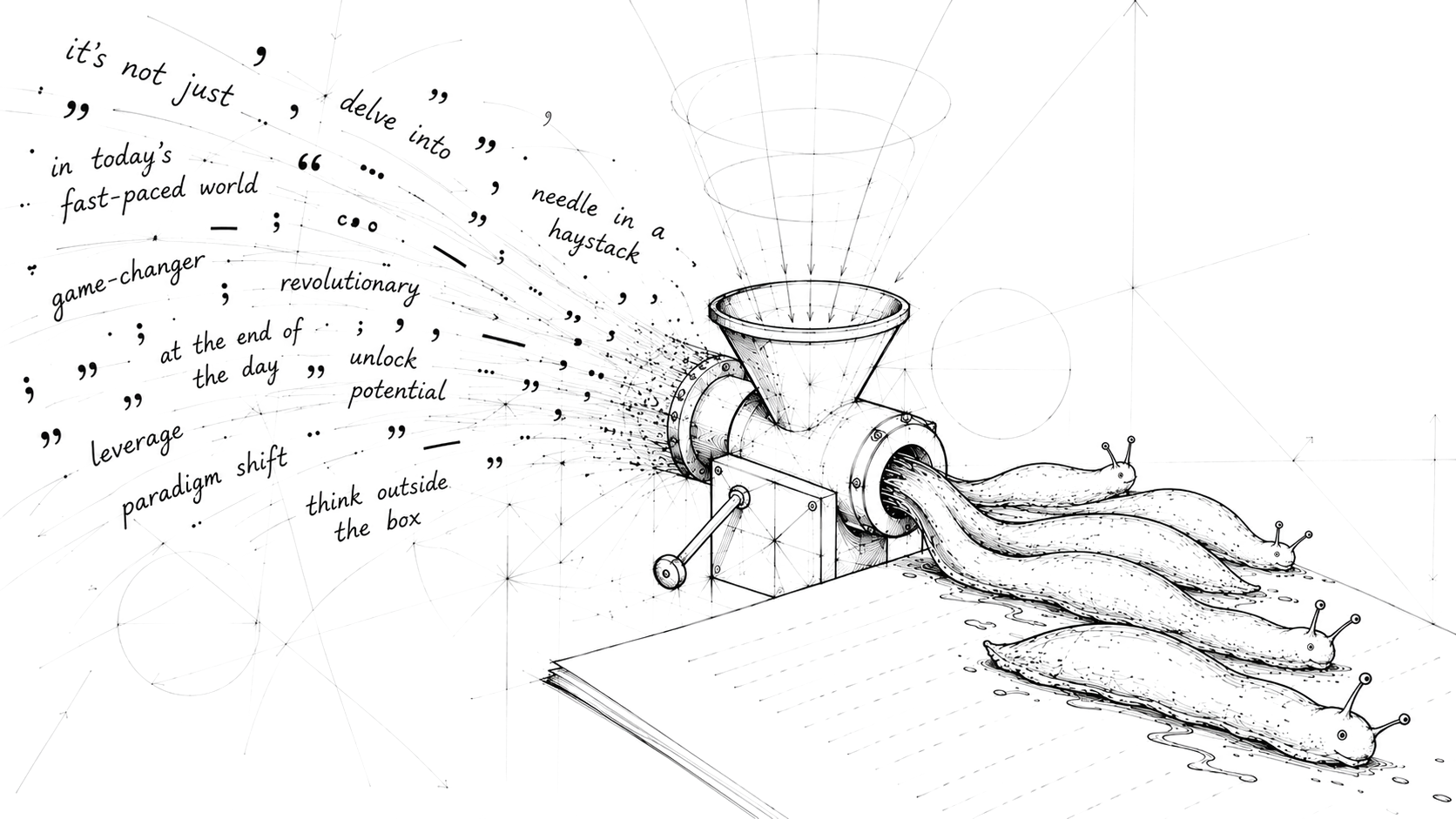
Punctuation often comes under assault. Kurt Vonnegut in 2005: “Here is a lesson in creative writing. First rule: Do not use semicolons. They are transvestite hermaphrodites representing absolutely nothing. All they do is show you’ve been to college.” Recently, there's been a wave of em-dash hate. Since chatbots tend to aggressively use them (multiple times per paragraph), any writer who includes them is now accused for having AI write for them. But I trust your writing less if you don’t use em-dashes.
First, it shows you’re not fluent enough in basic punctuation to properly articulate the thoughts in your own mind. I mean, sure, you get a lot done with just periods and commas, but punctuation marks are like visual aids that give you more precision in what ideas mean and how they are connected. I see em-dashes and parenthesis as siblings (of inverse function) that work together to help give structure to your emergent thoughts. I often find myself—mid-sentence—wanting to add details and embellishments; if they don’t fit into the structure of that sentence, I can contain them with punctuation. Both the ( ) and the "—[ ]—" let you inject detail into a sentence. They are “innies.” They either clarify or complexify.
These innie remarks are often a meta layer where the writer is reflecting on how the reader is processing their sentence, and they add clarification to make sure they are understood. They are punctuation marks about self-consciousness. Losing them is like losing a whole dimension of self-reflection. They’re used for digression, tension, clarification. Without them, you're not letting me see your mind at work, you are merelyh communicating. I wonder if AI bakes them in (via system prompt?) to give the illusion of a mind in thought, yet it’s really just capturing the syntax, and not really using it for digressions.
Garret on numeracy:
I suggest spelling out either: (1) all numbers below 10 or; (2) all numbers below 20 or (3) all numbers below 100 with the exception of your chapter references. If there are too many numbers like this in your pose, then the important numbers won’t stand out as much, like the reference examples later in this paragraph. Garner prefers option 1. DFW prefers option 2. Chicago style is option 3.
My reply:
Given different writers have their own range, is there a case for “all numbers below 2”? I’d argue that anything that is a quantity, other than a/one, can justify being a numeral: 1) it creates a visual fabric, where all quantity gets a specific symbol, and 2) it’s create the least readerly friction (I look to reduce this where I can because in other areas I intentionally add friction for specific ideas/phrases. To spell out “seventy-six,” in my mind, is a poor use of someone’s mental resources, an unnecessary drain of stamina. Even “7” over “seven” saves a few milliseconds of stamina that I will expend elsewhere. Also I love numbers. I’m really a math guy, and all my prose is just really filler between my numbers.
Here are some idiosyncratic rules on how to make these decisions:
This is a good example of rebelling against prescriptive, absolute rules: “everything under 10 must be spelt out.”
The advice that our writing voice should never be passive comes from overfitting marketing advice to essay writing. Yes, sales pages on websites warrant a particular aggressiveness in tone; in that context, there are many things to click on and you’re trying to communicate clarity in the quickest possible time. Essays are not like that.
AI: “The Oxford English Dictionary (OED) categorizes words into frequency bands ranging from 1 to 8, with Band 8 representing the highest frequency. This logarithmic scale means that words in Band 8 occur approximately ten times more frequently than those in Band 7, and so forth. The specific frequency ranges for each band are as follows:
This classification helps users understand the relative commonality of words in modern English usage."