
LLMs are hyperaccelerators for cliches
What to do about semantic satiation?
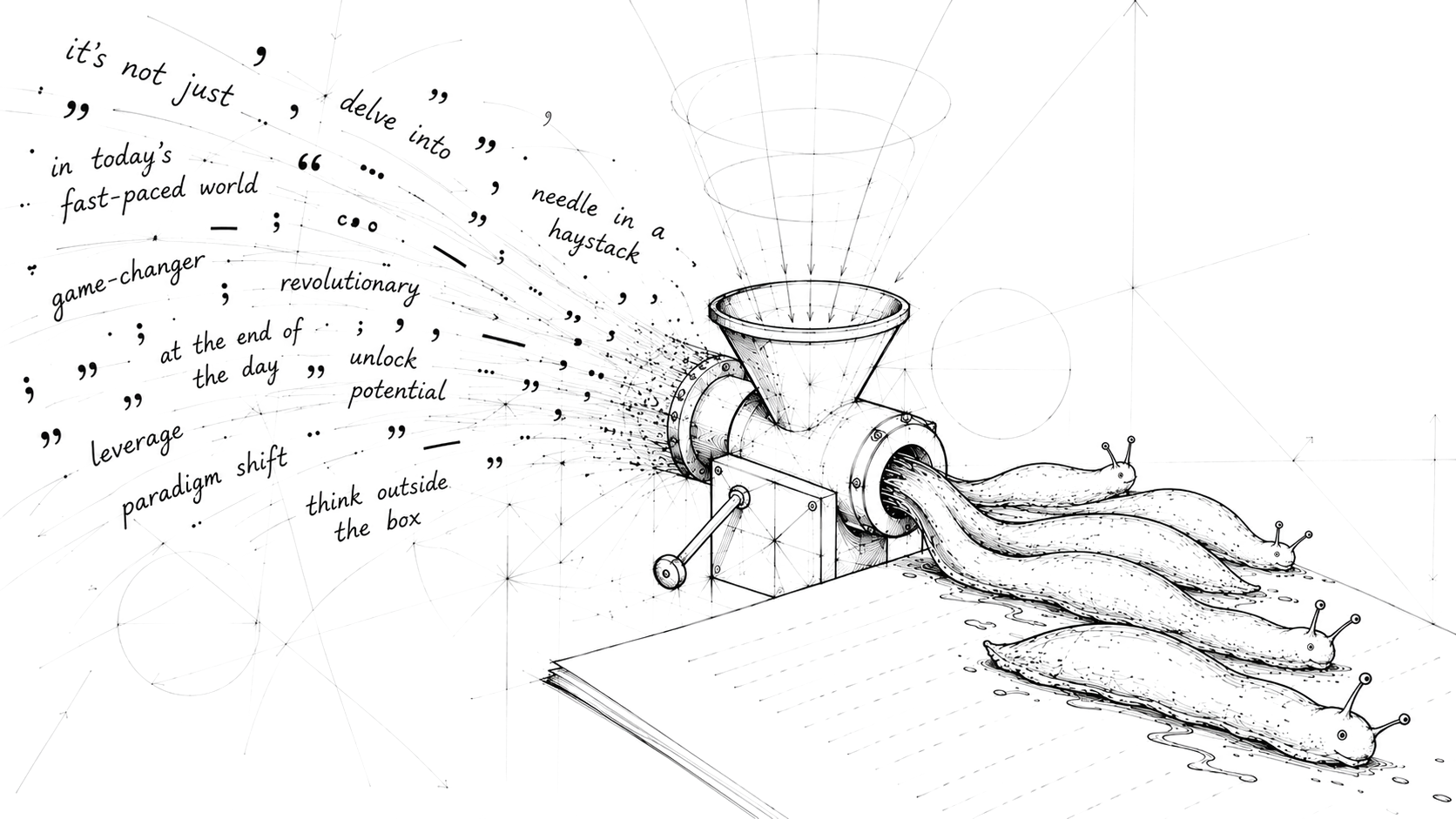
LLMs are like hyper-accelerators for cliches. It usually takes decades for writers to reuse the same tricks of language until they lose their freshness. There are a few big differences here: 1) AI generates language through probability, so it’s cliche by default, 2) millions of people are exposed to the same tropes of the current model, all at once, meaning it compresses semantic satiation down to weeks or even days, and 3) the cliches aren’t inventions, they’re mis-usages! “Needle in a haystack” was brilliant the first time, but most of our AI tropes come from misuse/overuse of a certain syntax without understanding how/why/when to use it. This becomes so annoying and so inescapable that we’re now bastardizing some of the basic devices that make our language rich.
Examples:
-
There are many ways to use an em-dash, but to me the best one is the parenthetical em-dash (an “innie”). These let you interject nuance—clarification, definition, elaboration, digression, etc.—into a sentence without destabilizing it. The sentence should be grammatically correct even if you were to omit what’s within the em-dashes. When you use an em-dash right, I actually trust you more; it shows that you care to add an inner layer of detail so I get what you mean. AI commits two fouls with the em-dash: (a) they’re rarely parenthetical (AI uses it more like a semi-colon); (b) it's overused, sometimes in every other sentence (limit it to once per paragraph).
-
“It’s not X, it’s Y.” This is a pretty standard way to compare two things, but AI does it in the cheesiest way: “it’s not just an app, it’s a revolution.” The second word is figurative, and usually, way too fucking dramatic (especially if you use it, again, every sentence). Example: “You don’t pay Facebook in dollars—you pay in privacy, in time, in the surrender of agency. The platforms feed on asymmetry: they know you, but you don’t know them. This is not a free market; it is a digital serfdom hidden behind convenience.” (Italics added to enhance the annoyingness). This is rhythmically and logically vacant, but the X/Y form has many variants. X can be a massive-run on, and Y can be a concise punchline. If done right, an X/Y can be the jewel of a paragraph.
-
“Delve” is a great word, but you never delve into a quarterly report. The etymology goes back to the 9th century and means “to dig” or “to rummage through.” It is not a synonym for “discuss.” It should be a word reserved for raccoonish behavior or roach-like research. If you are delving, it better be disgusting: “I delved into my clogged sink drain with a bent hanger in one hand and a cup of draino in the other to fish out a centipede braid of hair that was longer than me.” This is how you delve.
-
A good metaphor is an idiosyncratic association. It’s unlikely, unexpected, and uncommon, which is why AI can’t do it well. If we wanted a metaphor for “unfortunate words,” AI would say something like “words are poison.” Poison is such an obvious fill-in for “bad,” but the word has all sorts of undertones that don’t work (again, too dramatic). A better metaphor would be “words are slugs”; it’s unfamiliar, almost nonsense on the surface, but it has multiple interpretations (Are these words slow? Slimy? Did you wish it didn’t exist?). AI is not considering the subtext, so it just makes likely associations that don’t have power, and often don’t have any real associational meaning. When we get flooded with bad metaphors, it’s tempting to discredit all figurative language as purple prose, but actually, inventing your own phrases might be the core joy of writing.
A consequence of cliche saturation is that it makes you paranoid about usage. As you read, you’ll catch yourself wondering if a cliche phrase is AI or not. As you write, you’ll become aware of the slugs in your own prose. The best way forward is to be explicit about how you want to use language. If you can’t articulate when/why you should use a semi-colon, then you’ll either (a) never use it right, or (b) say that semi-colons are reserved for the litwits. I think the best thing you can do is make your own usage document to write through your linguistic dilemmas every time you pause.