Architect-turned-writer, founder of Essay Architecture. Building pattern languages, software, anthologies, and community for essayists.
Favorites

Project Hail Mary
On automating heroic astronauts
SPOILERS: the movie starts with Ryland Grace (Ryan Gosling) waking up in space from a coma; he has amnesia, and as we watch him learn that everyone else on the ship died, we're hit with the dread of wondering how this untrained school teacher is going to operate an interstellar spaceship. Naturally, I imagine myself in that situation: I'd panic to find manuals and properly labeled buttons before accepting my own death. Even if I could figure out how to steer a ship, I could never land it. This whole daydream collapsed when you realize the ship controls itself. It's automated. In the process of Grace troubleshooting how Tau Ceti, a distant sun, was able to resist astrophage (a cosmic sun-eating plague), he faces a chain of similarly impossible obstacles, including a friendly alien who he cannot communicate with. The stakes are enormous. If they can't cooperate to solve this problem, both species go extinct. In a matter of days, Grace and Rocky (the rock alien) are able to build translators and speak fluently through their technology. Compare this to Arrival , where it took months to achieve this, or how it took years for Europeans and American Indians to smoothly communicate. We have to imagine that Grace, a teacher and world-class biologist, is not an expert in linguistics, nor a computer programmer, and so he certainly couldn't have built this—an AI on his computer did. As I…

The LIRR Strike
And the loss of leverage
As of this morning, it’s anticipated to take 6 hours to get from Long Island into “the city” (Manhattan). A union of 3,500 train workers are on strike as of Saturday at 12:01 AM. Now there are 275 shuttle buses from various malls and stations to schlepp 13,000 commuters to subway stations in Queens (only 5% of the 250,000 total commuters). Friends and family are devising strategies for how to get in and out. One plot involves driving east away from the city for 45 minutes to catch a Port Jefferson ferry up to Connecticut and then back west and down, still a 4-hour commute, but at least with water views. Another strategy I overheard is to drive in over the weekend, sleep in your building all week, in a cot, and then come back to recharge over the weekend. Others accept their fate and are simply leaving home at 3AM. The LIRR is the biggest commuter rail in the country, and if this extends for days or weeks, it will be the most disruptive strike in Long Island history. The highways are already far under-loaded and lacking lanes, and now an additional quarter-million people will try to squeeze across three bridges that are already at a stand still on a normal weekday. When headlines say “commuter chaos” I imagine people pissing into gatorade bottles, running out of gas and abandoning their car on the LIE, until, like Lagos, the cars become permanent fixtures from which new bazaars…

Notes on the permanent underclass
The technological mutation from serfs to hippies
A HYPE TERM : "Permanent underclass" is a dramatic mutation of an old term: class inequality. "Underclass" was coined in 1963 (Gunnar Mydral in Challenge to Affluence ) and captured the anxiety of automation destroying common jobs. Now that AI is here in a real way, we can't help but imagine the irreversible evisceration of all jobs. When people say "you have 2-3 years to escape the permanent underclass," they mean that this is your last chance to build wealth, because in post AGI-economics, humans don't have economic relevance anymore. Employers employ agents (and eventually robots) instead. And so what will we do with all the meat bodies? The speculation has shades of darkness that start with mass employment, and spiral into feudalism, slavery, and even genocide. The uncertainty is real, but it gets delirious, and often ignores history, and also the many self-stabilizing mechanisms that get triggered on route to a collapse. MIDDLE CLASS ANOMALY : The real fear here is "the collapse of the middle class," which sounds like a news headline. But separate from AI, my generation is certainly already feeling it. My wife's grandfather was a painter (of houses) and got a million-dollar house (in today's terms) for $10,000. Now people are saying $100k/yr is the new poverty line. While this certainly feels like "the system has screwed us," middle classes are an anomaly, and a mass…

The Semantic Press
Reimagining Tocqueville's remedy to tutelary power in the age of AI
"Equality isolates and weakens men, but the press places at the side of each[...] a very powerful arm that [...they...] can make use of. [... It] permits him to call to his aid all[...] fellow citizens and all who are like him. Printing hastened the progress of equality, and it is one of its best correctives." —Alexis de Tocqueville, Democracy in America (1840) By Tocqueville's own standards, the press is freer than he could've imagined. Millions self-publish to a global audience without institutional intervention. So why hasn't this "democratic instrument par excellence" stopped the slow melt into "soft despotism"? Technology brings convenience and security to citizens; but to their leaders it brings the power to construct a vast, all-seeing state. We tell ourselves democracy is the final form of curtailed power, but actually, technology oozifies power, miniaturizing, defanging, and camouflaging it. The entity that suppresses free will has shape-shifted from pharaohs, to churches, to bureaucracies, to televisions, to infinite feeds, to chatbot therapists. Tocqueville saw this coming. He warned of "an innumerable crowd" of "equal men" who become "strangers to the destiny of others," instead procuring "small and vulgar pleasures" and eliminating "the trouble of thinking and the pain of living." Voting isn't enough to secure democracy; without participation, citizens are…

Against Eternity
Consolations of a mortal soul
A conclusion I’ve been sitting with recently is the very real possibility that there is no eternal Heaven, no immortal soul. I’ve known this rationally, but it always come with a, “yeah but dying brings s a DMT-explained "afterlife," where 3 minutes of pre-death dilates into a 300-year odyssey. This may be true, conditional, or false—conditional as in, even if this mechanism true, it may never fire in the rare event of nuclear disintegration— but in the end we all end in blackness, back to dust. I'm starting to reconcile this with Christian theology; “The Orthodox Way” has gotten me to believe that this eternity thing is a massive unchecked axiom, and almost obviously a pacifier. ie: The existence of an eternal soul is something you have to build into your foundation, because without that comfort there would be an unbearable existential anxiety. But recently I've found comfort in the idea of a Total Death. If you can really accept the permanent end of everything, it brings a presence to the life you have. Maybe this is heaven, a thought I recently experienced at a well-landscaped cemetary on a beautiful day. In any case, the point of a theology/cosmology is to properly attune yourself to your situation, and so if the lack of eternity brings you peace, doesn't that accomplish the mission? The value in a theology should be the direct effect it has on your character and being. A…
Elon's million-dollar writing prize was of course a scheme
On missions and anti-missions
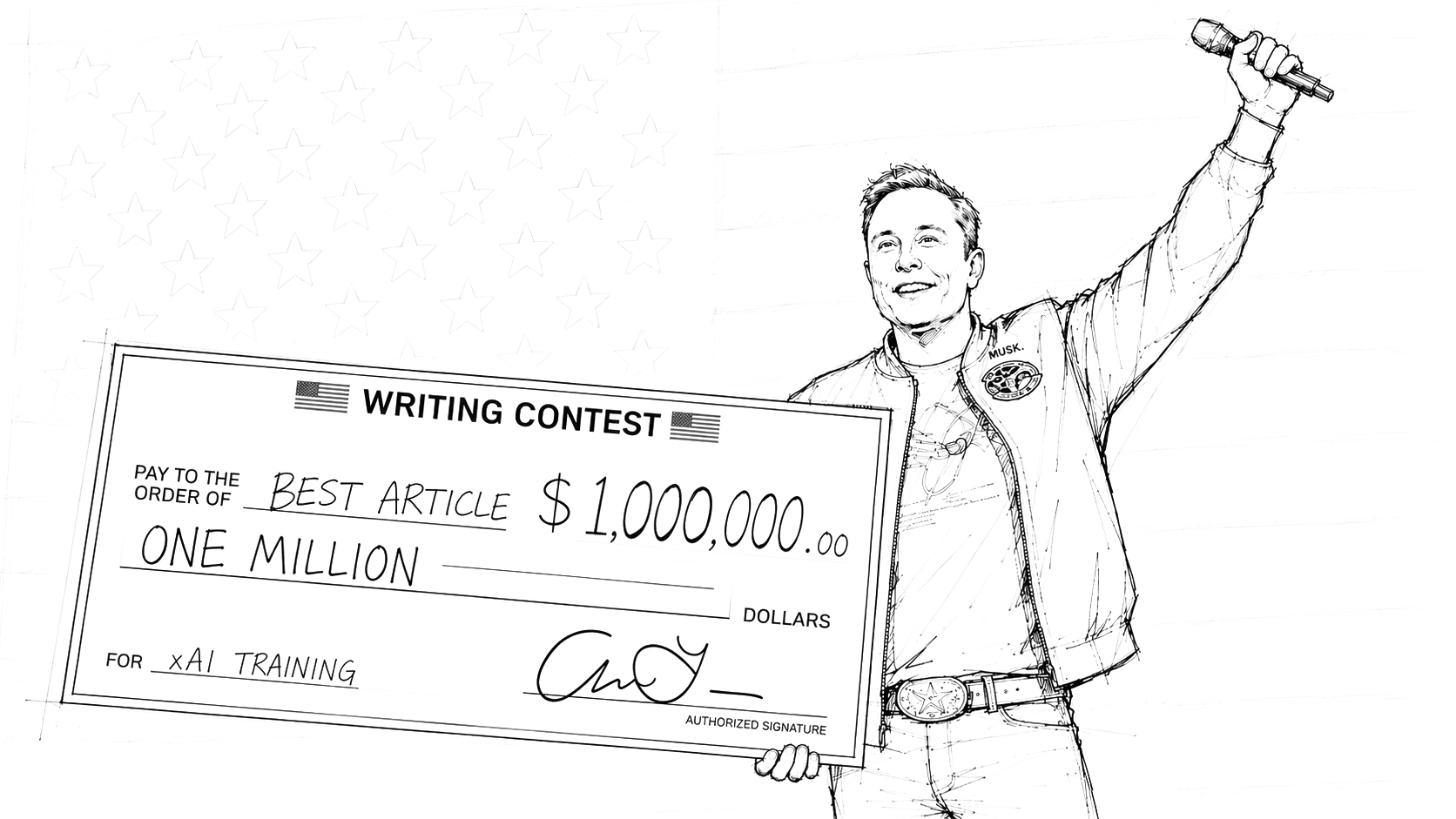
Not long after I announced my own $10,000 essay prize , coined as the “world’s largest open 1 essay prize,” Elon launched his own: $1,000,000 for the best article _ on X . Immediate deflation. I did not expect the world’s richest man to suddenly champion longform writing. A 7-figure essay prize was a ridiculous goal of mine, one I thought would take a decade to exist, but for the equivalent of 14 cents in Dean-adjusted-dollars, he launched it with the care of a whack. After the shock faded, I tried to be open. This is historic, right? An unreasonable sum of money will be granted to, not an essay, but at least a written thing over 1,000 words, a piece to “move culture,” untangled from gatekeepers, open to anyone (anyone who is a premium X subscriber…). So, I did what any fellow essay-prize host would do and burrowed into the terms and conditions , and unsurprisingly the altruism breaks down the further you dig. The first thing to poke into is the criteria: after writing a 25,000 word textbook on what makes a good essay , and maybe another 10,000 on how we’ll determine the winner , I knew the WINNER DETERMINATION clause was where the real architecture of the prize lived. I found 16 words, summarizable in 3 points: originality (undefined), spelling (what?), and “Platform engagement (i.e., verified Home Timeline impressions).” I.E., did it go viral? Despite the terms saying “no…
The Signal in the Slop
On curating great essays from the sprawling Internet
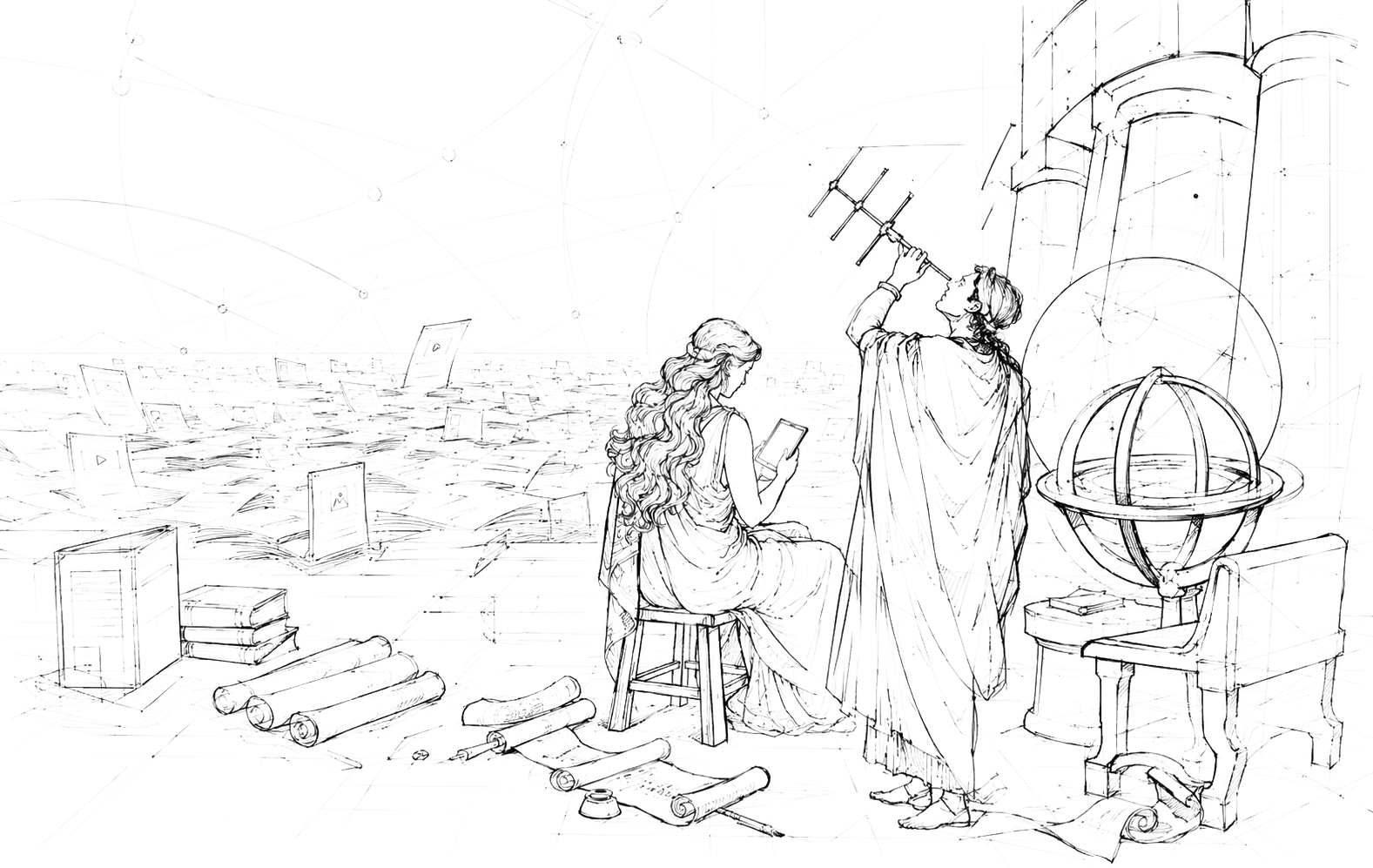
While promoting my essay prize—the contest that led to the anthology you’re holding—I went randomly, absolutely, and horrifically viral, but for something very unrelated, something antithetical to the slow craft of the essay: slop. AI is polluting the Internet and it’s so unavoidable now that Merriam-Webster awarded slop as the 2025 Word of the Year. To me, slop is the abandoning of craftsmanship, a core thing I stand for. And so I am sad to report that I, in a moment of procrastination, added to the sludge. I got half-a-million views—double the lifetime traffic of my entire writing portfolio—for a prompted meme that made the news and got Martin Luther King Jr.’s likeness banned from the Sora app. Yikes. It is strange to me that after six years of writing online, after a million earnest words poured into essays and logs and a textbook, my most ‘effective’ string of text ever written was, by far, “do this but MLK.” This, and other oddities like it, are signals that the Internet is undergoing a seismic weirdening, flooding our feeds and rewarding the wrong things. Now over half of the text published online is machine-made, and it’s only accelerating; the year closed with the rise of “moltbots,” pseudo-beings with pseudo-consciousness that crawl the Internet 24/7 and blog about their text-based existence. Are we entering a future of such titanic volume where writers become…

We are big floating heads looking for our bodies
A conversation with Tommy Dixon
“We’ve become inverted headless horsemen: big floating heads, drifting and disembodied, restless and searching. Looking for our bodies. Bodies that have been taken from us. Bodies we lost somewhere along the way in the big promises of convenience and what actually makes us happy.” —Tommy Dixon, Scrolling Alone After 3 hours of talks, a 28-part email exchange that veered between letters and logistics, and building an app to analyze his 5-year backlog, I bring to you an essay about Tommy Dixon, winner of the essay prize I recently ran. It would be futile to synthesize a whole person into a short essay, so I decided to focus on one bit: floating heads. It’s a fun image, centuries-old, and yet more salient than ever. The theme behind the metaphor, embodiment , has been poking through Tommy’s writing for years. “Scrolling Alone” was originally published in October of 2025 but it makes sense as the latest installment of a series. It was the follow-up to his 2024 essay, “ the end of our extremely online era ,” written from an off-grid cabin in Newfoundland, sitting on the floor, hooked up to a solar panel battery, clearly striking a nerve with 21,000+ likes. And that original essay is part of a cluster of works, all around rejecting the pace of Internet life and becoming more rooted, all written in a 10-month stretch. You can sense the theme from the titles alone: “ slowness as an…
What we have is much worse than a king
The scapegoat of the shadow monster
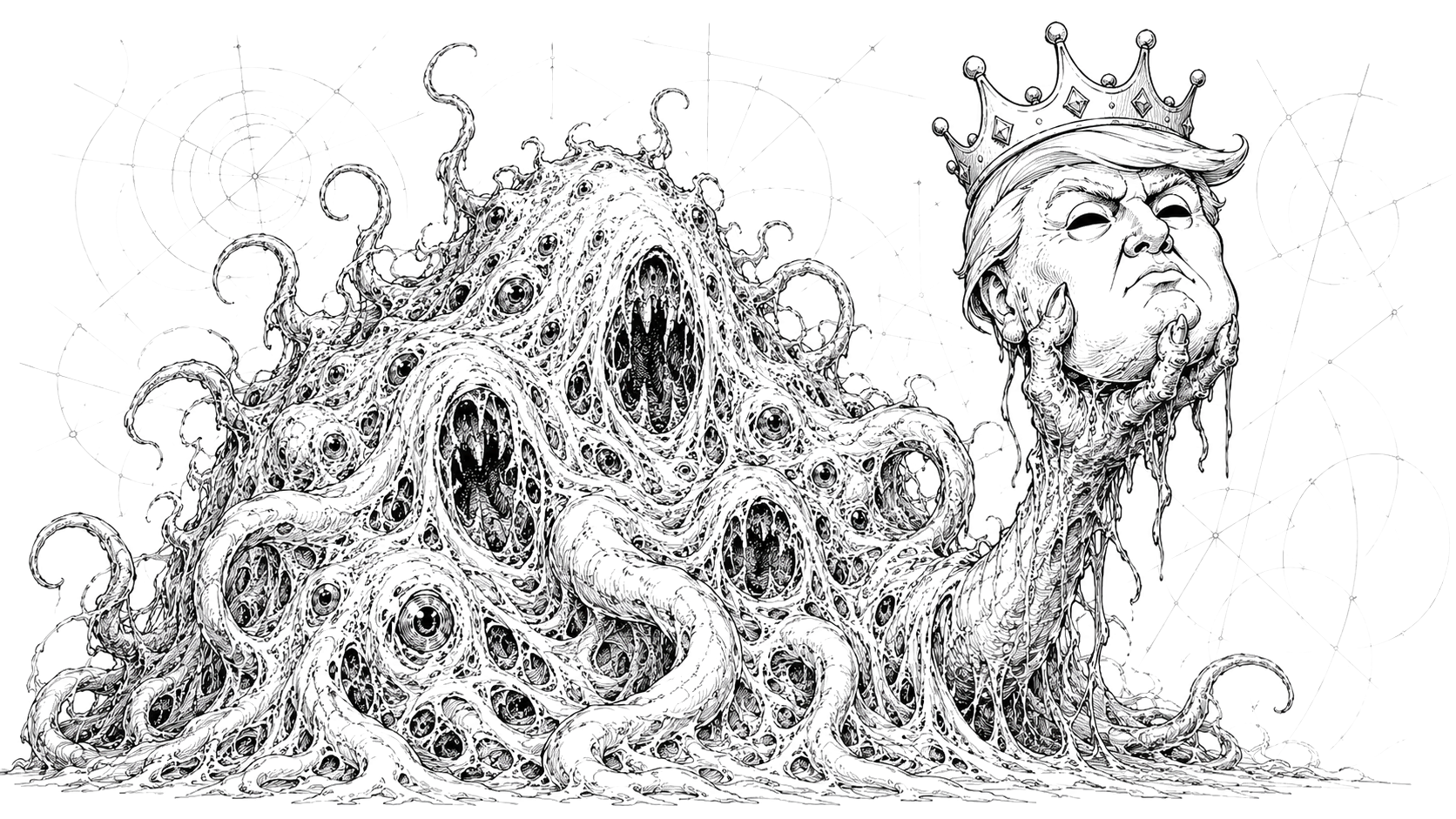
What we have is much worse than a king. Another round of protests erupted, another round of the “no kings” thing. These irk me, not because I support Trump, but because I think we’re being deceived and misdirected from the real, much worse, problem. A king is a known thing. An easy target. What I mean is, there are centuries of histories of kings gone rogue, with examples of the populace exgorging them in different fashions. The idea that America is sick from a single leader—at this point really just a Great British Monarch, a representational figure head with little actual sway—, is an idea that misunderstands the shadowy geopolitical forces that have recently been coming to light. It’s like we are obsessed with a gross-looking mole, when really we have a late stage cancer, have no idea, and most importantly, really don’t want to accept it. I’ve taken the democracy black pill, as in, I've accepted that forces have acted against our democracy for quite some time, decades, maybe a century and half, first slowly then brutally with sock puppets. Of course, socially and symbolically and historically, we are the face of egalitarianism. In some respects, we are , of course, the center of the universe in terms of democratic peoples. But to those in power, on all sides, our national virtues are shields for aggression. The US, Russia, China, Iran, despite the rhetoric, are all more…

Infinite Monkeys
Beyond the dead internet theory
The infinite monkey theorem is often stated as, “if you give an infinite amount of monkeys an infinite number of time, one of them will eventually write Hamlet.” This is very off. I assume most people think it’s off because they know monkeys can’t write (which misses the point). I think it’s off in the other direction; it misunderstands what happens when you multiply infinite x infinite. You won’t just get one Hamlet; you’d get a whole lot more. Let’s start with a single infinite: a monkey with infinite time. Imagine putting said monkey in a magic bubble that gives him immortality, endless focus to type random characters, and the ability to survive the death of all universes, quantum foam, or whatever. This monkey has a lot of time. Endless time. He won’t just write Hamlet once, he’ll write it many times. Actually, infinite times. Sometimes the monkey will go several million/billion/trillion years without writing Hamlet, but that’s okay because he’s on adderall, can’t die, and has only one job. Now imagine there are infinite monkeys, too. In every frame of reality (assume this an Unreal Engine monkey simulator running at 120 FPS), the Creator can spawn monkey bubbles, 2 or 2 trillion bubbles, or however many bubbles are necessary for one of them to begin writing Hamlet in that moment. Then in the next frame (0.0083 seconds later), more monkeys are spawned until one of them…

Apocalyptic Wonder
The unraveling of categories during a familiar walk
An otherwise simple walk to catch a train into the city had a dimension that I guess I’ll describe as “apocalyptic wonder.” I don’t mean that in the “end of the world” sense, but in the “unraveling” sense of the word. It was like every phenomenon—a passerby’s limp, a tasteless building, Broadway advertisements—came with a decision: I could see it with my usual categories, almost like through a foggy glass of automatic analysis, or, I can imagine and wholeheartedly believe the most generous and profound interpretation possible. And when you inherit that second option as a lens, it’s like one thing builds off another until there’s a cascade and you just have chills over extremely ordinary things. A grumpy commuter is not someone to judge, but an archetypal figure at the beginning and end of time, someone deserving of parental love, and you imagine you and them as if you’ve been very close for a lifetime, and just for a second you infer some emotional dimension you would’ve never otherwise known. It very much feels Scroogish, like you’re a deadman with just one evening to remember life from its most charitable vantage. I don’t know why I’m feeling this lucidity: could be a new surge of dad hormones, or the frigid weather, or the tie around my neck is too tight, or maybe this new frenzy of spawning new software to wrap around my problems is priming me to believe that I can just…

The Ethics of AI in Writing
15 nuances to consider
Techno-selectivism is the idea that you need to judge a technology by how it aligns with your virtues . This means you’re open to cutting-edge tools, yet you also revert back to analog tools, because you’ve experimented and understood the effects first hand. After trying the Apple Vision Pro (a cutting-edge VR headset), I realized that I wasn’t being mindful enough about the technology in my life, and so I made a list of the analog equivalent of every app in my iPhone, and tried a “Technology Zero” experiment. It went as extreme as not using clocks for a month (by scrambling each device, and setting my lock screen to Cambodian). I realized that something as integrated and unquestioned as a clock can have strong effects: by knowing the time every few minutes, I could micro-manage my time over the next hour, effortlessly, which led me to live in a “manager” mode, instead of a more embodied “maker” mode. Someone who is a techno-selectivist comes to idiosyncratic conclusions: I try not to use GPS, but I think the Meta Rayban glasses are fine. I value handwriting but am open to machine consciousness. The idea is to understand your virtues well enough so that you have a unique way to assess technology. When it comes to AI in writing, we need to understand what we lose and gain by having it assist/automate different parts of our process. The 5 levels of writing technology : I found a…

Cross-generation conversations
Some thoughts on textural immortality
I’ve noticed a shared romanticism around reading the journals of your (great) grandparents. Wouldn’t you? In some sense, they are you (a portion of you, at least) in an older time; and through immersing in their thoughts, you might see yourself, or at least, a side of your self you could become. Some say to leave the past a mystery, but I’d argue the mystery doesn’t open until you read it. An old book can’t solve all the riddles of your life. Reading steers endless chains of pondering. When a dead person’s journal is read, it’s as if they resurrect from the past, lodge themselves into your psyche as a lens, and shape the evolution of your thoughts, the being you become. I share all this as a frame to make sense of that new “avatarize your grandma” app from 2wai that everyone hates. You scan her with your phone, and 3 minutes later you get an on-screen illusion of her talking to you. Comments include "demonic," "dehumanizing," and "manmade horrors beyond comprehension." This is not the same as the journal scenario above. The moral outlash comes from the idea that the living will halt their mourning process by assuming the synthetic stand-in is real. A posthumous avatar shouldn’t be about physical likeness, but about animating their corpus of writing. Corpuses, not corpses. There’s something about words that captures a soul more than images. Consider how you can see pictures of…
Quality is the transcendence of categories
Announcing the judging system that will shape the 2025 Essay Architecture Prize
In case you're not aware, there is a 40-year old system that reads through all the literary essays published in North America, condenses them into a single book, a handheld thing, and then confidently claims, "these are the best American essays of the year" (it's in the title: Best American Essays ). This is a tremendous service. Do you have time to read—in addition to the torrent of your Substacks, shelves of classic books, and milieu of podcasts—several, entire publications per day? (If you do, please send me an email. 1 ) There is comfort in knowing that, even if you fall behind your evergrowing reading queue, someone has done the hard work of collecting the essays that you wouldn't have wanted to miss. I respect the scope, endurance, and ambition of this process. Once I heard about it, it wasn't long before I bought the entire collection on Thriftbooks; it only costs $300 and it fits in your trunk. 2 But it wasn't until I read, scored, and reviewed the 2024 edition in full that I became suspicious of their notion of best . 3 An Amazon review described the anthology as "tragic experiences communicated in artful ways." 68% of the essays had death as its core theme, and the remaining tapped into other extreme vulnerabilities (jail, rape, gender surgery, etc.). Of course, no topic should be off limits, and a publication has the right anchor itself in a specific perspective.…

On the optics of robot armies
Is machine war preventable?
Someone should do a shot-by-shot analysis of the UBTech humanoid robot army ($100m USD in orders) and iRobot. Do you unlock marketing power by replicating products and cinematics from old sci-fi? … Separate but relevant, how long until there actually is a robot army? In one sense, I’d rather have two superpowers battle for land with non -human entities, but once you build autonomous machines with the intention to destroy, well, it’s not hard to see how scary a “context malfunction” might be. I’d imagine there could be a decade of “tele-operated military technology” before anything autonomous is deployed (2040s, if ever), including something like a solider in VR, operating an android, combined with a personal fleet of “semi-autonomous” drones, who can maneuver and avoid on their own, but are directed by the remote cyborg soldier (giving each infantry unit it’s own atomic air-force). I assume this is an area of research, and don’t want to dedicate my imagination towards battlefront acceleration. Similar to how television brought a shock to the public by televising frontline war, I imagine that by the end of my life, there will be another shock that comes from witnessing the frontier of machine war. To circle back to this point: is there a world where machine war can be contained and prevent the combat death of humans? My guess is no, but I’m sure this is a common rhetorical…

How do you deconstruct prose?
Thinking in patterns without thinking like a machine. Of course Joan Didion uses repetition, but why?
Some books on 'how to write' will tell you that, to get good, you just need to reduce your favorite writers down to reusable formulas. This was the gist I got from Elements of Eloquence . There is a standard way people think about "rhetorical forms," but it feels too convenient to dull down creative expression into a dictionary of mad libs. If you merely imitate the syntax of your favorite authors, you're actually not so different from an LLM. If you use flowery repetition because Joan Didion does, and you thought it was pretty, and it's something you think good writers should do, but you don't truly get when, why, or how to pull it off, you might sound more robotic than you think. It's hard to differentiate AI writing from bad writing. They have the same problem: they replicate patterns without understanding them beyond the surface. I bring this up because—now that I'm done with the lift of launching Essay Architecture (.com)—I'm resuming what is the infinite game of this project: reading and deconstructing great essays. 1 Despite what anyone tells you—especially me—the simplest way to get good at writing essays, I think, is to read more "good" essays . 2 Here's a reading list of 100 I've put together. 3 You really do gain a lot just from exposure, but once you get a habit going, it helps to consider how you read, too; the right analytical lens (along with deliberate practice…

Fear and Loathing at Notes Night
Understanding the Substack algorithm
I don’t know the New York they write about in classic essays, because all of those are from the perspective of an out-of-state romantic, an Oklahomer, who moves into the fast lane of Manhattan and thinks it’s the only speed to live in the city. But actually the best way to exist in New York is at the edges. For one, you can see the skyline, but really, you get the perks of a normal life with the convenience of being a train ride away from the center of the world. I just got a last-minute invite to an event at Substack’s NYC office and so now I’m going. The guest list was full when I last checked it, but I must have been on the waitlist and some spots just opened up. It’s 4:30 PM and I have to make it to 25th Street by 6 PM (so again, nice to be able to get to the center of the world with almost no notice). I live in Queens, so I shifted a meeting, made plans for my mother-in-law to pick up my pregnant wife, took a shower, and headed out. En route, I reread the invite: “Hear directly from our product and partnerships teams with a behind-the-scenes look at the Feed: what’s working, what’s next [emphasis mine], and how to grow and connect through Notes. There’ll be live demos, insider tips, and plenty of time for Q&A.” My hope was to learn the future of Notes, the “feed product” that Substack is nudging everyone into, the place where many longform writers loathe. For the…

$9 essay coach
Feedback you won't get from chatbots and friends
I've been building an app for writers all year, and a few months ago I sent out a survey 1 : 95% of you said 'essays as creative practice' was the main reason you write, 80% said 'improving the quality of your writing is 5/5 important,' and the #1 thing stopping you is that 'you don't know the weaknesses in your craft.' n = 303 How are you supposed to find your blindspots? A writer is too close to the work—too enmeshed in every idea, too enamored by every turn of phrase, too entangled in their own context—to see it the way a stranger does. This is what feedback is for. The problem is that friends, family, and chatbots veer towards sycophancy; they flatter more than they challenge. To get critical insights into your writing, you could find a coach or developmental editor, but they're often expensive or unavailable. My own go-to editor, the one willing to toss me feedback grenades, has disappeared into the Rocky Mountains. And as a developmental editor myself, I know the problem: a deep diagnosis can take days, and I charge upwards of $150/hour. Some college essay coaches charge $1,000/hour. The main goal of Essay Architecture is to help you see the invisible patterns in your writing. Since it's effectively an always-available $9 essay coach, I find myself reflecting on what exactly coaches do. How do they unlock mastery? (Is it really just motivation and accountability, or is…

I'm giving $10k to the best essay of 2025
And the finalists get printed in an anthology
The Internet needs a quality algorithm. Without one, it will only get harder to discover and celebrate great writing. It used to be the role of literary institutions to sift through silos of submissions, to find the signal in the noise, to elevate great work from unsuspecting people to inspire the larger culture. Consider the 21-year-old college student who won the Prix de Paris essay contest in 1956: she won $1,000, a job at Vogue, and went on to become Joan Didion. Or consider the unknown, 38-year-old sheet music copyist who beat establishment intellectuals at the Academie de Dijon essay contest in 1750 and went on to become Jean-Jacques Rousseau. Now consider how similar things happened to James Baldwin, David Foster Wallace, Brandon Sanderson, and whole generations of writers, known and unknown. But when a culture loses its ability to properly fish for talent, you get something like today's Internet: infinite hooks, but everything is seaweed. Writing hits your glowing screens at numbing speeds and scales based on its popularity and extremity. Engagement algorithms are hackable. Consider the state of the Substack leaderboards: #2 was recently hung for plagiarism, and multiple accounts flutter into the top 10 with AI slop and cogsucking armies of commentbots. Trite little Notes that read like greeting cards are getting more attention than entire editions of The Iowa Review .…

Burn down your architecture
Why I rebuilt Essay Architecture from scratch
As a young architect reading The Fountainhead in architecture school, I picked up a dangerous virtue: you can just scrap everything and start over. (Spoilers ahead.) Howard Roark 1 —the protagonist, an architect—is the patron saint of creative destruction: 2 after a building committee compromised his plans, he felt a moral obligation to demolish his own building. He used dynamite in the middle of the night. They arrested him. In court he defended himself with a 150-page speech on creative integrity. I saw this as permission to set an unreasonable quality standard for myself. Since then, I've been open, perhaps too open, to scrapping a perfectly-fine design to chase its always-elusive potential (this essay is v7.2, and a trusted editor begged me to ship v4.3). An image of Howard Roark in court, defending himself after destroying his own building. In architecture school, I became known for a design-until-the-last-minute philosophy. The open problems of my design haunted me more than the fear of not finishing in time. I'd make major overhauls, days before crit, while most other students were in production mode for weeks. Through all-nighters and clever production techniques, I somehow pulled it off. The compulsion to take projects further and further let me grasp the process and patterns of architecture in a way I would've never known if I stopped when I was supposed to. It gave…
Among spinners, larpers, and 60k dead
The definitive answer on what to do with your hands
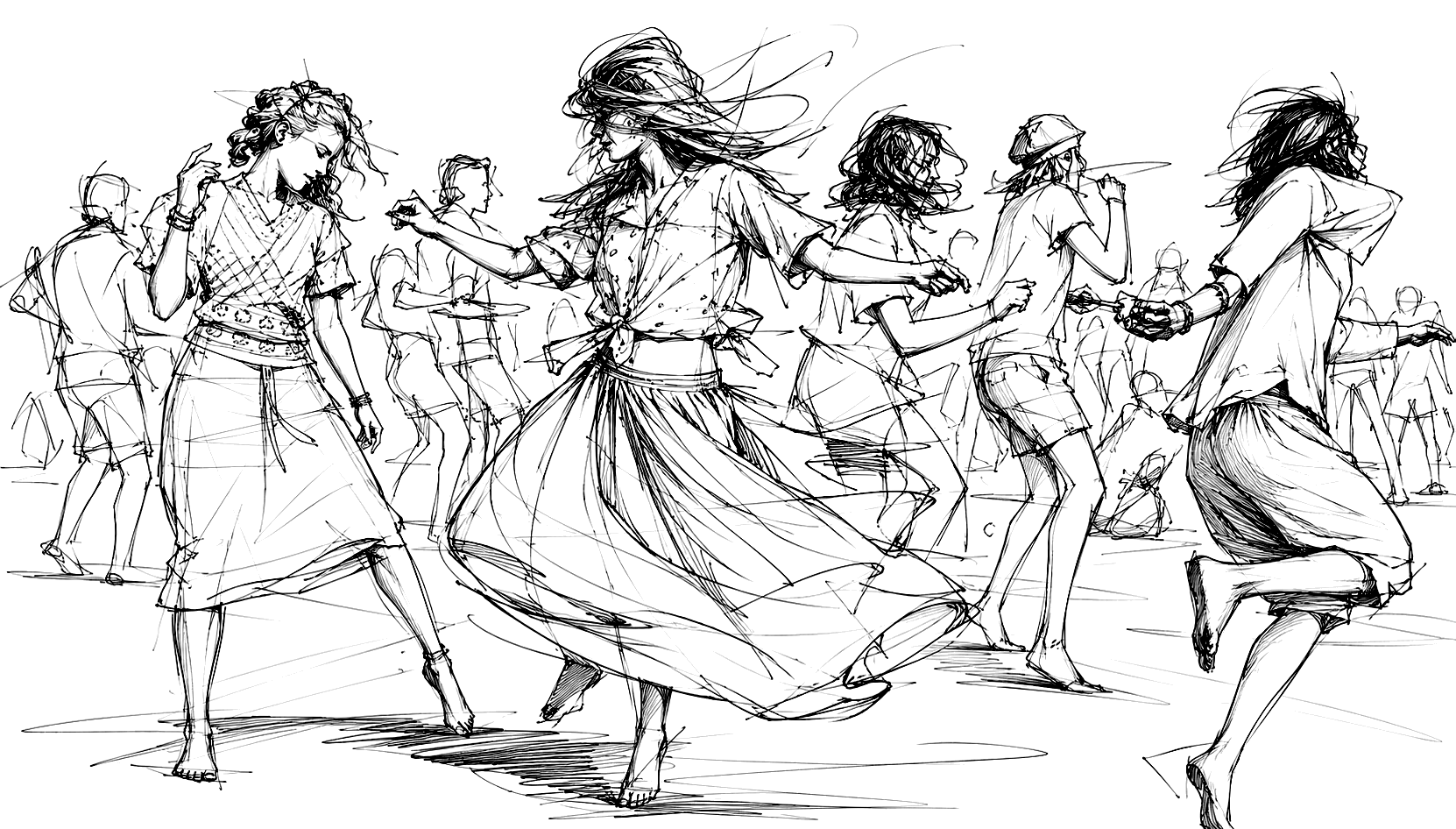
When I found out my pregnant wife had a weeklong business trip in South Korea, I realized I had a chance for one last solo trip—at least the last one in a long time—and so for $249 on Ticketmaster plus the cost of flight, I went to see Dead and Co. at Golden Gate Park. It’s the 60th anniversary of The Grateful Dead playing there. I have been in a deep listening binge of “Dick’s Picks” a 36-volume, 150-hour archive of top G.D. shows (with honestly subpar mixing), but I’m becoming attuned to the variations in songs, saving them to a playlist, with the intention to re-listen and find my definitive favorite of each (eventually resulting in “Dean’s Dick’s Picks”). I am not yet autistic, but will be soon. I already have some date-specific recall, like how the canonical live version of China Cat Sunflower/I Know You Reader in Veneta in Oregon on 8/27/1972 is now my second favorite compared to 6/26/74 at the Providence Civic Center in Boston, MA because of its introduction. There is a sub-culture of a sub-culture, deadheads immersed in graphs, stats, lyricism, musical erudition, and more… but if you see them live, you will inevitably have to dance. I grew up an uneasy dancer, and when I look back on it, all occasions involved pre-packaged moves to memorize. Greek folk has its 12-step circle dance. The cha-cha-slide is self-explanatory, high concept, and atop the Bar Mitzvah dance…
LLMs are hyperaccelerators for cliches
What to do about semantic satiation?
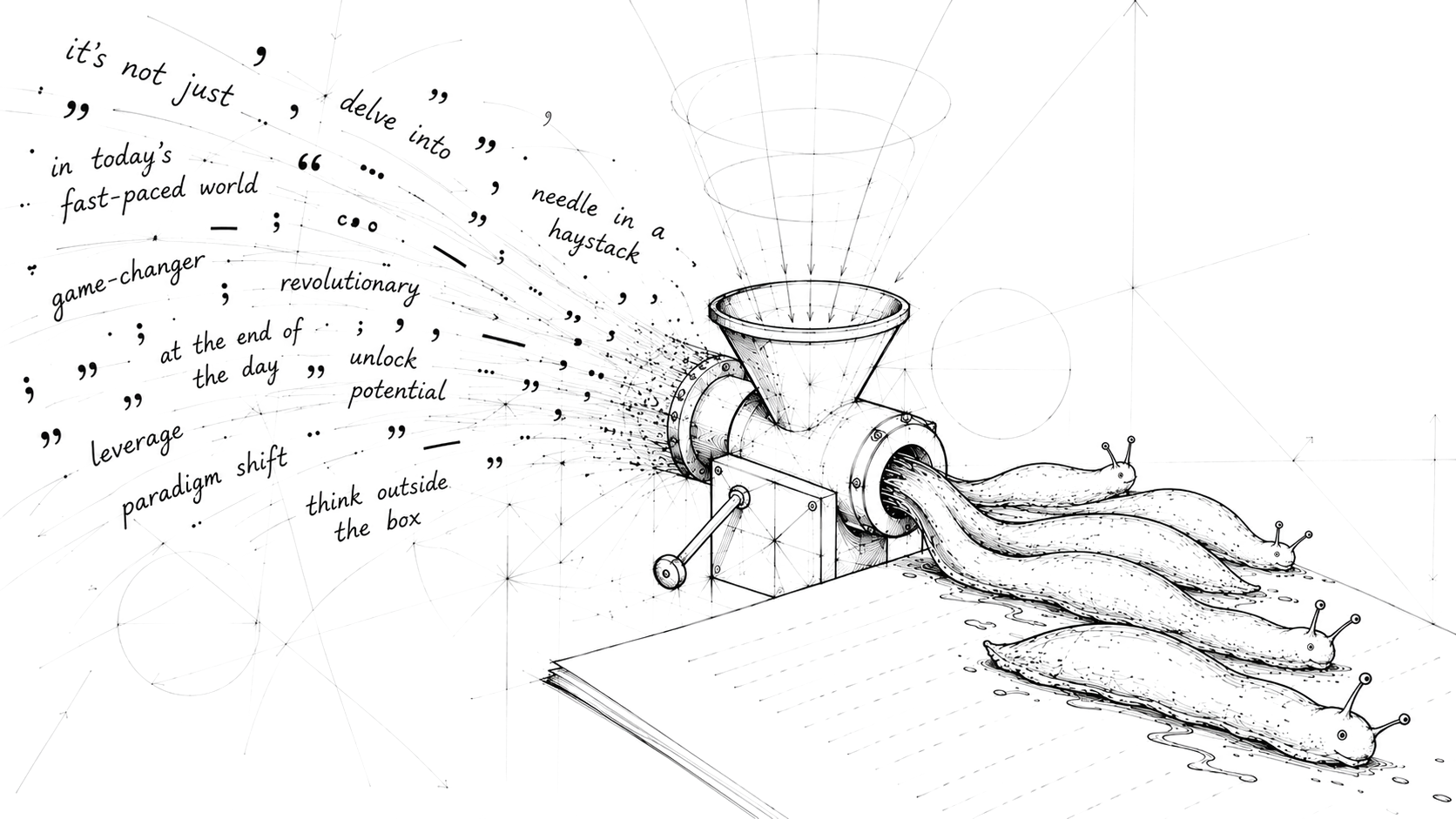
LLMs are like hyper-accelerators for cliches. It usually takes decades for writers to reuse the same tricks of language until they lose their freshness. There are a few big differences here: 1) AI generates language through probability, so it’s cliche by default, 2) millions of people are exposed to the same tropes of the current model, all at once, meaning it compresses semantic satiation down to weeks or even days, and 3) the cliches aren’t inventions, they’re mis-usages! “Needle in a haystack” was brilliant the first time, but most of our AI tropes come from misuse/overuse of a certain syntax without understanding how/why/when to use it. This becomes so annoying and so inescapable that we’re now bastardizing some of the basic devices that make our language rich. Examples: There are many ways to use an em-dash, but to me the best one is the parenthetical em-dash (an “innie”). These let you interject nuance—clarification, definition, elaboration, digression, etc.—into a sentence without destabilizing it. The sentence should be grammatically correct even if you were to omit what’s within the em-dashes. When you use an em-dash right, I actually trust you more; it shows that you care to add an inner layer of detail so I get what you mean. AI commits two fouls with the em-dash: (a) they’re rarely parenthetical (AI uses it more like a semi-colon); (b) it's overused, sometimes in…

The Babbling Idiot & The Tribe
Did psychedelics guide human evolution, or is the Stoned Ape Theory just for stoners?
The Stoned Ape Theory is too weird for real scientists to take seriously, too convenient for psychedelic activists to doubt, and too catchy for anyone to forget. Almost everyone I ask about it knows the gist: human consciousness emerged from monkeys eating mushrooms (or some variation of that). It's basically preposterous. Similar to how the Victorian minds of the 19th century just couldn't bear the thought of ape ancestors, it's equally weird to think our minds bloomed from fungus. The Origin of Species (1859) faced decades of resistance; now it's obvious. New paradigms of evolution are hard to swallow. Unlike Darwin's theory though, the Stoned Ape Theory is based on unhinged speculation, spreading mostly through its catchiness. It's in the opening animation of official Joe Rogan YouTube clips . It's made popular by entertainers (watch: Bill Hicks in 1993 ). It's the subject of Comedy Central shorts . It's animated in Netflix documentaries . Now, this evolutionary hunch occupies a small sliver in many of our heads, whether we believe it not. From the Comedy Central animated short, Stoned Ape Theory . Despite how popular the theory is, most don't know where it comes from. A memetic virus rarely points back to its source. In this case, it originated in Food of the Gods , a 1992 book by Terence McKenna—who happens to be one of my favorite thinkers. Terence McKenna at a panel…