michael-dean-k/

On Monday 6/15, I'm hosting a workshop to kick off a reading group for classic essays: RSVP here.

Topic

grateful-dead

15 pieces

St. Stephen Is Neal Cassady

· 381 words

I should make a case in r/GratefulDead that “St. Stephen” might be heavily inspired by the death of Neal Cassady.

Robert Hunter, their lyricist, confessed not knowing of the Christian “St. Stephen” until after the lyrics were shared with the band. So it’s not literal. Also, Neal died earlier in the same year (February 1968) that the song was first played (June 1968). The middle of the song is abstractly about death, but all the surrounding verses paint a portrait of Neal that, after reading 5 years of his letters, is now unseeable. Hunter knew Cassady well. Cassady was Weir’s roommate. Cassady was a “sacrificial muse” for much of that generation, so it’s conceivable. True inspiration or not, it will forever change the way I hear these lyrics.

  • verse-1: He steals a roses (Neal stole many things, like 500 cars), and “wherever he goes the people all complain.” The verse doesn't explictly say St. Stephen was a thief, but he “had a rose,” he “goes in and out of the garden,” (as a theft might), and everyone is annoyed.
  • v2: “Stephen would answer if he only knew how” relates to how, in Neal’s letters to Kerouac and Ginsberg, both masterful writers, he would excessively express how he couldn’t put words to his feelings.
  • v3: About death.
  • Bridge: “Speeding arrow, sharp and narrow” taps into Neal’s speed. On the road has the line, “the road ran straight as an arrow.” Also, “what a lot of fleeting matters you have spurned” ties to his range of chaos. “Several seasons with their treasons” refers to his shifting moods, and how he would predictably betray people (Carolyn, Kerouac) in search of something new.
  • v4: “Talk about your plenty, talk about your ills, One man gathers what another man spills,” Neal spilled everything, and Kerouac/Ginsberg saw immense value in what Neal thought was worthless confession.
  • v5: “Saint Stephen will remain, All he’s lost he shall regain,” maybe talks to the enduring influence of his spirit. And then “been here so long he’s got to calling it home,” speaks to his nomadism. (This is prob the weakest link).
  • v6: “Can you answer? Yes I can, But what would be the answer to the answer man?” speaks to their desperation, follow-up letters when their friend hadn’t answered them.

San Francisco

· 108 words

San Francisco, where billboards of slop promote slop promotions,

impossible benefits from machine intelligences;

San Francisco, where the Dead reborn in golden Park,

to dance with perpetual stank

face to nitrous balloons and tie dye,

until Mickey Hart plays cosmic harp,

with shamanic visuals to drunk men,

pointing and chanting his name;

San Francisco, where half the cars are driven by ghosts,

and sometimes catch fire at night;

San Francisco, where the powerful have,

their souls caught in their throats,

from crackled-out platitudes and slogans.

San Francisco, where that Transamerican pencil pyramid is,

a backdrop for cinema-quality technology trailers,

signaling their city is the city of new religion.

Telepathic hivemind

· 139 words

There was a particular moment last night in Fire on the Mountain that felt authentic to the spirit of the Grateful Dead. I think Dead & Co. is generally guilty of ego-driven power solos, where they go in a circle and just take turns riffing over a backing track that is “in the pocket.” But there was this moment where you could tell John & Trey were intensely focusing on each other, and they were harmonizing and playing into each other. Less about “here’s the genius coming form my head,” and more like, you’re locked in to the other one, adding to them, and even seeing ahead of them, and dancing back and forth. In the best moments of the original Dead, the whole band locked into a telepathic hivemind, totally unpredictable. High risk, but magic when it works.

The bus came by and I got on

· 172 words

I got into friendly conversation on a public bus in San Francisco, almost entirely due to the friendliness of the deadheads, and that, once you can tell, it’s an instant invitation to chat. I got tips for the show (ie: avoid the JFK promenade), and tips for the bus. Thanks to them I took a different route that went through Haight Ashbury, ground zero, which included a counter cultural museum, dozens of pop-up vendors, a rock band, and a nudist with a red sock on his cock. 

To what degree did this movement 60 years ago affect culture? I look to my left and see a white-haired woman in tie-dye furiously swiping through a feed on her phone. 60 years ago, it was edgy to wear tie dye to a concert. Now, the truly counter-cultural thing would be to wear a full suit and tie to a Dead and Company show. That might be the only way to actually feel the discomfort and community judgment that original hippies felt from straight society.

Sonic Patience

· 67 words

When someone says the Grateful Dead are boring, it shows to me that they might not know how to listen to music. I don’t think it’s a taste thing. I think people have sonic attention spans, and most people are conditioned to specific patterns in pacing (ie: verse/chorus). A good band will expand your conception of what music can be, and they demand your full attention.

New affordances at the Sphere

· 490 words

The Sphere can trigger peak/mystical/transcendent experiences and the corresponding reflection that comes from that. When a concert is able to trigger that 10x in a single show, it’s special. But also, you become aware of the variance, and your expectations rise. You are so attuned to what a peak is, that the average moment is boring or flat, like a planetarium+.

My review/critique of the Dead & Company of the Sphere is relative to what's now possible in a venue. It's less interesting to compare the Sphere to a traditional venue to the new affordances of what a show could actually be. Even though the whole thing is generally mind-blowing, it’s worth it to be critical and imaginative of the experience (after seeing it in its fullness). Instead of just saying “it was insane” or “the visuals are distracting” we should give specific feedback that might even improve the future of shows in that venue. It’s an entirely new medium, and it could be up to fans to articulate what’s working and what’s not.

The Grateful Dead ethos brings a challenge to the sphere, because it's not a pre-determined set; each night is its own arc, and it's also semi-unpredictable if they'll stay in a segment for 3 minutes or 7 minutes. The video DJ is something like a live band member, the interface between the band and the audience. When it's done well, it's sublime, and it's worst it feels like tacky CGI that retracts from an otherwise performance (I felt this about the skeleton motorcycle during "I Know You Rider").

A peak experience at the Sphere would require procedural synesthesia. Procedural means you generate the effects live; there is some of that, but it's mostly stitching 2D video into fixed 3D CGI sequences. Instead, a Sphere "background" should be like an environment of "receivers" that get animated and modulated by the sound itself. A basic example would be a snare drum triggering a ripple. There was little of this! There were some accidental alignments, and those moments were when it felt special. A real-time link would give the experience of being inside the music. It's all about the conversion of sound to shape. This is hard on many levels—design and engineering—and there's a possibility that the Sphere couldn't handle something that was entirely real-time.

Some scattered notes:

  • Warping 2D objects into 3D spaces (like they did with the Mars hotel—it was great, but only used once).
  • Faster pacing: don’t dwell on a sequence for 3 minutes, but undergo subtle shifts and transformations every 3 seconds.
  • Use effects to “green screen” out the musicians and embed them in digital environments (vs. putting them on screens)
  • Spherical camera rigs (multi-angle)
  • Fan footage (filter for anonymity)
  • Lyrics, song name, text
  • First person drum cam
  • Tracers/looping — distortions in time
  • More use of haptics (just drums/space, hit)

The telepathic spirit of jamming

· 134 words

John Mayer and Phil Lesh have opposite sensibilities, and that accounts for the biggest difference between Dead & Co. and the Grateful Dead. In the original Dead, it was less about the band keeping a backing track while people took turns with over-the-top heroic solos; instead, they were all soloing at the same time. At their best, there was no focal soloist; they were all listening to each other discerningly, warping forward in an unpredictable direction. They were not trying to compose a solo, but predicting where their bandmate would be in 5 seconds, and trying to augment that. The original spirit was more “telepathic” and unpredictable, where the worst of Dead & Co. feels like a literal circle jerk (John's orgasm face is not the problem; the problem is they should all have that face).

Shakedown Street

· 136 words

From the Venetian, we walked in 98-degree heat for twenty minutes to go to Shakedown Street, a Grateful Dead themed street fair in the parking lot of the Tuscany, which features, I imagine, some remnants of the original Deadhead culture (ie: people willing to camp in RVs in Vegas for 2-3 months at a time to sell merch during a Sphere residency), selling shirts and trinkets to tourists like us (just here for the weekend). Part of that culture is pranks (ie: the merry pranksters), and as we walked in, I heard two guys behind me saying, “let’s go fuck with some people.” Then I saw them run ahead, turn around, and greet us as boisterous trolls: “Make me rich! Make me really, really rich!” I guess they worked there. We collectively spent hundreds on merch.

(VR) Arcades vs. Albums

· 130 words
  1. On route to In'N'Out, we walked past the storefront of a VR arcade, and through the window you could see an overweight man in a headset, fully reclined, probably experiencing a roller coaster. As someone who has given a thousand VR demos, I know the vulnerability in being watched. We found that people were more open to try it if they were in a private room. This is the exact opposite. Hundreds will walk by and see a human vegetable, eyes occluded; he’ll never know you saw him, and you’ll never know what he saw.
  2. An article with Jerry Garcia talking about virtual reality in 1989.
  3. While the Vision Pro made my skeptical about the future of VR, the Sphere gave me hope. I could imagine albums evolving into multimedia experiences that layers performance, music videos, and lyrics on top of the song.

My First Robot

· 220 words
  1. Did Jerry Garcia ever comment on the future of robots?” I asked this question to the robot in the Sphere lobby, and it gave me a BS response (effectively, “No, Jerry Garcia, the guitarist of the Grateful Dead, never talked about robots, but people do!”). I really wanted it to infer what Jerry might think about robot chaperons in the lobby of his venues, but I had to ask the human host to ask the robot question, so I couldn’t get too specific.
  2. Most people seemed intrigued and revulsed by the micro-expressions in its face, except the guy behind us. He told us that several people have complained to the Sphere management that it makes them uncomfortable. He thinks humanoid robots will be commercially available in 3-4 years. He wants one in his kitchen.
  3. Andrew said someone told him that the hardest thing for robots to recreate will be a sense of smell, and so in the future, if androids look identical to humans, they’ll use smell tests as proof of humanity.
  4. The outer lobby of the sphere has black reflective floors, glowing hues on the parapets, and tangling installments that if you stare into, will trip you out.
  5. The Sphere markets itself as a haven for “22nd century technology,” but the travelators are broken.

Hippy Yearnings

· 193 words

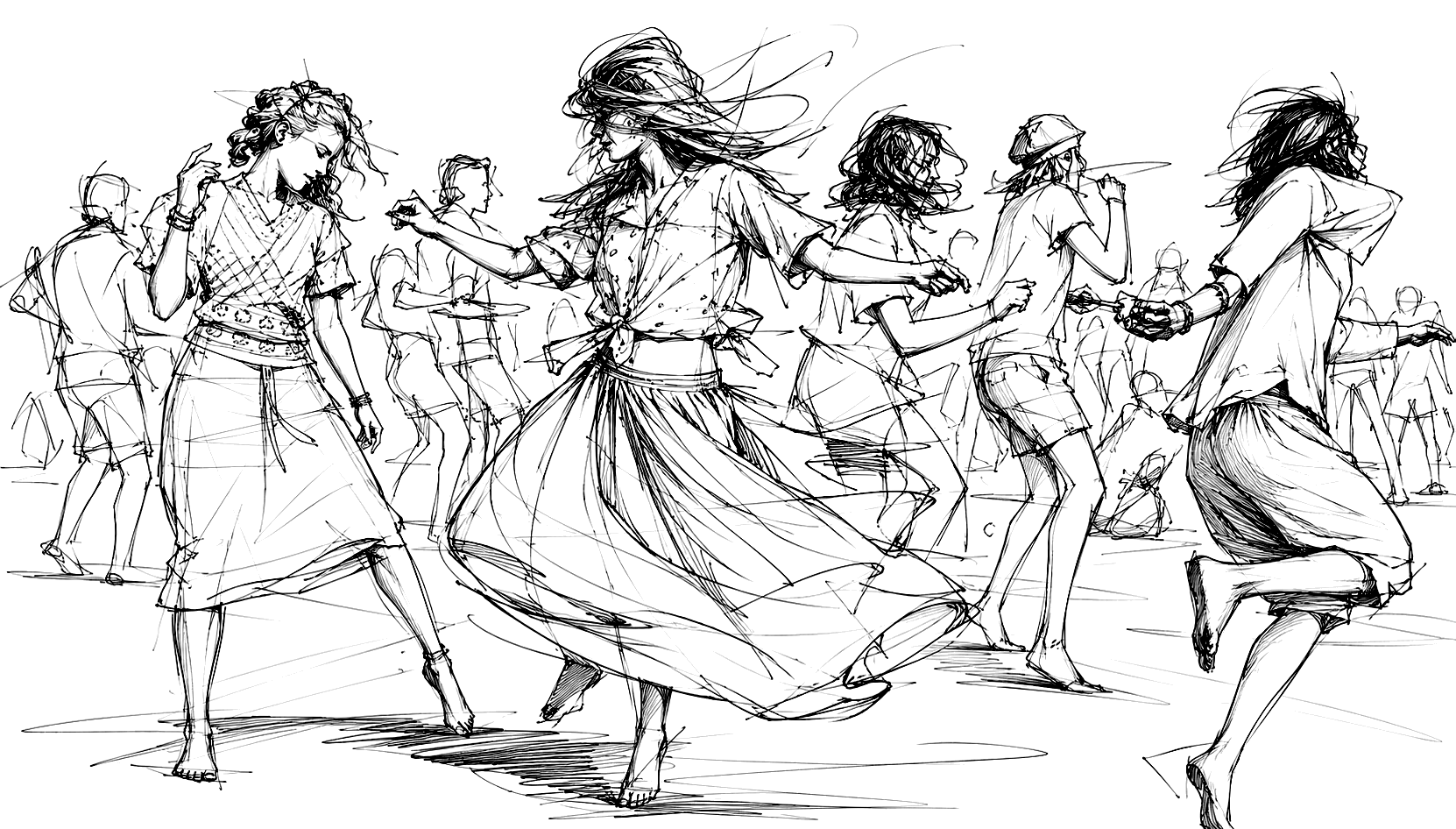
The Dead & Co. poster features hippy girls and a motorcycle man. The girls are dancing, twirling, with hair wild, barefoot in rags, liberated and free. The guy’s in a leather jacket. A rebel. These images are on their website, on the outer sphere, in glass windows in a mall that looks like plastic Venice. It’s the official Residency 2 image, and they are auctioning signed posters of it for $5k and up. These symbols are obviously tied to the history of the band, but even as standalone images with no context, I wonder if the hippie/motorcycle have a psychological power that taps into the troubles and desires of 2025 people? Might also explain some of the Dead’s rising popularity (the brand of the dead feels aligned with the “touch grass” catalyst of always-on computer culture).

(At the official Dead & Co. merch store, I noticed that the VIP tickets are branded as the “Vibee” tier, with 2 Es, and those customers should head to the “Vibee Check-in.” I know that “vibes” is a 60s word that has regained popularity today, and I wonder to what extend that word is correlated with Deadhead culture.)

Strangers Meeting Strangers

· 632 words
  1. In JFK there are several tie-die shirts, which is the long-distance way to signal to someone (from 100 yards away) that you are, a Deadhead, and going to the concert, again. If you look closer, there’s less obvious, less multi-color, less standoutish merch (a black shirt with a skeleton as a casino dealer, which tells you they went to the ’24 Sphere residency). The mutual noticing of each other’s merch is something like an unstated invitation to begin a conversation, which if not undertaken, is sort of rude. “Strangers talking to strangers” (isn’t that in Scarlet Begonias?). This taps into some old Tim Leary interview I saw, where his vision for the counter-culture was for instant immersion in real conversation—it was about the transcendence of elevator talk / keeping to yourself; about breaking out of default scripts and internal monologues and to take a risk in creating an interaction with an unknown person for an unknown result.
  2. Dead & “Company” has a triple meaning; the first impression is that company refers to the new band members. The cynical impression is that it’s the legal entity that John Mayer owns 51% of. The open impressions is that company refers to all the fans.
  3. Unrealistic goal this trip: Talk to 100 strangers. Not every interaction counts (ie: small talk). It only counts if you personally make an effort to extend the conversation one level beyond banter.
  4. From the gate you could tell this was a flight of Grateful Dead fans: an older man had a ’90 blue and orange (Mets colored) hat from their garden show (sold out on Amazon). Someone with dreadlocks loudly asked him “how many shows?” I couldn’t hear his reaction, but based on his eyes I wouldn’t be surprised if it were 100+. A man in a bucket hat with his wife brought up “idiots talking,” (during the show) and “Disney Dead.” In first class, I saw a GD sweatshirt, along with a white "Phil Lesh & Friends" hat. On the tram in Vegas: “How many under your belt?” She answered that her dad’s a deadhead, she’s been to 10-12, and she’s going all 3 nights this weekend.
  5. My Uber driver has lived in Vegas for 16 years. He hasn’t taken his kids to the Sphere yet (but wants to, and asked me about pricing). We estimated how long it would take for James Dolan to make his money back (he said 10 years, I said 4). He used to be a trucker in New York and South Dakota, found it way too cold there, and is grateful he overcame his smoking addiction.
  6. On the ride from Harry Reid airport to the Venetian, somebody graffiti’d the bear on a wall and wrote “dance like Jerry’s watching.”
  7. On my first impression of the sphere, it took the form of an obnoxious, 300’ tall yellow emoji. I notice this from the middle of the bridge I’m currently standing on with a homeless man. Now it’s a tie-die riverish 3D lava lamp. Now it shows hippies dancing.
  8. I landed a few hours before my friend, so I wanted to walk up and down the Venetian/Palazzo to get my bearings. This place is designed to be a maze (like Venice, except for different reasons). At some point I was walking outside, using my phone, and passed by what looked like two showgirls dressed in fluffy bird suits (insane for 80-90 degree weather), and one of them said “Are you texting us?” I gave a sheepish laugh and kept moving, but this was the first interaction that felt like VR Chat (absurd characters in an absurd place with little inhibition). The next VR chat moment was when I saw a guy walking around with blockish, red, knee-high shoes.

Robert Hunter on Songwriting

· 1,260 words

Robert Hunter on how musicianship and songwriting are two different mind states:

“In flipping through the draft pages of this book, I was surprised at the number of early lyrics by Garcia and by Ron "Pigpen" McKernan, songs that got an airing or two but apparently rang no bells for them. Both writers show distinct lyric promise. Their skills would have developed in proportion to the effort they exerted in songwriting, though both were first and foremost musicians. Words tend to be a chore when your first love is the performing of music. Penning and chord-combing don't have the same charge. I know from personal experience that when I perform much, my writing dwindles. In my opinion, most bands could benefit from a lyricist able to devote full time to the task. Musicianship and lyric acuity seldom dwell in the same body-different brain configurations, I figure. There are, of course, profound exceptions to this rule.”


Robert Hunter on how lyrical interpretation warps a song’s power:

“You can swallow a song like "UJB" whole for what it evokes in you, mystery and all—or you can track down the resources I selected while stumbling through the dark of composition, toward some kind of light, and achieve a gnostic synthesis of the song that may forever change the way you hear it. It may deepen the experience, or just explain it away. As with the language of love, the meaning of a song often lies less in what is said than in how it's said, the scan of the rhythm relative to counterweight of color and image. And mystery has a color all its own. But there's something other than those retrievable devices that's necessary: a uniqueness of overall character-that the song be that song, borrowings and all, and not any other. Not a copy of anything. A representative example of a genre that doesn't even exist, if it comes to that! A China Cat Sunflower. Avoidance of popular genres does not make for a commercially successful music; there's no formula for the cultural froth to fix on, but it does invite a long-term following. With only one hit in thirty years, I'm not even sure the Grateful Dead belong in the pop music section of the record store. But it definitely found its domain in the tape machines of an army of bootleggers.”


On lyrics balancing the specific and the general:

“A lyric that places its situation too restrictively in a particular time and place may fail in this regard but, on the other hand, might just redouble in such associative power to the ears of those from the same time and place. Usually New York City in the not-too-distant past. Mostly it's the trusty love song, specifically new love and love disappointed, that takes you there. When the parallels get a little too exact, it's just uncanny, and there's not much more to say about that. It's a bit more difficult to find subjects other than romantic love that partake of the particular and the universal at the same time, which is what a song must do to make any difference in the life of the listener. By report, I've done this with a few songs, such as "Ripple" and "Box of Rain" (neither love songs in the conventional sense), but I can't tell how it's done, only how it feels: like I've just spoken clearly to myself and survived the experience. Exalted. Satisfied.”


On allusion:

“An apt allusion can act like a magnet among the iron filings of a verse, making them all coalesce and decisively point north.”


On songs outliving the writer:

“There are songs of such enduring stature that they have become part of the common mind, from "Row, Row, Row Your Boat" to "Happy Birthday to You," from "Stardust" to "Auld Lang Syne," from "Subterranean Homesick Blues" to "(I Can't Get No) Satisfaction." They seem like natural forces (as indeed they are)—unequivocal as the moon and perennial as grass—but in each case, oddly enough, somebody wrote the piece, wrote it or made it up, and passed it along, always around a fire-somebody whose name has come down through the ages along with his song, somebody like King David or Cab Calloway, or, more commonly, somebody forgotten. I like to acknowledge some of these works (it's called allusion), borrowing a bit of their pizzazz or charm, certain of their authority if not my own.”


On the power of the bands’ name:

“The Grateful Dead was, is, the master metaphor for our group situation. And yes, the shoes have run away with the feet at times. The evocative power of that strange, not at all comical name is considerable, for grace and ill. I know that my own input into the scene, my words, were heavily conditioned by that powerful name. It called sheaves of spirits down on us all. It expressed a deep and mystic hope about the nature of eternity. Our shows were ceremonies and our people, celebrants, in the most archaic sense of the term. There was no place else on God's green earth that I, for one, fitted. Now that it is gone, there is no place else I fit so exactly as to shape.”


On metaphor:

“The juxtaposition of one metaphor to another yields relation; a juxtaposition of relations, a situation. A juxtaposition of situations provides narrative.”


On the modes of a song:

“Ontology is an examination of causative factors, of intent. What was the impulse that seemed to require certain images to be duly expressed? Love, carnal or spiritual? Irony? Sentiment? Contempt? Patriotism? Existential devaluation? Self-advertisement? Revenge? Paranoia? Romance? Annoyance? Deconstruction? Revolution? Peer status? Exuberance? Broken-heartedness? Grief? Indomitability? Salvation? Sales? Sacrilege? Inanity? Responsibility or the lack of? Need of another song for the album?? Discontent? Protest? Inspiration from another song? Disaster, personal or worldwide? There are prime models for each of these impulses in the literature of song, in the musical mean in which we swim.


It seems like lyricists never want to reveal the meaning behind their songs. Robert Hunter says a song is a naked, amorphous living creature. Its meaning evolves, and is unique to each person. The book of annotated lyrics I have is about scatology, which objectively describes the external references and allusions. I appreciate this, but it would also be neat to know a range of interpretations from those who have a ton of context. I think there’s a way to differentiate and label analysis/interpretation, and if done right, it would help the curious break into their own idiosyncratic interpretation.

“Well, yes, I know exactly what every line of my work was meant to mean, its sources or lack of them, and what it's trying to prove—if not the subconscious motivations all artists keep hidden from themselves, the tinder to ignite their dreams. So why don't I say it al for once and for good, and fatten this book up a bit? I'll say it again: The songs themselves say everything I personally want to say about them. The melodies of the unstrung harp are meant to be felt, not heard.”


What does it mean to “internalize” a song? Is it about memorizing the lyrics, or the insight it triggered in music theory, or the memory of the place when you first heard it, or the person who recommended it, or your perceived ideal/ethic/meaning/message behind it, or the liner notes on its writing/recording, or all of the above put together?
Dreams of Broken Spheres

· 102 words

I had multiple, connected dreams about the show last night. Jerry is back and no one cares. Set 1 is only 3 songs that no one has ever heard, and the visuals are effectively a Windows screensaver (just black with a dim purple swirl). They cut it short for an intermission. You guys leave, thinking it resumes the next morning, but I stay and see set 2 which is also only 10 minutes. The band walks through the crowd to exit. I shake their hands and John Mayer tells me “good job.” We realize the Sphere broke and are expecting a refund.