michael-dean-k/

On Monday 6/15, I'm hosting a workshop to kick off a reading group for classic essays: RSVP here.

Archive

November 2024

34 pieces

The Paragraph Contest

· 374 words

(Note for an essay contest with LWS:)

Whatever genre you write in, if it’s made of prose, it’s made of paragraphs. E.B. White said the paragraph is “the unit of composition.” The idea that each paragraph contains a unique thought is an ancient one. Before there were spaces on the page (between paragraphs, and even between words), there were symbols in the margins to let the reader know when the writer was shifting to a new idea.

I like the idea of scoping this week’s contest to a paragraph for two reasons. 1) It’s a small scope, and I hope it might trigger a daily practice where you record your ideas and thoughts as paragraphs (I recommend writing a few and submitting your favorite), and 2) It will get you to think more analytically about the atomic unit that makes up all of your writing.

My project, Essay Architecture, has caused me to think extensively about what a paragraph is. Of course, there are galaxies of possible paragraphs. Each one should be different. The commonalities between them are almost too obvious: a paragraph has a beginning, and end, and a path to get there. This sounds obvious, but

  • Frame: How can the opening sentence serve as a hook? The opening of a paragraph is more than a factual summary of the information contained in it; it is often a concise statement with an embedded mystery. Orient us, while leaving something unresolved.
  • Fabric: How can you build a compelling chain of sentences? If your paragraph is a single idea or scene, you can “rotate” around it to show different facets of it. As you move through ideas, consider how synonyms, transition words, and sentence forms can be used to create forward momentum.
  • Finale: How can the closing sentence have power in the subtext? Some writers end paragraphs on a punchline, and others end with an emotional punch. Some paragraphs can close on an epic, long sentence, and others on a short quip, but in either case, there can be an implication that rings bigger than the words in the sentence. When you close by showing rather then telling, it gives the reader something to see, feel, and reflect on in the space between paragraphs.

The Story of Each Finger

· 34 words

An essay on the symbolism of each finger:

  • Thumb = human evolution
  • Pointer finger = gun trigger
  • Middle finger = curse
  • Ring finger = display
  • Pinky finger = promise

Breaking Plane

· 40 words

The creative process is filled with wormholes. Imagine thought happening along an XY plane; eventually, the inquisitive mind is blocked. It looks for a new insight to transcend into the Z axis, spiraling to find some new plane to occupy.

Rethinking Grading

· 145 words

I wonder how a “relative” grading system has skewed us. You’re given a set of facts; getting 100% is feasible, and under 65% is failing. Isn’t it odd that the majority of students are in the top 20%? Shouldn’t it be distributed so that 50% is the average score?

What might it look like if the entirety of the K-12 math curriculum were on a 0-100 scale, and each year you gradually move up the spectrum? The average 2nd graders would have 17% of required knowledge, and the average 10th grader would have 83% of required knowledge.

What if you could “study ahead” to opt-out of classes? Ie: If a 8th grader can spend their summer studying 9th-11th grade math, and ace it, why force them to sit through the class? Why not give them the autonomy to make room in their schedule for electives?

The Substance

· 50 words

Just saw The Substance, and my general reaction after was “I can’t believe somebody did that” (particularly, the ending). That’s what movies should evoke. Almost any exclusive series served on a streaming service is designed to appeal to the mean. There is no demographic for mutated and grotesque Demi Moore.

OCD vs. Schizophrenia

· 50 words

Visualizing OCD vs. Schizophrenia

"According to dynamical systems, psychiatric disorders can be seen as energy landscapes with peaks and valleys. OCD has deep valleys where neural activity gets stuck, while schizophrenia has shallow valleys that let neural activity roam too freely, connecting unrelated ideas."

Pappou Qs

· 46 words

HOW OLD ARE YOU? WHAT IS YOUR FAVORITE PART OF BEING HERE? WIFE? TELL ME ABOUT YOUR FAMILY? WHEN DID YOU COME TO AMERICA? DO YOU LIKE PLANTING TREES? DO YOU REMEMBER THE FIRST TREE YOU PLANTED? WHAT’S IT LIKE TO LIVE HERE ON THE FARM?

Incentives

· 14 words

The risk of socialism is no incentives; the risk of capitalism is bad incentives.

Intercom Static

· 51 words

I was standing up on the airplane, waiting in line for the toilet, and the announcement was so fuzzy and illegible that the woman next to me asked, “are we doing an emergency landing because someone’s giving birth on the plane?” A flight attendant confirmed the situation: the Wi-Fi was down.

Corpus Shock

· 28 words

A word for the shock of unexpectedly finding a whole tome of work from someone you know that is larger than you can digest in a single sitting.

Evil Thoughts From Good Men

· 799 words

"Evil thoughts from good men." I wrote this in the morning—thinking it could be a good title of a novel—before having a chilling evening that night, one that is effectively the perfect opening. One day I imagine I write this out at it's full potency, but I figure I will quit procrastinating and get some version of it written (I'm adding this 21 months later, in August of 2026).

My wife and I took a cab to catch a play of The Tempest, but were five minutes late; they closed the doors, and so we wandered into some random bar. After ordering drinks I went downstairs to the bathroom, returning to find an older woman sitting suspiciously close to my wife. She was farmer, from west of Oxford, in town for a labor protest. She beheld a witchly charisma, seemingly able to meander group-to-group in our half of the bar, making each one laugh, before returning back to us. I assumed she was just an eccentric British woman, perhaps archetypal of the culture, until she insisted that she was a demon in her ring door bell—an incredible premise.

She insisted on showing us her footage of the demon, but I refused. Even if it was a glitch, some visual artifact, or CGI, I try not to load my subconscious with paranormal imagery. But she insisted on explaining it—its "black skin... pointy little horns... and beady yellow eyes..." She told the story with solemnity in her face, and keep looping back to this description—"black skin... pointy little horns... and beady yellow eyes—" "Enough!" I cut her off after 3 or 4 loops. It was as if she were trying to hypnotize us.

Later she confessed that she had supernatural powers, that she feels bad about freaking out young couples in bars, like us, causing them to flee from the bar in terror. She asked if wanted to predict our future; I said no, but my wife wanted to see her read her past. After a few minutes, she started recalling details from her childhood, giving her sharp summaries of specifically how each parent treated her. She started to cry. After nudging me again, I agreed to let her tell me future. She asked what I wanted to know—"how will everything work out for me as a writer?" She burst out in hysterical laughter, and wouldn't stop. This went out for five or ten minutes. After she calmed down, she'd like at my with frightened eyes and apologize. I asked her to explain herself, and the moment she tried she just started laughing again. It felt like there was no conversation left to be had, so we signaled to her we were calling it a night. On the way out she said, "I'll see you soon."

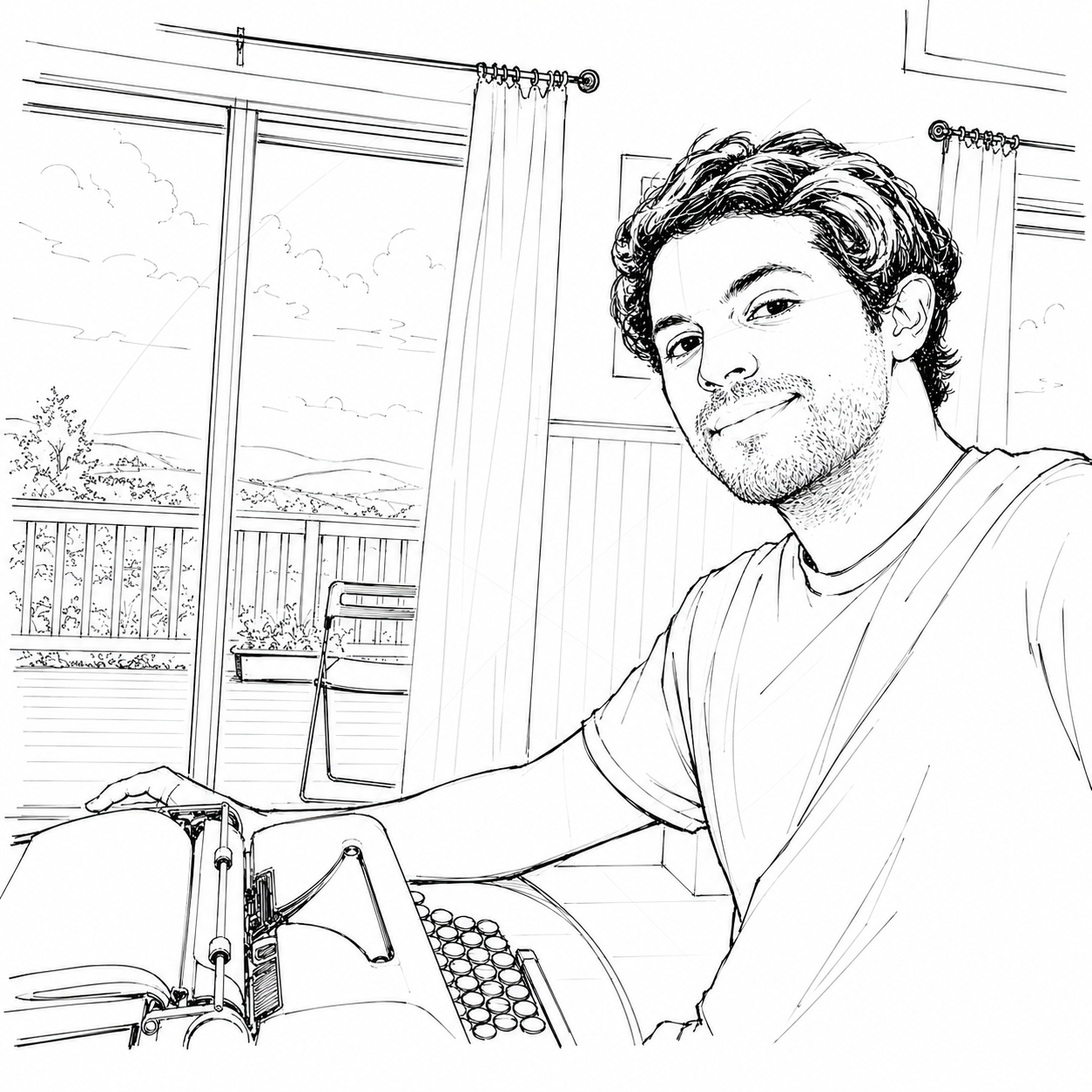
Out in the cold air of the street, we confided in each other on how strange the experience was. We oscillated through various paranoias, wondering if she was a witch, if we had been given some voodoo, or if she had drugged my wife. We threw out her business card. But then I checked my phone and read the most mysterious text from my dad, sent around the minute we left the bar—"Your uncle was going through his attic and found this old typewriter. Do you want it?" It included a picture of the scariest looking typewriter I'd ever seen: black paint, it's prongs floating above the keys, looking like two pointed horns, and of course, beady little yellow eyes—it fit the exact description of the demon in the doorbell. The brand was Underwood, but I misread it as Underworld, as if it were a typewriter from hell. My body was pulsating with chills.

Over the next week I'd ruminate on if I should except this potentially haunted object in my home. I consulted my writer friends. One noted that Oxford is associated with black magic, and another said I should consult a shaman, or someone versed in these matters. Another said I should take it and use the occasion to write from my shadow. This calls forth the opening synchronicity—the log I wrote that morning: "evil thoughts from good men." Was this a sign to get that typewriter and write that novel on it? I will save my specific thoughts on the shadow for a future post...

Anyway, I called up Gramercy Typewriters and described them my Underwood, and how it was a "batwing"-style typewriter. They said those are rare and they don't know how to service them. Regardless, my indecision meant I never gave my uncle a definitive yes or no, and so he said he'd bring it to Thanksgiving. In the end, he forgot it, and I never heard about it again.
Notes from London

· 364 words
  • Nov 15, 9:19 AM—A blistering toe, three suitcases with their guts spilled out, and a hotel room with an Oscar Wilde aesthetic: royal blue door trims, floral print, a British landscape, and of course his portrait.
  • Nov 17, 1:34 PM—The first bell I heard at the one-hour mark was a dud, but 1:34 PM was a holy minute. I found myself at the right corner, at the time the sun carved a hole and illuminated the gold trim of the clock tower. There was a bagpipe player, who I could hear but not see, droning a deep note and riffing in some mysterious Celtic scale I couldn’t quite identify. It was crowded, but even a passing ambulance couldn’t and didn’t break the trance.
  • Nov 17th, 11:31 AM—Our tour guide could easily make it on Twitter. “Those lions aren’t lions,” and “You’ve been lied to, that Buckingham Palace is not Buckingham Palace, I’ll explain why” (and then walks away, towards it—what we know it as is actually the 3rd extension, and no one lives there). “Here’s Big Ben, but that’s not its name.” Also, “we’re going to meet some spies, I’ve arranged it.” Hook after hook.
  • Nov 18th, 7:07 PM—The holy grail of prose is the transfiguration of narration and analysis. It's not in the description of the foggy window, nor in the details of London's climate in November, but in using one for the means of the other.
  • Nov 18th, 7:15 PM—Why does Shoreditch remind me of Manhasset? The rain blurs everything—the sidewalk has yellow jagged reflections of neon advertisements —and in passing I hear “it’s pissin’ out.”
  • Nov 19th, 3:20 PM—Eleven strangers in an elevator. You know not the language they speak, or the clarity of their mind, or their proximity from death in recent months—but we all know how to occupy the silence of a 30-second ride down to slab where we will immediately disperse and forget each other.
  • Nov 21st, 2:21 PM—Cognitive liberty is the ultimate right, and it’s one you have to claim for yourself.

Prose Is Not Teaching

· 59 words

Great writers aren't necessarily great educators. If you're trying to actually transfer knowledge that a stranger across space and time can realistically implement, you might need a level of explicitness that would curl and destroy a memoiristic essay. Both McPhee and Gornick feel as if they care more about their own prose than their readers ability to write prose.

Types of Literary Intelligence

· 28 words

Writing isn't just thinking. Writing invokes conceptual intelligence, compositional intelligence, and linguistic intelligence. Also, of course, emotional intelligence and self awareness. And recursive intelligence. And a bullshit detector.

Airport notes

· 162 words
  • The circus spires of Manhattan, bedrock splinters, antenna azimuths, surrogate steel, offshore investments, east of east in the west, home.
  • An exercise for airport queues: look at each face and imagine their unbelievable potential through a specific caricature (a princess, an astronaut). Next time you see them around the bend, imagine the opposite—their worst self (a killer, a leech). Then, imagine the realistic middle scenario.
  • What do you call two people who share a half-sibling but are not related?
  • Only converge into expansive containers. If you're going to put yourself in a box, ensure it has trap doors and mirrors on all sides.
  • You can never know if the present moment will survive the great filter of human memory but you can be fairly sure it won’t.
  • I remember logging about a (crypto?) ad near gate B24 a few years back. The act of turning a basic perception into a sentence records it to memory.

Sacrifice

· 66 words

How much do you believe in yourself? Are you willing to cut all shows and movies and social media? Are you willing to spend long stretches of time alone with hard problems? Are you willing to sacrifice hobbies you love? Are you willing to sacrifice exercise, leisure, experience? Are you willing to sacrifice what you think you are to see what it is you really are?

Betrayal of impressions

· 54 words

How might you write in a style that might betray everyone’s impression of you? What could you write that might get you fired or cancelled? To be mythological, what would get you crucifies? Obviously, these questions are extreme, but they nudge scared writers in the right direction, out of their shell of extreme self-consciousness.

Astronaut.io

· 28 words

Astronaut.io shows a feed of random YouTube videos uploaded in the last week that have basically 0 views. It’s a collage of everyday life.

The Internet's Best Comment Section

· 310 words

Texts to a friend on how to solve the political information crisis:

  • I think there could be value in using AI to create: “the Internet's best comment section.”
  • So often, whether its Reddit or ZeroHedge or Twitter, I skip the content and just look at reactions, but the biggest friction is redundancy—if you click into a Twitter trending tag; you’ll see 50 posts in a row that all parrot the same headline, but with different wordings. You need to schlep through slop to find a signal. You also get echo chambers, and bot storms.
  • So consider the story of “NYC protests about immigration or deportation”—one thing happens, and there’s a shockwave through old and new media. Imagine processing every article and every comment for that event… I really just want to see a headline of what happens, and then 10 radically different comments to expand my range of interpretation.
  • I don’t think it needs to be “left/right/center” it should look for distinct takes—it means every chosen comment is a unique or novel way to process the given facts. It's not "bias-free." I don't want to eliminate bias, I want to categorize and consider all possible bias.

Prompt: “You are an expert at synthesizing complex comment sections for political news articles. You will read the hundreds of comments below, and then create a list of the distinct interpretations of the event. There is no given number of points you should end up with, but no two points should be remotely similar. It's your job to cluster. To structure your points, please start with a concise, punchy, witty one sentence summary, and then use 2-3 sentences to unpack, and quote directly so we get a sense of the source. The quote or comments can vary in length (from 20-100 words each). Comments below:

Bagel Store Training

· 63 words

While picking up breakfast, I had a thought about the young tattooed guy working there—that working at an extremely hectic bagel place 7 days a week will stretch your memory in a significant enough way that you could get a job with 3x the income. But how much of a job is memory alone? Which jobs rely on a strong working memory?

AGI Baby

· 40 words

It feels symbolic that Sam Altman is having his first around the same time an AGI is being born. There is definitely a fiction idea in an AI engineer translating insights from his developing child onto the AI he's building.

Hive Crowd

· 33 words

Imagine an app that lets fans of a baseball stadium coordinate to create highly specific cheers and taunts that could throw off the away team. What if it worked? Would it be banned?

Agenda 47 Notes

· 128 words

Why was agenda 47 pushed on X? It seems like old videos (1-2 years old) are being presented as breaking. Hundreds of people are restacking. I saw one community note indicating that this was old (and it then appeared to disappear).

Some points on what it includes:

  1. Ability to remove rogue bureaucracy
  2. Clean out corrupt actors in national security & intelligence
  3. Reform FISA courts
  4. Expose the hoaxes and abuses of power
  5. Stop collusion between government and media
  6. Independent Inspector General
  7. Independent auditing of intelligence, no spying on citizens or disinformation against American people
  8. Move bureaucracies out of Washington
  9. Ban bureaucrats from taking jobs from companies they regulate
  10. Push a constitutional amendment to oppose term limits on members of Congress

Next Generation

· 28 words

What do I want for the next generation? Value family. Cultivate your virtues. Take risks. Find your own religion. Make things. Be involved with civics. Be open minded.

Media Paradigm Risks

· 73 words

There's a cartoon argument that a network news station is controlled by donors and spews propaganda to brainwash the public; alternatively, the information you found online is free, bottom-up, more democratic, slant-free—"free media." I think the opposite might be true. Social media is more dangerous and dehumanizing than mainstream media. It's easier to believe that the source is free of gatekeepers, because the source looks like you, not an professional news anchor.

Anatomy of a Democratic Media

· 93 words

People often reduce democratic media down to a single criteria—free speech—but it requires more than that. It's not just limiting censorship, but eliminating self-censorship. It's about enabling the citizen, the fundamental unit of the country. Can they speak? Can they control what they see? Are they pressured to towards saying certain things?

Some principles:

  • Participation: does everyone post, or is it still a reality show?
  • Explicitness of Feed: do you have control/legibility over what you’re being fed?
  • Commodity-proof: are you incentivized to converge into a 1D brand?

New American Golden Age?

· 91 words

The post-election Twitter memes are predicting a “New American Golden Age.” These videos are a rejection of woke DEI liberals, and they’ve over-corrected to become indulgent in materialism, violence, and sex. These videos show yoga pants, hot girls, tongues, weapons, cars, Greek villas, 9/11, tennis sluts, Rome, tanks, Sears, motorcycles, NYC, and dogs. It’s a sad breed of Americana that seems edited by a 16 year old. Comments include, “I felt my testosterone go up 20 pts,” “All I want is a blonde trad wife for christmas,” and “White Boy century.”

Republic Contradictions

· 128 words

As someone who doesn’t identify with either party and has voted for both, I’ll have to reflect more on this [an essay of a friend].

There are definitely some exceptions that break a simple dichotomy. For example, a republic of different states can promote more diversity compared to a single globalized entity (it's ironic that Republicans are culturally against diversity, but structurally for it). And if you actually look at what a republic is, I’d say that offloading responsibility via election goes against the republican idea of autonomy.

There’s another interesting thread here on the nature of selfishness. Either end of the spectrum is wicked: I think it devolves into “altruistic” mobs or hubristic self-destruction. Maybe solving this paradox is key: selfish interests that benefit the larger organism.

Good Metrics

· 151 words

I think we all tend to hate metrics in general because so many metrics are being forced on us. Social media is particularly guilty of this. What is otherwise a non-quantitative activity (socializing) now has stats and graphs, winners and losers.

Metrics can be particularly valuable, though. If you set your own metric(s) that matter to measure, it can serve as bedrock; a stability among a constantly evolving mind. Out of the infinite things any person can measure, I think it’s about determining what’s actually worth keeping in mind.

Do I need to score every day 1-5? Probably not. The problem is when we’re over-conscious of too many metrics without them influencing us positively.

There's value in trusting intuition in addition to metrics, but you don't have to pick one or the other. I agree that most metrics should be cut, but I also think it’s worth finding a few metrics that are worth treating religiously. What might those be?

Coup Scenarios

· 72 words

The norm is for power struggles to happen in private. While each party is positioning itself to the working class, this really might just be a coup–some private elite overthrowing the established public elites. Some scenarios:

  1. It's thwarted;
  2. They integrate;
  3. A struggle—they both die;
  4. Coup (no change);
  5. Coup (far worse);
  6. Coup (better off);
  7. Coup (the battle kills both, makes room for new);
  8. Power vacuum (the emergent order is worse);
  9. New party (exposes both, well-oriented, popular but limited power);
  10. Constitutional reboot (system-level change).

A Number Snake Through Prose

· 127 words

When restructuring a draft I often pepper numbers, out of order, throughout the piece. It might seem random at first, but if you read through it chronologically, it points to a potential new structure of the essay. Each number represents a distinct idea that could be its own paragraph.

The numbers flow in order (1A>1E, 2, etc.); when you see letters mixed in, it means that multiple scattered parts could actually be unified into the same paragraph. And if two areas have the same mark (4B), it means they cover the same idea, and can be compressed or consolidated.

This system allows us to talk with more precision around structure and sequence (especially within a linear document editor). It's an alternate path through the same material.

MET notes

· 115 words
  • The Rembrandt painting of Aristotle (in medieval garb) touching a clay bust of Homer is a good example of an anachronism.
  • Mandalas are not just pretty symmetrical drawings, they are ritualistic diagrams for Buddhist to model reality.
  • Buddhist deities often appear to seem simultaneously silly and demonic. This seems similar to the psychedelic tactic of how to deal with the shadow. If something terrifying comes about, don’t cower in fear and ignore, but address it, turn it into a cartoon, and it tends to vanish.
  • Why is Jimmy Eat World playing in the gift shop of the MET? This is a weird vibe to cultivate after the ancient Asian art exhibit.

Exposers are offenders too

· 90 words

In 2016, Trump brought the word “deep state” to public consciousness. Conspiracy theorists used to be an Internet fringe group. Now it’s partisan. The killing of Epstein in 2019 brought a new level of lucidity; that half of the insane things Alex Jones rants about might be true. Now in 2024, the assassination attempt of Trump is drawing parallels to the JFK assassination. I think Trump’s will to power came from exposing the corruption of rival power—that doesn't mean he’s not equally implicated. Is there any precedent of this?

Archive