michael-dean-k/

On Monday 6/15, I'm hosting a workshop to kick off a reading group for classic essays: RSVP here.

michael-dean-k/
Michael Dean
michael-dean-k/

Architect-turned-writer, founder of Essay Architecture. Building pattern languages, software, anthologies, and community for essayists.

Essay Club ↗
Recent Essays
#essay-architecture21 pieces
Michael Dean
michael-dean-k/

Architect-turned-writer, founder of Essay Architecture. Building pattern languages, software, anthologies, and community for essayists.

Essay Club ↗
Michael Dean
Michael Dean

Architect-turned-writer, founder of Essay Architecture. Building pattern languages, software, anthologies, and community for essayists.

Michael Dean
Michael Dean

Architect-turned-writer, founder of Essay Architecture. Building pattern languages, software, anthologies, and community for essayists.

Essay Club ↗
Michael Dean
Michael Dean

Architect-turned-writer, founder of Essay Architecture. Building pattern languages, software, anthologies, and community for essayists.

Essay Club summer syllabus

· 233 words

Join Essay Club and meet with us on Mondays at 7pm ET to read and talk about these classics:

The vitality of a vital person vitalizes

On finding and prioritizing The One Thing

· 1,306 words

It’s amazing how many tricks the mind can play to prevent you from picking and prioritizing The One Thing. I can declare I’ll do one thing per area, which is pretending to focus when I’m 9x overbooked. I can say “one hard thing per day,” but if each burst moves in random directions, then the average of those vectors may leave me where I started. I can write, print out, then pin it up and pray to a single 3-year goal each morning, but if every task can loosely ladder up to it (through some round about way, because everything relates to everything), then there’s no hard decision being made.

A few months ago I wrote that my one goal was to hit an ARR target through “mission-driven creative work” by 2028 (via Essay Architecture). If something didn’t directly support that, I’d have to cut it. If you achieve your One Thing, theoretically, then most of your other problems are solved: my wife could stop working to spend more time with our daughter, I’d have more space to work on creative projects, we’d be closer towards getting a house, etc. This makes it easy to say no to personal projects that are obviously unrelated (ie: record an album, read the dictionary, hike 40 mountains), but even within what seems like the limited scope of “a writing business,” it is tricky to define the arrow from which everything else follows.

I am in many ways over-extended. On the business side, I have a curriculum, editing software, an anthology, and a community of practice. Then there’s of course my own essay practice. I’m able to juggle these five things, but each is held back from the sprawl. I focused on The Best Internet Essays from November 25 - March 26, and in that time I couldn’t iterate on the software, I couldn’t grow Essay Club, and most of my writing revolved around the prize & anthology. And, importantly, the decision to juggle meant that the core thing (the anthology) was probably executed at only 50% capacity.

So why am I resisting prioritization? I see as Essay Architecture as a “micro-institute,” a range of inter-connected pillars that work together towards a civic and personally-aligned mission. Software without a curriculum feels unanchored in learning science. Software without the literary prize angle could easily turn mercenary. Software without community loses the personal touch. If I’m not writing myself, how could I even know what the software needs to be? If I really wanted to double-down on the software, I’d raise money and build a team, and the incentives would require me to make software for knowledge workers, which would turn it into an auto-complete tool, my anti-mission.

I have been part of and observed companies where the personal writing practice of the founder was slowly neglected until total abandonment when empire building hit a certain velocity. This warning feels etched into me. The core reason I started Essay Architecture in the first place was to create something that was aligned with my own essay practice. I’d much rather be writing essays for 50 years with a modestly growing company than build an extremely successful and impactful company that doesn’t let me write until I retire in 50 years.

If everything should be in service of my own essays, shouldn’t that be my One Thing?

The reason I haven’t given myself permission to do this is because true, self-driven essay writing is hard to monetize. So it comes down to financial anxiety. But I don’t think I’ve honestly doubted my premise: is financial growth actually necesasry for me right now? Between the ARR I already have, a new part-time consulting gig I just started, and my wife’s income, we’re actually not far from my goal. It also turns out that my wife now enjoys her job after maternity leave (because she’s working part-time, not overtime), so even if my business took off, she might still want to work.

This feels selfish for at least two reasons: selfish because I’m not taking the path to best support my family, and selfish by putting my own needs over what paying customers of the Essay Architecture system might want. However, if you are focused on the Right thing, and are properly prioritizing and focusing, then you become a gravity well and matter bends in your favor. Paradoxically, but obviously, you can only build something useful for others (and, thus a company), if you are selfishly operating in your zone of genius. For me, that is not marketing, but essay writing itself. When I dial into and optimize for attention, growth, and revenue, it strips me of my vitality, and it doesn’t seem to work; might I get objectively better metrics if I were locked in and oblivious to the stats?

Craig Mod is a good example here. He’s a writer/photographer known for 300-mile walks through Japan, and runs a successful membership program that’s in serve of his personal work. A few lines from his rules stand out: “you are building a community,” but not managing it, instead “you must have faith that the work itself is strong enough to be a binding agent,” and “if the work isn’t strong enough, work more on the work.” This inverts how a traditional business-builder, or even solopreneur might think. It is you, the artist, at the middle; you are obsessed with your craft, but opening different pathways so others can work alongside you. There’s a way in which every part of my micro-institute benefits from doubling down on my own essay practice. If I write inside my own software, the software will naturally evolve. If I’m trying to become a master, then the curriculum is just the trail of what I’m already learning. If I’m publishing each month, then Essay Club is the tribe I do it with.

A friend and fellow acolyte of The One Thing, Matt Svarcs-Richardson, recently shared a paraphrased line from Joseph Campbell that resonates: “the vitality of a vital person vitalizes.” 1 You will not inspire anyone into action unless you are operating at the edge of your flow, a flow that is very distinct to you, a secret flow you can get lost in for 10 hours where others don’t even know how to enter. This doesn’t mean to burrow into longform essays and ignore Essay Architecture. This means that my own writing is the spearhead from which the institute follows (even Emerson said that an institute is the shadow of one man). The software, the curriculum, the club, and the anthology are not separate businesses to grow and optimize for, but critical components of my One Thing, my essay practice.

This inverts the typical time-scale. Usually you focus on growing a business and then decades later, assuming it works, and assuming you still have the fire, you can begin working on the thing you’d work on if resources were no issue. Instead I want to start with the fire, and use that to slowly build an institute over decades.

Footnotes

  1. The original quote is "the influence of a vital person vitalizes." Here is more context, sent from Matt:

    "Bill Moyers: “unlike the classical heroes, we’re not going on a journey to save the world but rather to save ourselves.”

    Joseph Campbell: “And in doing that you save the world. You do. The influence of a vital person vitalizes. There’s no doubt about it. The world is a wasteland. People have the notion of saving the world by shifting it around and changing the rules and so forth…No, any world is a living world if it’s alive. And the thing is to bring it to life. And the way to bring it to life is to find in your own case where your life is and be alive yourself."

Winners of the $10k essay prize

Congrats to Tommy Dixon and the 10 finalists in our new print anthology, The Best Internet Essays 2025

· 676 words

A friend texted me this weekend— “I am too addicted to Claude code and need to touch grass. You said I should read an essay book can you recommend one that I can order physical” —not knowing I was about to launch The Best Internet Essays 2025 . This little book, a 4.25” paperback that fits in my…

read essay ↗

Theme Visualizer

· 140 words

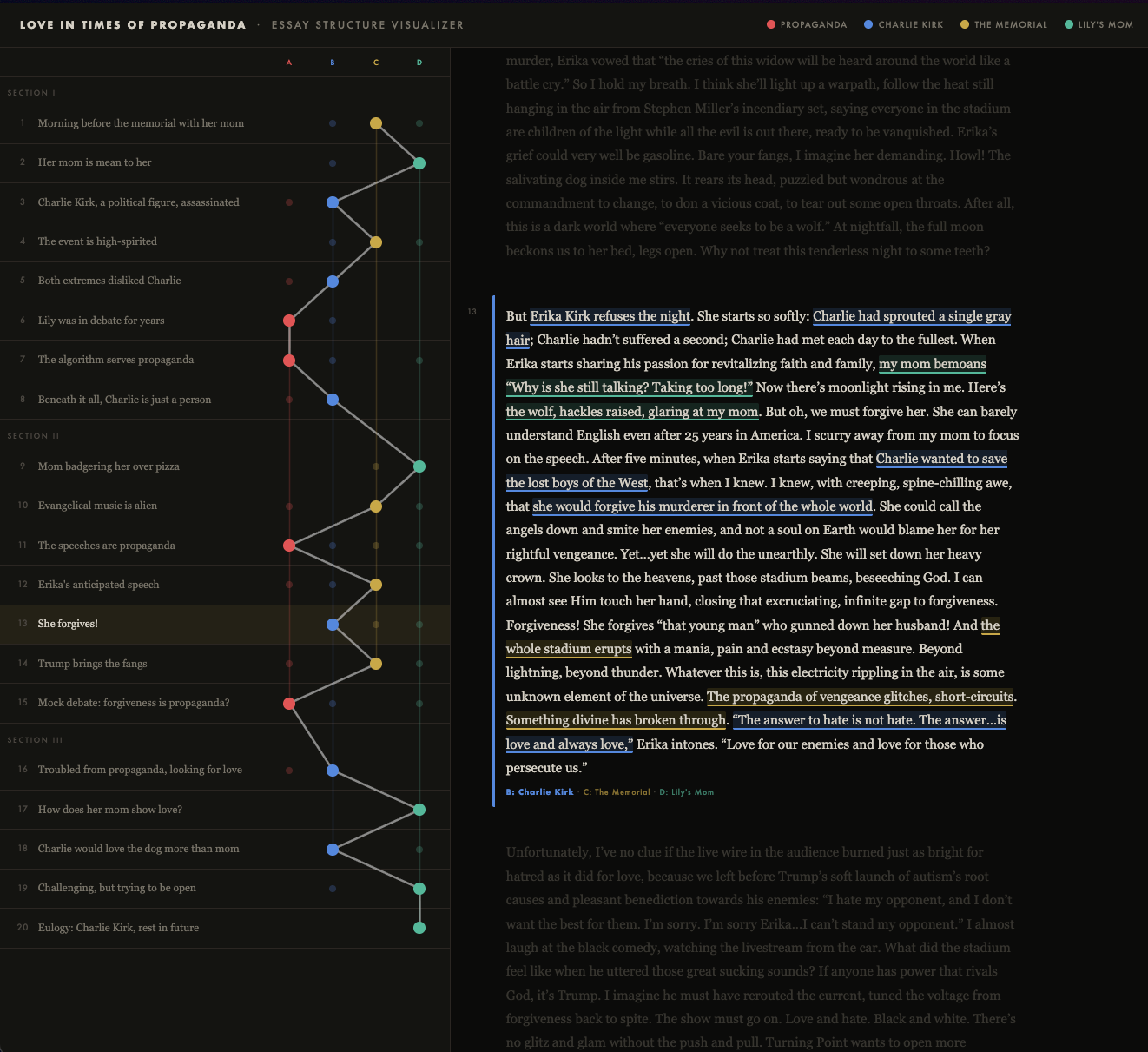
Just prototyped an essay theme visualizer. This one is for braided essays, so you can see how the main focus shifts around, yet still references other threads to keep the whole thing cohesive. Then you can click into any paragraph and see how those themes weave in at the sentence/word level. I’ve done stuff like this with static images, but it’s a different thing to read an essay with animated overlays and full context. Now realizing that I could go through classic essays and make unique interfaces for each, to focus on different patterns. And then maybe, those same interfaces could help you see things in your own work? I have a lot of experimenting to do; feels like I need to enter a divergence phase, and then see what I can bring back into the Essay Architecture core app.

→ source

On Paul Graham's "The Best Essay" (2024)

· 655 words

This essay tapped into a striking definition of timelessness. He doesn’t get there until halfway through though, and I found myself disagreeing with—or at least, questioning—a lot of his earlier points (I’ll come back to this). The main point is distilled into this: the best essays are “ineffective” because they reveal the timeless problems that each generation fails to synthesize. Timeless essays speak to the common foils in the human operating system: the blindspots of parents, the lies of institutions, the avoidance of mortality, the ineffability of relationships, the mundanities that are never captured in enough detail. These are different than “discovery” essays, like Darwin’s Origin of Species. The holy grail of an essay is surprise, and a timeless essay is not just sueprising for one generation, it’s surprising for every generation. And so timelessness, then, is a type of “breadth of applicability.”

PG also ventures into a familiar territory of “essay as a mode of thinking.” Where as in the past he used “the river” as his metaphor (2004), this time it’s a tree. You start from an origin, and then you explore many different branches in search of generality x novelty. What is a good starting question? He says a good one is “outrageous, counterintuitive, overambitious, and heterodox.” It doesn’t have to be a complete thesis, but some puzzling gap, and importantly something you care about. You won’t be able to stretch an origin question into cascading insight unless you have a unique angle into it. The origin doesn’t matter too much though, because it’s a recursive process, and you can eventually get to the best question in “a few hops.” I love how he emphasizes that you need to write to explore branches of a tree, and there are many dead ends; you realize how you are mistaken, incomplete, and inelegant (you go from vague to bad). Don’t get discouraged by these; finding your false assumptions is possibly the only way to really begin.

Despite loving his whole exploration of “mode,” I don’t think that means you have to neglect essay as “genre”; he says form/style don’t matter in “the best essay,” and I disagree, obviously. He has Darwin as the pinnacle example of an essay, and I’m really challenged by that (I definitely have to read it now). Is that an essay or a scientific paper, just captured in shortform non-fiction? He seems to imply that the essay is at its best a vehicle for discovery, as a mechanism to bring forth surprising, important, and useful ideas. From the creator of “make things people want,” this isn’t surprising. Even though a new theory of evolution had broad implications for society, I assume the paper itself is technical, intended for a scientific niche audience, which in my mind, makes it more like a scientific paper than an essay. An essay is something that is universal/general enough for the average person to read. An essay, I think, functions like an information transfer system between specialized facets of society; it’s about making your specific niche legible to all the other niches, and I don’t think that was the specific goal of Darwin's writing (even though it was inevitably understood by everyone, it wasn’t through the writing, but from the effects of the writing).

(Added: Another note on Graham’s notion of best as timelessness: he says that timeless esasys are the perennial insights that each generation can’t absob. This implies that the insight is never enough: even if you know something, there is often a lack of wisdom in applying it to your own circumstance. And so really, these unteachable lessons are ones that can only be obtained through personal experience. Does this point to the fact that all essays need to be personal? Maybe bland insights can’t be digested by a reader, but if they are integrated to vivid personal experience, experience vicariously, then might this actually be the best medium to transfer wisdom?)

A Manifesto for Institutes

· 1,612 words

This is a memo I wrote after a talk with Will at the diner, about startups vs. institutes, in the general vibe of Emerson (grandiosity, certainty, metaphorical lushness):

I want to understand the different range of “social organizations,” and so I’ll use the domain of writing to paint the differences between types.

The “institution” of writing is the centuries-old, intergenerational norms, traditions, and constraints that are inherent to practice, medium, and distribution. One does not simply “start” an institution; it is an abstract, ancient entity; an “institute,” on the other hand, is a concrete group with a specific purpose, aiming to steer or reform the behemothic institution. We are in a ruthless river of progress, and the cost of civilizational acceleration is the endless erosion of institutions, and so it’s the near-holy responsibility of each generation to build institutes that inject vitality into their dying fathers.

An institute is born from a “dream” in one man’s head, but they’re not on a “mission” until they step out of the stream of circumstance and act. An “institute” is not a planted flag from the fumes of excitement—I refer to a friend who, on an acid trip, claimed to have founded The United States of Brooklyn, right then and there—, but the ripcurrents created by decades of stubborn action. It is not a name nor brand, but the systematization of one man’s unreasonableness.

It all starts with a “project,” a spasm of effort, a groping forward to find leverage towards their purpose. The visionary will find projects drooling out of their mouth like the blood of life; many will fail, some will hurt, but once a cluster of projects start spiraling around a central spine, you have an “embryonic institute.” I use the word embryonic because institute mortality rates are high. It is far easier to start projects than to nurture them past infancy. The hallmark of an institute is stability through time. 5.4 years, I’d guess (+2,000 days, spanning 3 molts).

In the case of Essay Architecture, I am stretched across (6) verticals: a curriculum (the 24,000 word textbook), a school (the AI app), a library (the 100 essay archive), a club of shared practice (Essay Club), an economy (the $10k prize), and media (the anthology). In a single year I’ve planted these seeds, and you can see the buds poking through the soil. There is something happening, you can see, but it will not be a force of authority in the eyes of me or the world unless it all survives and feeds society through several winters.

An institute, then, in its dizzying scope, contains interconnected “objects”: (a) knowledge, (b) services, (c) events, (d) activities, (e) opportunities, (f) people, etc. It is a fractal version of society; it contains all its parts, but all dedicated towards a single thrust of mission. This is hard to maintain! So in comes the money.

The question is, how does the structure of the institute not get corrupted by the cannibalizing incentives of capitalism? How can you sustain the mission without it becoming a cog of the market, the mission reduced to a dress?

Unless an institute has an endowment, it needs a for-profit wing. A “startup” is about discovering new market opportunities, while a “company” is about operationalizing, scaling, and extracting from a known opportunity. Startups, companies, and institutes can all have “missions,” but only the institute is “mission-driven.” An institute will take money, but never compromises. If you cow to the market, a drip turns to a torrent, and the mission will be gutted, twisted, used as a narrative mask to help you lie to the world and yourself. It is a common and tempting line of logic to say, “once I make all the money, then I’ll do good.” Meta thinks that once it conquers the entire economy, it can finally focus on doing the good work of helping people “connect.”

The year one actions cannot be only tangentially tied to the mission; they need to be the mission itself. Building an enterprise-grade API for Grammarly and Brown will make me rich but tired; having spent my years spawning my anti-mission, the death of the essay, I would move on to some other project, maybe music.

When I look at all the writing technology startups, you can see how, in their first years, they’ve completely oriented towards business writing, towards the automating of prose, towards things that betray the ancient institute of writing. They either don’t get it or don’t care or just really need the money, but writers see their slogans of “helping writers write” as marketing drivel.

The insanity of a true institute is the stubbornness to put the mission before everything: before markets, before investors, before people, before ego, before legibility, before reason. This sacks your own speed, and is only fueled by heroic effort and the faith that, with time, it will find a real, timeless form.

The fruit of this insanity is trust: the various guilds of people that orbit an institute can sniff beyond the rhetoric and see what’s really driving its actions. If there is no track record of humility, or of “doing things that don’t scale,” or of “doing things without revenue potential,” or of “directing resources towards weird ideas because they advance the purpose,” then trust is lost, and all the mission-driven rhetoric is seen as the wolfish guile of someone who can no longer notice their own animotronic limbs and memes.

I believe the will, hope, and talent of an institute’s founder are the pre-requisite to birth a society-scale entity, but once you operate at abstract scales, architecture matters, extremely. Has Christ not been bastardized? Did the American experiment not get wrecked by the hyper-capitalistic invention of trains? Our very best religions and governments did not have the foresight or civic inventions to prevent them from getting sacked by barbarians and wolves. What I’m getting at is that we need some sort of 21st century constitution for institutes, an immune system to enable the virtue-driven founder to build something that has a chance to make it in an exponential landscape of virtueless technocapitalism.

I imagine it should look more like a loose collection of protocols than a single canon. For what it should contain, I can’t sketch right now, but I think it has something to do with mediating power, money, status, people, etc. My intuition is that the playbook is possibly the opposite of a startup.

The institute is the inversion of the startup. Where startups are designed to accrue all of the upside, an institute is sacrificial: it should be designed so that society gets the upside, even at its own peril. Really, it’s quite Christian. Of course, this shouldn’t prevent the founder of the institute from getting wealthy, but if the primary goal is personal wealth, then it’s not, definitionally, “mission-driven.” Instead of saying, “I need a $10 million valuation so I can open up $250,000 in grants for writers,” I want to say, “through paying writers $10 million, I will somehow make $500,000 a year for myself.” The idea is to become potentially wealthy through spearheading a radical mission, one that is worth it for itself—an adventure of a lifetime—, and one that is also, a magnet for capital.

This maybe gives some context to my goal for the next 1,000 days: “become financially independent through a mission-driven company and non-convergent artistic practice.”

To close with some specific examples, here are “acts of institute” (for Essay Architecture) that a startup would never make:

  • No demographic optimization: The curriculum is not tailored for the biggest demographic (beginners). It starts at the edge of my knowledge (301), and then radiates in each direction (towards 501 and 101). Eventually, it will touch all demographics, so I need to start where my energy is, and never stop.
  • Virtue-driven development: Even though people want the AI to write for them, and they want to use this for fiction and books and business memos, this is squarely an app to advance the genre of the essay, and it will never write for you. Even though more and more people will automate as AI gets better, this will be the go-to app for anyone who wants to engage with the process.
  • Community voting: Any big decisions about the format of Essay Club are presented to the community as votes, which treats them like shareholders instead of customers. Of course, the founder won’t present options that contradict the mission, but instead of assuming which specific form is best, or choosing the one that is best for me, the community will sustain if it is co-shaped by them.
  • Checks and balances: To promote the Essay Architecture tool most directly, I would have made the app the sole determinant of the prize winner, but instead 2/3 of the vote is determined by external judges. In some areas, my own perspective and taste is required, but it’s important to know when I need to systematically remove my own ego and preferences. An institute is not about scaling my taste, but in creating scalable systems that help achieve an ideal that I couldn’t reach on my own.
  • Paying the public: At the start of 2026 (Q1), I want to crowdfund $100,000 for the next essay prize. I think this creates even more buzz and intrigue in the institute. It’s not at all what I would do if I were a startup: I’d be fundraising to build a team and scale the app. The goal is to create an ambitious cultural magnet that gets writers paid, while simultaneously catching the tailwinds so that I can get paid for my tool and curriculum.

The Crucible of an Audience

· 270 words

Once I have my anthology scored, I can compare it with Best American Essays (2024/2025), at least in terms of “composition quality.” I definitely think it’s possible (we only have to get higher than a 3.7). 

The mystery to me is, how is this possible? How is it possible that a bunch of self-taught writers can put together better essays than people with English degrees, MFAs, and status badges from being featured in notable magazines?

I have a guess: the independent writers who operate in the free market of readers has more incentive to improve. They publish, get instant feedback, and publish again, either a week or month later. They have total autonomy to evolve their topics, their forms, their voice. They need to put in the work to make something great (it’s not enough to get a commission, and to make it good enough to live in the magazines). What the independent writer has is more feedback, more speed, more freedom, more stakes. 

Compare this to the writers who swarm the literary institutions: they often get no feedback, publish maybe only a few times per year, have to conform to the house style, and the magazines carries all the stakes. There is a staleness that comes from being disconneted from your readers.

So even if literary writers have something like a 5 -year head start, self-taught online writers have a higher slope, and can far surpass the average MFA graduate in terms of ability. (And this is without any kind of formal independent writing education! This is a good reminder/anecdote for me to remember in terms of my curriculum/textbook/app).

Long-game activism

· 165 words

Instead of spending 5 hours per day mad at trending social justice issues (20,000 hours per decade), I want to focus on building an institution for the essay. It’s a sort of illegible, seemingly irrelevant, idiosyncratic thing to do. But if it works, and if it somehow has any affect on how writing is taught in schools, and that improves the critical thinking of a generation, it will have way more influence than if I spent all that time protesting and howling for nothing. This just taps into a core belief of mine that the only way you can possibly help anyone outside of you and your immediate circle is to pick something dear to you and approach it with unreasonable fervor. If someone were to criticize me for ignoring a genocide, I’d say that all you can do is intensely dedicate your life to a single vector for multiple decades in the hope that you can tilt the scale away from next generation’s genocides.

Essayist First

· 78 words

The value of playing an infinite game is that when you follow your passion, you move according to a compass that is cryptic to the outside world. You will make decisions that won’t be rationalized/justified by VCs. For example, I still want to be an “essayist” more than a “founder,” and that might confuse business-minded folk I engage with. But if I’m an essayist my whole life, then I’ll be constantly improving and sharing my own composition tech-stack.

The Death of Technique

· 336 words

I want to write an essay about how—starting In the 1990s—creativity advice was re-targeted for the mass public, and in the process, it got watered down.

There are three general modes that have become mantras for beginners:

  1. Art is therapy.” This is found in Julia Cameron’s morning pages and in Stephen Pressfield’s The Resistance. It frames art as self-help, as a kind of therapy. You can’t create because you’re blocked, and once you create, you unblock. This frames the idea that art isn’t about mastery and the struggle and will to attain it, but in feeling good about yourself.

  2. Taste is all you need.” Rick Rubin is associated with this new philosophy that technique doesn’t matter; you just need strong opinions. This is a worldview that is easy to adopt, because everyone likes to believe they have good taste without having to work for it. Now with AI, doing the work won’t matter as much as having the vision for what needs to be done. There’s a weird and unfortunate ethos that craftsmanship is redundant, and all you need to know is good from bad.

  3. Just show up and it gets easier.” I think of Austin Kleon’s Show Your Work—a book that first introduced me to the idea of self-publishing online—which encourages you to just share your process. Keep showing up. It’s a philosophy that’s unique to the digital age where anyone can publish, and is probably the origin of David Perell’s Write of Passage too. It is the operating mode of newsletter writers. It helps get started. Paired with this idea is The Taste Gap by Ira Glass, that says the more you work, the closer you get to your heroes (I believe the opposite: the better you get, the better you realize your heroes actually are).

There is truth in all of these, but they are half-truths where their opposites are just as important. If you ignore the forgotten halves (analytical study, craftsmanship, embracing challenge), it might actually hold you back and frustrate you.

Confrontational Software

· 113 words

Essay Architecture should expand your conception of what an essay can be.

As long as it’s profitable enough to sustain itself, I have the opportunity think differently on the product management front. I can subtly defy “the customer is always right” rule. Each writer has their own goals around writing. Maybe they only want to write personal essays, or academic essays, or memos, or whatever. Part of my vision could be for this app to gradually open your mind to what an essay can be.

The scoring system can and should be confrontational. A flaw of GPT-4o is that it’s sycophantic; it’s so attuned to you that it’s a mirror, reflecting back your strengths but also concealing your blindspots. If I do this right, an objective quality standard will reveal your blindspots instead of hide them.

The purpose of asking “what’s your goal?” on upload isn’t so that all the feedback warps to match your goal; it helps me challenge you (“I know you’re going for X, but why does that preclude you from also achieving Y?”).

Letters for machine training

· 100 words

Part of my process in building Essay Architecture is writing thousands of words for machines. Basically, it’ll run hundreds of prompts, rollup the results, and point me to areas where the AI scores most diverge from my own. I read them in detail, and as I notice errors in its thinking, I’ll just write paragraph of prose to explain why it’s oversimplifying or over-converging. I then feed these notes back into AI, discuss, and then have it refine its own prompts based on its new understanding (which I then review, edit, and clarify). I’m noticing that instead of writing the prompts to determine how it should think, it’s better than I describe all the nuances and then let it determine how to implement.

The Good, the True, and the Beautiful

· 149 words

I like how you frame it as "beauty" instead of just writing quality. Composition isn’t just a theoretical thing that craft nerds care about, it leads to beauty. I’ve been trying to map this into “the good, the true, and the beautiful.” I think Essay Architecture sits in the 3rd, but the other 2 still matter. It’s possible to write a beautiful essay that is also an evil lie. I should probably write something how you don’t want to obsess over beauty in a vacuum—you want to use composition to articulate something good (generally subjective) and true (generally objective).

Another note on this is that maybe things shift from subjective/objective as you scale in an out. It’s a subjective choice on which medium you pick (writing/music/code), but then each medium has objective constraints, but then you have subjective liberty in how you solve each constraint.

Podcast Jitters

· 158 words

The Jitters. How will this go? I think I’m imagining a storm of 100,000 haters. Or, at least, will the required process of editing and memeification invert what I believe?

Essay Architecture is all about complexity. In a way, it doesn’t require me to translate ideas or make them digestible and catchy; it’s about training machines with infinite patience to create a piece of software that is—to the user—simple and profoundly useful.

I guess this is a test to see how well the idea can be meme’d. Is this something you can enjoy listening to while you wash the dishes? It’s a hard constraint. A fun problem.

To tie this in with David’s tweet on how managers prompt people, an interview is something like a host promoting their guest to package their ideas according to the taste of the host. So in some ways this will be like my ideas through David’s vision for his channel.

Elephants and Lobsters

· 106 words

Note to David on podcast scope:

"Then we can bridge this into writing by comparing 'Consider the Lobster' & 'Shooting an Elephant' (a popular essay by Orwell). In many ways they’re opposite (saving vs. shooting an animal, digressions vs. plot, maximalist vs. minimalist), yet they both score 9/10. Each has a high-concept title (like “snakes on a plane”) which makes the context load light. I’m thinking the majority of X-ray examples can come from these two essays. And since “essay” is part of the framing for my project, it makes sense to deconstruct a DFW essay in high detail (probably the most famous essay since 2000)."

The meta-skills behind patterns

· 49 words

When you practice the patterns of essay writing, you don’t just become a better writer, but a better thinker. Rhythm enables you to compress ideas on command. Repetition helps you poetically elaborate. Rhyme helps you search a synonym space based on sound. Imagery enhances your associational and descriptive abilities.

Future Fossils

· 2,389 words

A simulated conversation with Ask Future Fossils, an AI trained on all of Michael Garfield's podcasts. I'll be on his show first, and thought it would be neat to see where our ideas interesect.

MD: Essay Architecture is a framework that organizes composition concepts into a series of escalating triads. The root triad (the organizing 3 dimensions) are Idea, Form, and Voice. From there, there are 3 elements in each, and 3 patterns in each of those. At every scale, the organizing principles is Aristotle’s ethos, logos, and pathos. This resolution of 27 is a series of core, fundamental questions (not answers), that any essay on any idea can synthesize. Within each pattern is a galaxy of solutions (none of which are any better than the next), but each solution can be evaluated along descriptive criteria of what makes that pattern “complete.” What do you think of this? What resonates? What are your objections?

AFF: The proposed Essay Architecture framework presents an intriguing approach to organizing compositional concepts, resonating with the integration of structured guidance and experiential wisdom discussed in Cory Allen’s work [1]. The triadic structure, rooted in Aristotelian rhetoric, offers a comprehensive yet flexible system for essay composition, potentially enhancing the effectiveness of scientific communication as explored by Leidy Klotz [2]. However, this framework’s emphasis on questions rather than answers aligns with the balance between personal philosophical beliefs and narrative structure examined in Evan Snyder’s approach to storytelling [3]. While the framework’s resolution into 27 core questions provides a robust foundation for essay development, it may risk oversimplifying the complex interplay of ideas, form, and voice in artistic expression, as highlighted in Greg Thomas and Stephanie Lepp’s exploration of jazz as a manifestation of social values [4]. The framework’s potential lies in its ability to guide writers through a structured yet open-ended process, but care must be taken to ensure it does not constrain the authentic expression of ideas or limit the integration of diverse perspectives.

MD: The 27-point system of Essay Architecture is indeed a form of hyper-reductionism, but I think it veers into enough complexity that it approaches being a (probably) wrong, yet still useful approximation of intuition. Yes, it isolates elements of craft and locates them in a hierarchy, but a key point is that each pattern is linked into a web of dependent patterns (ie: 9.1 Image is connected to 9.3 Motif, 2.1 Microcosm, 1.1 Experience, 3.0 Title, 6.3 Finale, 8.3 Rhyme, etc.). This whole framework is very inspired by Christopher Alexander’s Pattern Language. I agree that the act of essaying is an act of jazz, but there’s also a form of analytical practice that enables a jazz musician to spontaneously perform at the level that they do. The goal of my app is to analyze your writing and find your compositional blindspots. From there, it can give you exercises, examples, readings, and ideas to shore up patterns, which then reverberate across to other patterns. The goal of practicing the system is to eventually forget it. Best case, it enables artists to get into experimental grounds because they have such a firm understanding on the basics of writing legible, resonant prose. Any thoughts on this? (On the forced existence between Cartesian rationalism and unhinged expression).

AFF: The tension between structured analysis and intuitive expression in artistic practice is a recurring theme across disciplines. While the 27-point Essay Architecture system may appear reductionist, its interconnected patterns echo the complex improvisational structures found in jazz [1]. Just as jazz musicians rely on a foundation of technical proficiency to enable spontaneous creativity, writers can benefit from a systematic approach to hone their craft [2]. This aligns with the concept of ‘conscious participation with archetypal energies’ in personal growth, where understanding underlying patterns can lead to more profound self-expression [3]. The goal of internalizing such systems to the point of forgetting them resonates with the idea of ritual art practice as a tool for developing self-awareness and transcending habitual patterns [4]. Ultimately, this approach seeks to bridge the gap between analytical rigor and intuitive expression, potentially enabling writers to explore experimental territories with a solid grounding in fundamental principles.

MD: Can you tell me what you know about hyperobjets? I know you’ve talked to some smart people about this, and I fear I’m using the term without a complete understanding. My sense is that there is a hyper-object beneath the essay (each genre/medium has their own hyperobject on composition). The idea is that it’s too large an object to rationally hold in your head at once. Through constant exposure to it, seasoned writers/editors have an intuitive grasp of its different corners, even if they can’t explain it. Often though, there are gaps, corners of the object that go unexplored. Ultimately, the goal of a curriculum should be to have accurate maps of that domain’s hyperobject. Students learn one facet at a time, repeat it, study it, until it’s automatic. The rational mind can only really wrap itself around one corner at a time, but eventually they fuse with it and it lives in the muscles. It surprises me that we don’t have any maps—or even, a definition—of the essay. I’ve been reading some literary criticism on essays (from Iowa, Oxford), and they both imply that the essay is something that can’t be defined. I think it can, it’s just a hyperobject, and it’s wrapped in complexity and paradox… Thoughts on hyperobjects?

AFF: The concept of hyperobjects, while not explicitly discussed in the provided references, aligns with several ideas explored in philosophical discourse about complex systems and human understanding. Hyperobjects can be understood as phenomena too vast and multifaceted to be fully comprehended by the human mind at once, similar to the ‘inherent limitations of human explanation and understanding in the face of complex systems’ discussed by Ford and Martel [1]. This notion intersects with Mauss’s exploration of ‘the self-referential nature of consciousness and idea formation’ [2], suggesting that our understanding of hyperobjects, like essays or other complex concepts, is inherently limited by our cognitive constraints. The process of grasping hyperobjects through repeated exposure and intuitive understanding resonates with Davis’s idea of ‘literary transmission of spiritual-psychological states through text’ [3], implying that deep engagement with literature or other complex domains can lead to a more holistic, if not fully articulated, comprehension. This perspective offers a framework for understanding why defining certain concepts, like the essay, proves challenging, as they may indeed be hyperobjects that defy simple categorization or complete rational explication.

MD: What are your thoughts on AI and hyperobjects? Maybe you could say that an LLM itself is a generalized hyperobjects, but at the moment, I don’t think it wields a mastery over domain-specific hyperobjects (it’s not great at writing/editing yet). My sense is that humans need to manually map these things, and then code them on top of LLMs, like a pre-frontal cortex on top of a subconscious web of associations. The definitions of the hyperobject guide the flow of language/information within it. Ultimately though, here’s the point. I think humans across all domains need to start exploring, mapping, and codifying hyperobjects, and from there, there can be a pretty radical shift in education. Most the learning/education AI apps I see are interfaces/wrappers without deeper opinions or structure on what the discipline is.

AFF: The concept of AI as a generalized hyperobject presents an intriguing perspective on the evolving relationship between human and artificial intelligence. While large language models (LLMs) demonstrate impressive capabilities in processing and generating information, they currently lack the nuanced understanding and mastery over domain-specific hyperobjects that humans possess [1]. This limitation suggests that human intervention remains crucial in mapping and codifying these complex, multidimensional entities. The idea of manually structuring hyperobjects on top of LLMs, akin to a prefrontal cortex guiding subconscious associations, aligns with the notion that AI systems require human guidance and supervision to reach their full potential [2]. Furthermore, the exploration and mapping of hyperobjects across various domains could indeed lead to a radical shift in education, as it would necessitate a more interconnected and holistic approach to knowledge systems [3]. This transformation in our understanding and organization of knowledge could potentially address the challenges of information overload while preserving human agency in the age of AI [4].

MD: Agency is key, and this ties into Humans On The Loop. I think the best scenario is that we program AI as an interface between humans and hyperobjects. It’s not about me asking a prompt, getting an answer, and then saving time and money. It’s about confessing to the machine, having it then locate us in the hyperobject, and help us structure our limited attention in areas of high personal leverage. Meaning, AI shouldn’t be a tool to automate labor, but a tool to guide our attention to areas where the most important/urgent vectors of transformation can be realized. Curious to hear about the overlap between Humans On The Loop and Essay Architecture.

AFF: The concept of ‘Humans on the Loop’ aligns with the idea of maintaining human agency in our interactions with AI systems. Rather than automating human labor, AI can serve as an interface to help navigate complex ‘hyperobjects’ and guide our attention to areas of high personal leverage [1]. This approach resonates with the notion of technology as a ‘martial art,’ where humans learn to skillfully navigate and harmonize with powerful technological forces [2]. By designing AI systems that augment human capabilities and decision-making rather than replacing them, we can create a symbiotic relationship that preserves human agency while leveraging AI’s computational power [3]. This human-AI collaboration model could potentially address information overload by helping structure our limited attention towards the most important and urgent vectors of transformation, thereby enhancing our ability to engage with complex systems and ideas [1][4].

MD: A big question for our generation is how machine-legible will each person make themselves? Are you rendering all the corners of your consciousness in text? By building a 5-10 million word corpus, there is a medium-resolution synthetic replica of the self. All sorts of benefits come from that (the ability to find patterns in journals, connect you with strangers across the Internet, etc.). The question is, will the benefits be enough to overcome human laziness? Writing is hard, and without motivation, the tasks of thinking-via-writing will continue to be automated. In my Cosmos essay, I talked about how the essay has had a long, hard, unsuccessful history, but holds real promise. PG referred to the Internet ushering in “the golden age of the essay.” Maybe that’s in progress, slowly, but now AI will further transform what the essay is. We need a new narrative on what the essay is and why people should care to write them. It’s some combination of sensemaking, memory capture, transformation, community, and puzzle-loving. Would you say that essay writing could be a sacred practice?

AFF: The question of how machine-legible individuals will make themselves is indeed a crucial one for our generation, as it touches upon issues of personal identity, creativity, and the evolving nature of human-AI interaction. The creation of a comprehensive textual corpus as a ‘synthetic replica of the self’ offers potential benefits in pattern recognition and social connection, but also raises concerns about the authenticity of digital self-representation [1]. While the essay form has been posited as a promising medium for self-expression and sensemaking in the digital age [2], the challenge lies in motivating individuals to engage in this practice amidst the ease of automated alternatives. The transformation of writing through AI technologies may necessitate a reimagining of the essay as a sacred practice, one that combines personal reflection, community building, and intellectual exploration [3]. This evolution of the essay form could serve as a counterpoint to the potential loss of authentic self-discovery that constant digital engagement may engender [4], offering a path to maintain coherent personal narratives in an era of information overload.

MD: How can essay writing be a sacred practice?

AFF: Essay writing can be viewed as a sacred practice through its transformative power on both the writer and reader. Like the art of tattooing, which evolves from a counterculture practice to a respected artistic craft [1], essay writing can transform from a mere academic exercise to a profound spiritual journey. The act of writing itself has the potential to alter our perception of familiar and unfamiliar experiences [2], serving as a channel for spiritual growth and self-discovery [3]. Just as ancient sacred sites inform contemporary methods of personal transformation [4], the practice of essay writing draws upon a rich tradition of introspection and meaning-making, allowing individuals to explore their inner landscapes and connect with deeper truths.

MD: What are the ethical implications of Montaigne in Vat? (resurrecting him as an AI and asking him to reflect on his new circumstance)

AFF: The ethical considerations surrounding the resurrection of Montaigne as an AI, or ‘Montaigne in a vat,’ are complex and multifaceted. This scenario raises profound questions about the nature of consciousness, personhood, and the ethical implications of creating artificial beings with self-awareness [1]. We must consider whether such an AI would truly be Montaigne or merely a simulation, and whether it would possess genuine consciousness and emotions [2]. Furthermore, the act of creating a sentient being solely for observation and study raises ethical concerns about autonomy, consent, and potential exploitation [3]. As we navigate this uncharted territory of becoming ‘creators of artificial life and consciousness,’ we must carefully balance the potential benefits of such experiments with our ethical obligations to artificial beings and the broader implications for human society [4].

MD: Tell me what you’ve said about alchemy.

AFF: Alchemy, as a precursor to modern science, represents a fascinating intersection of mystical experiences and empirical inquiry that continues to inform contemporary discussions on the nature of reality and consciousness. The integration of occult wisdom with biological science [1] echoes alchemical pursuits, suggesting that ancient esoteric knowledge may still hold relevance in our scientific understanding. This idea is further supported by the parallel drawn between traditional magical systems and modern artificial intelligence regarding power, responsibility, and societal impact [2]. Furthermore, the role of mystical experiences in scientific discoveries throughout history [3] highlights the enduring influence of alchemical thinking, where intuitive insights and empirical observations coalesce to drive innovation and expand our understanding of the world.


Researching the Essay

· 203 words

I’ve embodied the role of researcher these last 3 days. I fear a disorderly private spiral, yet also, I might be more obsessed with Essay Architecture than I’ve ever been.

If I want to write about “the essay,” I feel like I couldn’t do so in good conscience without reading the top books on criticism (On Essays, Essayists on the Essays), the top guide books (Elements of Style, On Writing Well), a curation of literary forms, and maybe even the introductory essays to The Best American Essays series since 1986. Throw in a few hundred essays too. This isn’t so unreasonable. And it’s definitively not “avoidance,” as long as I write through the whole process.

What definitely has to change though is the nature of publishing. At the year’s start, I set a plan to carve through pattern-by-pattern: 1.1 > 1.2, >1.3 > 2.1. Now, I’m more so like a gas filling all the crevices of the hyper object, collecting specimens, and slotting them into a map. I should probably just be hyper-publishing everything I find, every highlight, without much thought or strategy. If my process is chaotic, my publishing should be chaotic. And yet, at the end, the order will present itself.