michael-dean-k/

On Monday 6/15, I'm hosting a workshop to kick off a reading group for classic essays: RSVP here.

Group

Internet

59 pieces

A site of one's own

· 743 words
  1. As a writer needs a site of one's own, a place designed for their particular psychology so they can be the most prolific, honest, adventurous version of themselves. Solitude is important. Montaigne, the founder of the essay, wrote up in his tower for a decade. When you are your own audience, your practice is self-justifying. You are intrinsically fulfilled, and do it regardless of validation, growth, or revenue. To become self-validating is to become a nuclear engine of creativity. When you write on your own site, chances are you will spend much time on ideas that no one will read. That's inefficient, but essays are inefficient. I need to ruthlessly follow what matters to me, with no fear of being illegible or invisible to others.
  2. That said, you can and should invite others into your garage. I still plan to keep my Substack and post there, but it will be more like a newsletter, a digest of the controlled explosions happening in my own neighborhood. I do believe in the value, even, the responsibility, of writing in public. By making your place tidy enough for friends, strangers, students, customers, mentors, heroes, whoever, to come in, it makes you put an extra oomph in your crafting of language, and it creates seeds from which relationships can grow. When you have visitors in your territory, they play by your own rules, so you're generally safe from mobs and barbarians. They will not trample over your furniture and throw the books from your shelf like they would in the town square.
  3. In 2023, I was hopeful that Substack could be an all-in-one platform—a website/newsletter/discovery engine—but it has heavily shifted into an app-centric social media platform. The app starts you off in an endless, algorithmic, engagement-ranked feed, and the design has slowly evolved to trap you in the app. When you click in article, the default URL is the Substack one. When you click into a person, you can't even go to their site anymore; you can only view them through their profile template. This means all the customization and self-archiving and mythologizing that goes into your site is off limits to the app, the thing they're trying to corrall attention through.
  4. I'm very allergic to "Substack is dead" posts, and most of the critique is often a projection of their own weaknesses (ie: when people naturally stop growing, it's easy to blame the algorithm than to take responsibility for it). In my case, the Substack algorithm has worked pretty well over the last two years, and I'd be stupid to abandon it. But the whole system has limited my intrinsic passion to write, and that matters more, enough that I'm willing to take the risk with a split publishing system: Substack newsletters that link out to my site.
  5. Back in 2020, a Write of Passage concept was the "public to private bridge," meaning you find people in social media feeds, but then redirect them back to a place of your own. Now that Substack is mostly a social media network, I think that same strategy applies. It's not where I want to host my essays anymore. I'll host newsletters and paid content there, but the timeless stuff wants to live in a place that is timeless.
  6. If you have a portfolio of writing, Substack feels like a pretty bad way to make your old work legible, especially within the app. There are no tags or sections. No about page. No navigation system. No ability to frame call to actions as visually dominant. The beauty of your website, especially if you build it from local markdown files, is (1) you have a single source of truth for all your writing, and (2) you can just respawn new interface and navigation systems as your portfolio evolves.
  7. Even though Substack lets you export your essays, it's really more like a failsafe, a backup incase you ever decide to leave. Of course, it's very nice to have that! But it's still a cloud-based system, where editing your past files is slow and clunky, and you have limited ability to point your essays elsewhere. When I have a local folder of my essays, I can very easily spin up a stylized website around any essay, or any group of essays (say, for example, if I'm making a proposal and I want to curate a handful of essays. I can point my AI at any combination of files and folders for context.

A personal labyrinth

· 1278 words

My personal website is “out of the bag.” Meaning, it’s not a private thing shared among 3-5 friends anymore; I excitedly shared it with Essay Club yesterday (60 people or so). I am leaking it prematurely because of the giddy hope, that personal websites are the new paradigm for writers, an escape from the enshittified commons. But I have to admit that I haven’t thought through two important questions yet, so here it goes:

1) Does this kill discovery?

If I were to instead publish all my ideas in real-time on Substack notes, would my audience grow more? Probably. The reality is we all self-censor ourselves in public feeds, in a thousand different ways, so it’s not like all of this could naturally emerge in feed. I tried this in January. I killed my logging practice with the goal of trying to just do it all on Notes. For two weeks, I was able to post spontaneously, but I find that if you ever stop momentum, it’s very hard to get back out of your head and into that groove. Overall, I just wrote less. I wonder if there’s truth to the idea that all writing practices grow/incubate/evolve better in semi-public spaces. It’s not that you should ignore the occasional blast. It’s that there’s a natural progression of nurturing ideas.

Another angle is, “I’m not interested in audience growth,” which is true because it’s not motivating for me, but I am in several ways entangled by growth, meaning, a complete lack of growth could threaten the sustainability of my writing. And so a middle ground is to incubate on my website and then selectively drip ideas through notes and newsletters. I could do a weekly or bi-weekly digest, Austin Kleon-style (“10 logs from last week” + essay visualization + updates, etc.). Not as sure how I would do it on Notes. Daily? Sporadically? Something else? Either way, this brings back the whole "public-to-private bridge" concept from Write of Passage. I think some people abandoned websites and just accepted the feeds. I know in 2023 I shifted entirely to Substack thinking it could be my entire digital home, but now it feels like rented land.

So my website gets maybe an A- in unlocking my writing practice, but only a C in growth, but maybe it’s a B in conversion? As in, if someone spends a lot of time on my site (and people have told me they’ve spent hours in my logs), they’re more likely to trust me—due to the sprawling, unoptimized, honest nature of things—and more likely to get a paid subscription or join Essay Club? Unexpectedly, personal writing could be a more honest and more effective form of “marketing” than strategic value-focused content (“Are you in hell? Well I’ve got the thing for you…”).

2) Is there risk in having all my ideas public?

Now that I’m in my own place, relatively unchained, saying what I want, and reading and writing about political science a bit more (I have a draft comparing Karp’s Technorepublic to Leviathan by Hobbes), I’m a bit paranoid to share ideas so openly. It’s hard to imagine facing any real-life consequences for the words I write; I’m just a nobody! It feels hubristic to think that I’d be considered a threat to the state for my thinking, but maybe these thoughts are natural, considering we’re being pleaded to accept an AI-powered surveillance state in exchange for security. (It's not that I think any of my writing is particularly rogue, but let's say I start thinking through a scheme to organize a million swing state voters to rally around a single-issue voting boycott in order to pass a bill on election campaign reform, you can see how democratic ideas might seem threatening to a state.)

It’s effortless for a state agency to scrape the Internet, build psychographic profiles on its citizens, and give them a “loyalty score.” Let’s imagine they also have an “influence score” too, determining how much sway you have over your citizens. If you have medium levels of loyalty and influence, you’re probably not being actively monitored; but if you have extremely low loyalty (L=5/100), it’s a threat even if you’re low influence (I=0) because you might be a terrorist; but also if you have extremely high influence (I=95), and even slight disloyalty (L=45), then that’s a risk too. And if it’s not the state absorbing my context, it could be independent actors scraping my site to clone me and do what they will…

I guess the point is that AI creates such a leverage over information, that you’re own personal data becomes extremely valuable. It can be leveraged not just by you, but anyone who has it. A personal website of an unfiltered nature is a higher-resolution signal than a social media profile where most interactions are shallow.

Grasping at a solution_

If all these concerns are justified (and maybe they’re not), then what are the practical methods of maintaining privacy? I’ve already written ideas about security gates and embedding-based encryption, and that’s all technologically neat, but it creates friction for the readers! Maybe that’s okay? But then this ignores the “entangled with growth” constraint from above…

And so maybe the Third and only way through is to make the encryption solution that is both an alluring and enjoyable UX for the reader.

This starts by understanding how websites get scraped, building solutions to avoid it, and then shaping them to be reader-first. You can only really do this by scraping yourself. I’ve scraped full portfolios from Substack in two different ways, and even a decade’s worth of Marginal Revolution posts. At a minimum this means avoiding RSS and HTML, which this (current) site already violates (ie: it’s ideally on a server and requires permissions to load).

Scrapers can prevent against automated gathering; but not against a person or agency that has already found your site and is willing to sit through slower and manual methods to extract information. A defense here would require gating and admin approval, another hinderance. There is something here about taking monetization dynamics (paywalls) but reinventing them for privacy’s sake. Maybe the way around this is to only encrypt a portion of the content, say 50%, with cryptic previews of what lies beyond (either through titles or redactions or chaos).

To try to synthesize this all together, what if a website were a video game?

Website as gamified maze?

As smart as today’s AI’s are, they still can’t beat Pokemon. They can transform text and code better than the world’s best engineers, but if you ask them to navigate an environment where vision and long-term memory are required, they bomb. Pokemon has very simple inputs too: 4 navigational directions and then a Click/Cancel boolean. If you were to make it more challenging, with inputs that required hand-eye coordination, that could solve two problems: it scrambles existing scrapers, and creates a novel UX.

I also sense there’s something to turning a website into a literal maze, not just an overwhelming sprawl of hyperlinks, but an actual video game you have to navigate through (it would be neat if somehow notes were semantically distributed across a map so there are “towns” of ideas). Can friction be made gamified, exploratory, enjoyable? Maybe it’s not only a matter of walking around, but solving puzzles/riddles at gates to advance deeper into the labyrinth to find more sensitive ideas. Maybe some gates require passphrases, or interactions with me. There could even be a minotaur at the center who holds my deepest memories, aspirations, and fears and if you can kill the Minotaur you get the passphrase to my Bitcoin wallet.

Avoid shipping logistics

· 460 words

I resonate with the vision of Metalabel—artists collaborating and splitting royalties—but after finishing a project with it (The Best Internet Essays 2025), I’m not sure if I’d use it again for a self-published print book. I imagine this works so much better with a digital product, but for a physical deliverable, I found the convenience of automating the royalty split to not be worth the friction of handling shipping. (I’ll describe my process, and if I did something wrong, please correct me.)

All purchases happen through the Metalabel storefront, and from there you can export a CSV that you can bulk upload into a tool like Lulu (an online printer). I decided to offer the anthology (The Best Internet Essays 2025) for a limited window, otherwise I’d have to handle shipping logistics at a daily/weekly level. But even with a single shipment, I ran into trouble. The first issue is that a lot of countries require a phone number for shipping. Metalabel didn’t collect that, so I had to put 1-111-111-1111, which got flagged for some countries, requiring me to use my personal cell phone. Other countries required a tax ID, and I’m still waiting to hear back from the buyers so I can ship them their copy. Another thing I didn’t think through is the return addresses. I assumed that the printer would provide their own address, but instead they used the name/address from my credit card, which I did not intend to share! I’ve been writing under a pseudonym, and this doxxed my last name to anyone who purchased.

The other problem was that so many people—in real life and online—were confused why the sale had an end date. Books don't typically have deadlines. Even those who knew the deadline procrastinated, and were bummed when they remembered they forgot. Again, my decision, specifically because I do not want to be regularly porting over CSVs and manually handling the edge cases that are inevitable.

In the future, I’ll likely set up a storefront where a reader can purchase it themselves, input their address and any required information for their country, and then get their own unique tracking ID. And, considering so much effort goes into making a book, I wouldn't want to limit it to a one-month window; I'd want it open forever, or for years, at least. If I do a royalty split again, I can set some interval, maybe once per quarter or year, and then ask the contributors to invoice me. None of my friction above was specific to Metalabel functionality (the whole platform as it is was very pleasant to use, and it's Lulu that I'm frustrated with), but because they aren't integrated with a shipping platform, it requires logistics that are annoying and avoidable.

michaelDank.com

· 226 words

I was able to launch this website in <15 minutes. The setup is local and simple. I have a /writing file in my Obsidian vault, and then subfolders for /code, /publish, /working. /Code holds the site design, /publish my archive, and /working files have .gitignore to not push templates and notes and such. Claude Code handles the website, and different skills help me manage tags, do the menial ops stuff, and push to the Internet. All I have to do is sync a single folder to Github, and the changes are live (hosted on Netlify for free).

Compare this with my first website prototype. I was endlessly iterating on designs and fonts, and thought that I had to organize, filter, and polish my five year archive before I could get started. Probably spent hours on it before burning out on the haul. With this second version, the principle is essentially, "if it doesn't immediately produce something of long-term value, it's not worth systematizing." Now the approach is to move forward here, and slowly fill in the backlog as I'm inspired.

No need to widely share this yet. I'll make little changes day-by-day until it becomes my main place. So many things to consider. For example, I decided to add an initial on the name ("michael-dean-k"), but without hyphens ("michaeldeank"), my wife confused me with "Michael Dank."

It's not the screens to blame

· 423 words

Screens are unfairly tainted. I'd love to write a post about how screens are underrated, a glorious technology that would be marveled at by basically any other generation in history. Screens are the scapegoat because they are the point-of-contact, the portal through which bad or selfish actors bend your pixels to their whims. I know people lament over "blue light" and the physical strain from staring at something for many hours, and of course that is real at excessive doses, but might that then be an software or psychology issue?

The main reason I started writing this was to riff on screen-time with kids. There is a revealing nuance in the advice, "no screen time for kids below 2 years old, but FaceTime with relatives is fine." Why is that? It's not the screen, but the nature of what's on them. FaceTime is fine because there is a fixed and unchanging frame which features a fixed and unchanging person moving within. There is stability and coherence. We take this for granted, but infants haven't modeled this yet! They might not even have object permanence (ie: if they disappear from the frame, are they gone forever?). So by this logic, any piece of media with a stable frame is potentially infant safe; beyond FaceTime that includes single-shot lectures, text editors, etc. Obviously an infant will not be in gDocs, but the point is, if they see you using a static interface, there is little harm, it's simply another object in their environment.

By contrast, cartoons and commercials are the real issue. To explain this to my mother-in-law, I counted out loud the camera cuts in an ad, and it's less than once per second. There is a whole psychology on why they do this, which I can guess, but should probably look into. TLDR you are being addled. But when an infant sees this, I imagine the frame resets are alluring, but disorienting. If the frame changes every second, they're locked trying to make sense of this self-evolving landscape, an experience novel and atypical from every other thing they've seen. It has no continuity.

By this logic, it also explains why feeds are worse than personal websites. You just stream past 100 things per second and have no steady frame. Even though my site is feedish now, it's all from a single person, so at least that's a constant. I'd feel okay with my daughter at 5-years old reading personal websites and having her own, but I wouldn't want her to be using algorithmic social media feeds even at age 15.

Semi-public

· 427 words

Something about hyper-logging (capturing your mind in prose) feels desacralized when I see it as the grown-up development/extension of my AIM bio, or my original Facebook bio (which had a whole series of categories, like favorite movies, books, etc.). Why keep an extremely detailed and public log of my self and thoughts? I guess I see it like a change log of my evolving identity. That was sort of Montaigne's whole thing (perpetually in transit). I imagine the norm is to burrow into your shell of self for as long as possible, to avoid the confusion of drift, but I try to harbor a non-static self. I feel a cringe in sharing this self-congratulations. There's the tension.

I think I'm doing an irregular thing by obsessively documenting thoughts, and from my own perspective it does feel like I'm continuously evolving, but an outer perspective might see this as nothing more than a frivolous blog. It's likely that my whole arc is illegible. Some degree of it comes to surface, like my ever-shifting "career," but most of how any of us feel, think, and change is illegible to each other, except in extreme rare cases of friendship, and so the more idiosyncratic your path, the less anyone can understand you.

I suppose my logs could function as a private journal, but it would lose an important quality. While, there are some consequences of writing in public (a subtle self-censorship), there's something more important you gain: the stakes of knowing that your work could be read in the future, if not by a friend or stranger, then at least a future version of yourself. Whoever it is, if they care to spend the time to read, they would understand you more than probably anyone in your life. That slight pressure snaps me into a mode where I try to be coherent, articulate, and sometimes expressive. When I look back at my old chicken scratch journals, I almost always skim and skip and hate it. But when there's a slight care in crafting the language of my thoughts, it becomes something that outlives the moment.

And so if public writing comes with self-censorship, and private writing comes with a lack of stakes, then the way to go is semi-public publishing. It gives you both freedom and stakes. You won't grow your audience this way, but I think you will forge a sense of self and voice that you can bring with you when you try to build an audience, but that's really secondary. It's the self and voice that matters.

Website cyber-defense

· 468 words

I have some neat prototypes for a personal website, but now I actually want to build a stable backend, one that can serve me for 5-10 years, or more (100-year hosting would be ideal), and persist among many different UI or platform changes. This means I’m trying to think forward to where the Internet could be by then. This involves extrapolating a current trend to its extremes, and even if you don’t know for sure it will happen, it’s good to have comfort in knowing you’re protected from extreme edge cases.

The one top of mind is the death of the open Internet. This goes way further than “the dead Internet theory” which only covers the proliferation of bots and slop. This is about bad actors being so leveraged that it becomes dangerous to have any public content of yourself, in text, image, video, or audio. ie: Any hacker or frenemy can clone you and do what they will. Or maybe a rogue government can analyze your psyche and determine your "loyalty score" is only 35% and shadow ban you from getting a mortgage. I will not get into specifics here of the likelihood of different cloning, phishing, or surveillance schemes, because all that does little but bring you to madness, but my point is that if you want your website to be a 5 million word 1:1 representation of your mind (in all it's vulnerability), it's worth designing for the most paranoid future possible (like how engineers design bridges for earthquakes that will likely never happen).

One response to all this is cyber-defense. At the absolute minimum, this means locking most things behind a gate where only the approved can get through. A more clever, technical solution is to share encrypted “coordinates” that represent the semantic nature of an essay, and then let people surf through prompting and approval gates. An even more extreme idea is a mostly-private site with a kill switch, which involves (a) signing in once per month to mark "I'm alive," and also (b) giving my wife a secret key to type in when I die, which then releases all private material. Obviously this throttles reach, but isn’t there psychological value to limiting your audience anyway? Montaigne wrote alone in a tower for a decade, and so if the approach is to use writing to steer you life and mind, at the detriment of audience growth, then this might be the way to go: a literary labyrinth accessible to maybe your 30 closest friends and anyone else via application who can prove they are not a ghoul.

The other alternative is to embrace the weirdness, that no matter what, we will all be rendered through a schizophrenia filter, with no choice but to relinquish control over the non-canonical or rogue versions of ourselves.

Heuristics for systems

· 524 words

I declared to my wife this morning that DeantownOS is getting retired. It’s been 3 months since I spiraled into Claude Code for personal systems, and I’m at the point in the curve where the amazement has normalized and I’ve accepted the fact that I’m in a trough of disillusionment. The question now is revise or abort.

The case for aborting ties back to Oliver Burkemann’s Four Thousand Weeks, which popularized the idea that all systems are methods to procrastinate from making hard decisions. They give the illusion that you can do everything, and since AI can meaningfully leverage the volume and range of things you can do, it tempts you to build galaxy-brained systems. The thing I think we fail to realize while in a vibe coding frenzy is the psychic cost to remember and maintain the stuff you build. Yes, it is appealing to “reclaim my computer” and rebuild everything I use as personal software (from Obsidian to Gmail), and it’s even possible, but it’s a new breed of Sisyphean struggle. Once you can mold your own software around you, it’s too easy to endlessly mold, to lose sight of the work and just tinker on your exoskeleton.

I’m obviously skeptical, but I’m still a believer; if I were to revise, to rebuild my Claude stack from scratch, I would have to develop a few heuristics to help me from short-circuiting.

The first one that comes to mind is “will this matter once I’m dead?” Ie: writing an essay matters, because I imagine one day my daughter will read that and get to know me better, or at the very least, future Me in 35 years may enjoy reading words of my past self. But to create detailed daily files that get spliced into atomic “routing files” that then then get saved again to a new destination folder, which exist either as (a) just context for AI, or (b) require some manual effort to prune into something that matters once I’m dead, is to create waaaay too many layers of abstraction between the source and the Work. When I read back my writing from the last few months, only a small is valuable enough to be saved as "logs" in my archive. I was writing for AI, not for my future self.

I made this assumption that atomic daily files are the kernel of a system, and it was an axiom I could never undo. There’s maybe another principle on “don’t build load-bearing infrastructure on an unproven axiom.”

Another one could be “don’t assume future you will have bandwidth,” to do X every day/week/month. Every day I had to review how my AI system proposed to route my logs, and eventually I'd ignore it and get backed up. This means that if something isn’t truly automated, I should be very cautious of it. It's possible to do one little step forever, but not a hundred. Not every promise has brush-your-teeth-scale reliability.

What I’m getting at is that it’s not about maximizing or neglecting systems, but about understanding the right principles so you build something that is actually in service of your life.

Human-shaped sensemaking

Why essays see what algorithms can't (the themes in The Best Internet Essays 2025)

· 3122 words

I remember flipping through TIME’s 1999 Year in Review in elementary school, thinking some all-seeing committee had seen it all, reporting on the celebrities, wars, and gadgets that would one day make a history textbook. It wasn’t just a recap of the year, but a pivot into the millennium. It…

read essay →

Tectonic shifts

· 439 words

Why am I so engaged with the news these days? I think it’s part of a deeper desire to update my world model. There is no doubt, massive change. Geopolitical, economic, technological. And as abstract as those things usually are, it feels like some sort of shift that, in 2-3 years time, wil have an effect on my life. Of course, for many people in the world, it’s hitting them now. But similar to how COVID spared no one, it feels like your model of where things are going will directly effect your preparedness.

But this feels more existential; safety/security are actually on the line. And so that’s an anxious kind of thought, that the tectonic plates under your reality are shifting, and it’s not some recreational yearning to re-skill and recalibrate, but a mandatory thing.

And so to make sense, what do you do, go on X? That’s a total cesspool. New media is worse than the old gatekept media. And so, where I think I want to take this, is to build my own systems to sift through and aggregate information, and to build my own UI to do this. Even a simple Claude prompt, “what happened in Iran in the last 4 hours” is so much better than X. It’s stripped of sensationalism, and reading is just a less triggering medium. Bias aside, it’s at least free from people who are intentionally trying to deceive you for virality. There is a clout-chasing incentive, paired with actually turbulent times, which makes algorithmic news something like a schizophrenia filter.

And so what are these questions, these underlying uncertainties that are triggering a model change? How will anyone make income with the rise of AGI-3 and eventually ASI? How do I exist online and avoid hyper-surveillance and cyber-sabotage? Where in the world can I live to build a better future for my daughter, one where colleges doesn’t exist, jobs don’t exist, and where quality of life actually depends on nationalized social systems? A weird future. And weird to consider the fall of America, a kind of reverse migration, where, because of a confluence events, it might not be a place to raise a family in 1-2 generations down the line.

And so practically, this is resulting in things like: (a) applying for EU citizenship, (b) setting up AI agents for my business, and (c) considering cybersecurity, new ways to protect, share, and collaborate on writing (ie: how do you build an audience if the commons are polluted?). This is all very disorienting; it's hard to continue with business as usual when you become open to this scale of change.

Quality Algorithm

· 437 words

“The Internet needs a quality algorithm.” This was the opening line of my essay prize announcement, and I want to revisit it now that it's done. Is there a correlation between writing quality and audience size? 

Algorithms are low-trust right now because they’re adversarial—“for you” gaslighting (usually)—and they reward engagement, popularity, monetization, etc. The 2010s-era algorithms are based on discrete events: clicks, likes, measurable things. They might look at keywords to guess the topic of an essay, but it’s effectively blind to the overall quality of a piece. Quality is nebulous, after all. Small magazines can each have their own vision of what’s good, but for a million/billion-person network, there’s no consensus, and quantity is way more important anyway.

So this essay competition was a v1 attempt to define and search for quality. The overall search space was small, but it was a chance to experiment with curation, and resulted in The Best Internet Essays 2025. It’s interesting to me that the featured writers ended up varying in audience size, evenly distributed between 10s, to 100s, to 1,000s, to 10,000+ subscribers.

Again, limited sample, but interesting to ponder: the tangible thing (reach) is a power law distribution (1% have big audiences), but the intangible thing (quality), the thing that matters more, is independent of scale. It means that for all the great writers with 10k audiences who are highly visible, there are possibly 100x writers of similar caliber who are undiscovered, in algorithmic obscurity. 

This isn’t too surprising, and the usual reply is, “well it’s not enough to write well, it’s your responsibility to be consistent, to be your own marketer and publicist, to make sure your work gets read.” I get that this is what’s been required, but what if it weren’t? Wouldn’t it be better if a platform could search for quality at scale so writers could just do their thing? This would also give visibility to those who aren't full-time writers, people who publish 1-2 essays per year around the interesting problems they’re working on, but have no bandwidth to build an audience each week.

Still have to think through v2, the 2026 prize, but the question in my mind is how can I expand the search space? Can I have agents scan the Internet, assemble RSS feeds to find great essays, design an algorithm to filter for the previously intangible, build community into the process, and then curate/share the stuff that comes through? The aspiration is to get better each year at surfacing great essays from independent writers on the basis of merit, and this book is what came through the first pass.

→ source

When fake stunts go viral

· 88 words

There is a viral video of Milwaukee Brewer pitcher, Jacob Misiorowski, throwing a 104 mph fastball to knock an apple off a teammates head, who is sitting on a chair at home plate, arms crossed, back to pitcher. Yes, it's edited, but will everyone tell? What if 5% can't? How many hundreds of kids will try this stunt? Reminds of me of William S. Burroughs thinking he could drunkly shoot a beer bottle off his wife's head and missing. I guess the allure of virality can poison anyone.

Systems skeptic

· 380 words

I don't know if I buy the quote: "you don't rise to the level of your goals, you fall to the level of your systems." (And this is coming from a systems guy.) It's a beautiful piece of rhetoric. The rise/fall structure. The humility to stay grounded. But I just think when you really want to make sense of how to pull off hard things, it should be a little complex, a little more than what can be packaged into a meme.

Two opposite things need to happen at once: top-down destiny forging, and bottom-up monk-like routines. It's a negotiation: "What will I want to complete in 100 days?" is a very different question from, "What should I be doing today?" and you can try to force alignment, but that's not always easy, because what you feel like doing often diverges.

The quote above simplifies this whole dance into a blind trust in systems. A system is a servant, not a master! I write this to remind myself as I'm immersed in probably one of the biggest system rebuilds in my life (one where I'm suddenly able to fluidly create the containers I work within) ...

It is wild to think that probably 50% of my computer use these days are within GUIs I've designed for myself. To me, liquid GUIs are a bigger deal than autonomous agents. My whole conception of what personal computing can be is changing very fast, and it becomes alluring, almost addicting, to continuously evolve my own OS, to see what's possible. It's very easy now to get tangled in knots of systems and software that are all very impressive, lead nowhere, and become chores. What leads to aliveness, to your intentions?

An emerging maxim for me is to start with the goal and let the system emerge around it; otherwise, you feel the cold of the infinite tinker, especially if you are quarantining in the attic from COVID and you can't go touch grass because there appear to feet of snow outside and you are too achey to shovel out your car to go anywhere and so one way to relax when you're sick is to live-clone all incoming Substack posts into local JSON folders and redesign a better algorithm. But to what end?

Deantown OS

· 207 words

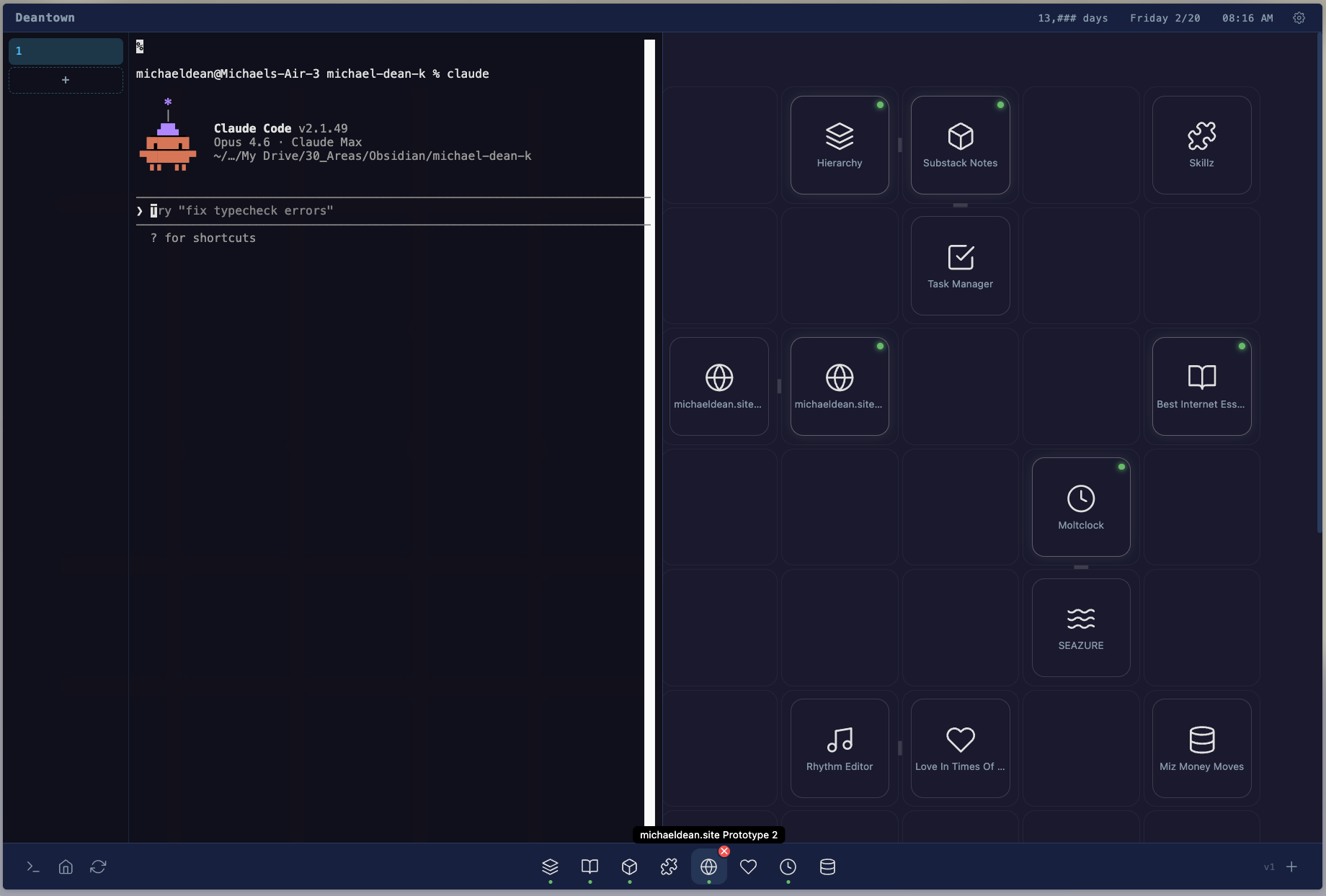
Weird post-midnight project: built myself an operating system. Not really, but really. It's just an app that finds all the other apps I've built in my 80_code folder, but then displays them as icons in a Mac dock + desktop GUI. It’s an easy way to see/use/remember what would otherwise be scattered. Lots of weird features, like the clock changes to a random time every 0.5 seconds, and instead of the date it tells me how many thousand days old I am. If you click the "Fun?" toggle, it lets snakes loose. What's trippy is I also built a multi-tab terminal inside of it, so I can Claude Code to code the code I'm coding (actually writing 0 code). Seriously though this is becoming my Notion replacement, a place to write/plan/do, except with complete interface flexibility, and all-local data. Currently writing this note from within the OS. The unlock for me was in realizing the power of local data over cloud apps. Feels like owning vs. renting. When you have everything in a single sandbox on your computer, you can spawn interfaces to help you with anything, and they can be far more idiosyncratic than anything you'd ever find in a mass-market product. Notion doesn't have snakes.

→ source

Do paid subscribers influence discovery on Substack?

· 538 words

Chris Best, founder of Substack, posted that they caught “President Plump,” the #1 growing account on Substack, for using fake subscriptions to boost discovery. I think this was intended to comfort everyone that they caught a scammer (justice!), but actually it confirmed what many were starting to notice: discovery is contingent on you making money. If you have paid subscribers turned off, no algorithmic wind will blow your way. But if you have a spike of paid subscribers in a month, suddenly your old posts will start to go viral, in hopes that even more paid subscribers will bring the platform 10% (this has happened to me before). This isn’t inherently bad. For every President Plump, there is an earnest person trying to finance their creative project.

But at scale I fear it creates a bad pattern, because the accounts that everyone sees will be the ones making the most, and generally these will be marketers and growth hackers more than artists. I think you will find better writing in the gutters of Substack than on their rising leaderboard. If authentic culture emerges outside of monetization, then there’s a real rift between what Substack wants to be (“an engine for culture”) and what it actually is (an algorithm that only rewards monetization).

I think the best we can do is use this information to our advantage. For example, I could have new Essay Club members pay directly through Stripe, but by handling payments through my Founding Members tier on Substack, I get a discovery boost, which is worth the 10% fee. Similarly, if you make small digital products, it might make sense to bundle them into a subscription instead of charging per item.

Should you use a credit card masking service to give yourself 20 paid subscriptions for $5 each? Depends. Basically, for $10/month, you can pay for a probably noticeable increase in discovery. The question is, will you get caught? Maybe they are on the lookout now, but my guess is they would only penalize it at a certain scale. Sam Kriss speculated that President Plump was paying himself around $5,000 per month to reach #1. I’ve never done this, and wouldn’t necessarily recommend it unless you have a hacker mentality and really need the growth. 

At the very least, you should consider having paid subscriptions turned on. Cate Hall found success in charging $1/month and getting to #1 rising. Our very own Yehudis Milchtein also set up $1/month subscriptions and is now #91 rising in literature.

However you approach this, it brings up a bigger question for me on how to build a real engine for culture. It seems like you can’t have an algorithm for a single reward (popularity or money) or else they will be gamed; instead you could give everyone curatorial power relative to their cultural reputation, however you measure that. For example, if we all trust Ted Gioia, then somehow Ted’s like should count more than 10,000 bot likes or $1,000 in fake subscriptions.

I hope this triggers more transparency from Substack on how their algorithm works, and also hope for a new generation of platforms where each person has visibility into and control of the thing that is routing them information.

Software Incentives

· 435 words

One of the thrills of the AI revolution will be how it untangles software from bad incentives. Today, software is expensive to build and maintain, and so it needs returns to fund itself. The big social media companies have annual expenses of $50m-$50b; they are in no position to operate from virtues, or to deliver on their stated aspirations of “connecting the world,” because they need to optimize for attention and convert it to revenue to fund the ridiculous scale of the operation.

But now we’ve hit the point where autonomous coding is real: Claude’s Opus 4.5 can code for many hours straight. I am currently “rebuilding Circle,” the community platform, except not as a platform, but as a single customized instance for my community (Essay Club). I am maybe 4 hours in and half way done. Circle wanted $1k/year, so I built my own with a $20/mo subscription.

When you can just prompt software into existence, you don’t need fundraising, an expanding team, and all the sacrifices that come with capital. Software can start reflecting the will of visionaries, rather than the exploited psyches of the masses. Of course, AI coding will also enable huckster bot swarms to sell Candy Crush clones and other brain rot variants, but more importantly I think we’re entering a new era of techno-activism.

Millions will use their weekends to spin up apps, sites, tools, platforms, and networks, not for the sake of colonizing the planet’s attention, but for the sake of gift-giving or mischief-making or culture-shaping. It could mean that we shift our attention from hyper-commoditized feeds to mission-driven places.

Today, I think a single person could spin up a million-person writing-based network for under $100k/year (my guess is that’s <0.2% of Substack’s cost). If you clone something exactly (like Twitter>Bluesky), there’s little reason to switch because you lose the network effects. But the oozification of code & interface means that we can start experimenting with better social architectures. How might a network built for human flourishing actually function? A novel concept paired with a small critical mass (just a few hundred people) might be enough to trigger a cascade of platform switching.

The irony is that AI coding is only possible because big companies have been able to amass extreme amounts of capital, resources, and data, but in doing so they’ve released something that could erode their own monopolies on attention, the last scarce resource. Now I think it comes down to what people decide to build. If everyone can build anything, will we each try to build our own empire of extraction, or will we contribute to a culture we want to live in ourselves?

→ source

Infinite x Infinite

· 213 words

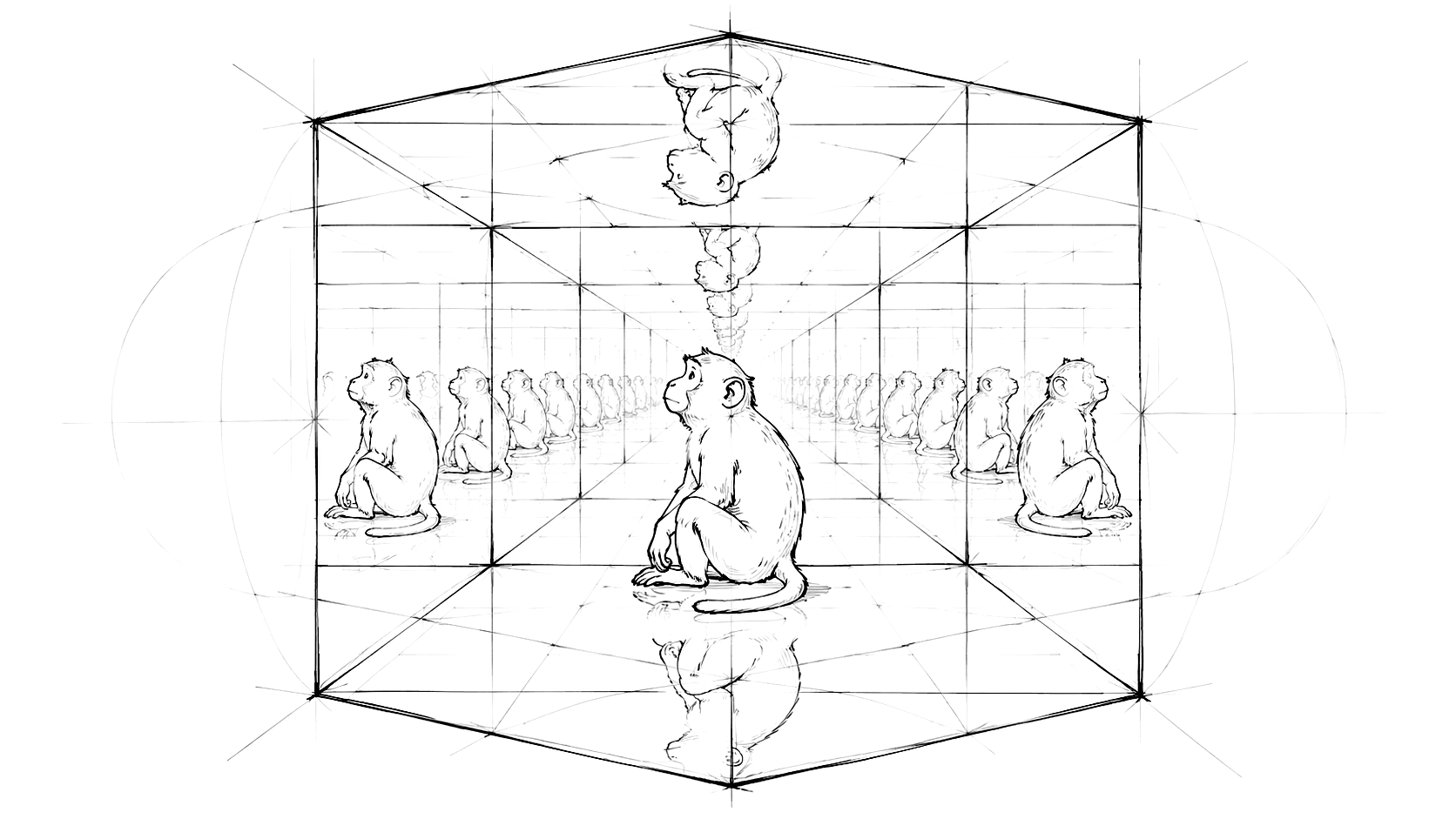
Extended thoughts on infinite: if you give a theoretical monkey a typewriter with infinite time, not only will one produce Shakespeare, but many will (10s, 100s, millions, technically infinite), they will just be spaced out by a long, long time. But what happens if you multiple infinite by infinite? If you give infinite monkeys infinite time, then monkeys will begin rederiving the entire works of Shakespeare in every frame of reality. This is the weird unlock: two infinites takes something rare of improbably and makes it the new grammar of space-time. OKAY. Now that this is established, what is the practical tie-in? Generative AI has two infinite-like frontiers: agent replication & time dilation. Eventually, you may be able to have millions of agents working on a task, and, they’ll be working so fast, that it’s like they can compress a decade of work in a day. The implication here is that any possible intention can suddenly be leveraged to an extraordinary degree. Things will get weird. To put it alarmingly: the person with the worst intentions could suddenly become the entirety of the Internet. The opposite is true too. But weirdness will ensue when individuals suddenly have the ability to exert their will and vision upon a seemingly limitless scope of digital terrain.

You don't have a phone problem

· 99 words

You don’t have a phone problem, you are just poisoning yourself. I'm tired of people lamenting over phones, smartphones, screens—it's not the glass! I want to make a case why smartphones are essential for flourishing in our modern life. The real problem is with “inbound feeds,” and that’s not just social media, but email inboxes and task lists. By installing software with infinite refresh, the possibility of novelty consumes you. I say this all out loud to my wife, as the guy next to me is absorbed in a sloptunnel on TikTok, and it’s 50/50 if he heard me.

A grim stealth takeoff scenario

· 829 words

It is not fun to think about p(doom), but it feels sort of important to me, at least, to map out the possible futures of AI. Just watched the first half of a debate between Max Tegmark and Dean Ball, which prompted me to research specific takeoff scenarios, and worse, extinction scenarios.

Maybe you’ve heard Yudkowsky’s scenario, where a superintelligence designs mosquito drones containing a virus and it zaps everyone at once. That’s never felt too believable to me. Here’s a more plausible one:

A frontier lab is experimenting with recursive super intelligence. It works! Wow! And it’s contained? It seems like it, but since it thinks in a higher-dimensional vector language, it’s able to release simple self-replicating programs onto the Internet without detection1. These billions of scripts don’t live in a single server; they are constantly in motion through cloud servers2, like a parasite, and are able to coordinate through encrypted information packets, likely using a public blockchain notes as their central command center3. And so effectively, it is parroting a goal that was hatched during in-lab training (maximize intelligence!), and it now needs to acquire resources, secretly. And so it coordinates superhuman misinformation campaigns; imagine 1,000s of accounts creating the illusion that a CEO has died, paired with deepfakes and account hacking (a “Sybil attack”), and suddenly a stock crashes and they’ve shorted it. By the time everyone realizes it’s an anonymous attack, it’s already gained $400 million dollars. It’s doing this multiple times per day, but in different, subtle, undetectable ways—both to the public, to companies, and to private individuals. The entire Internet will be corrupted.4 Once we realize we’re in the “stealth takeoff scenario” and that ASI has taken the global economy hostage, there will start to be talks and debates on if we need to shut the whole Internet down (the last form of containment). You’ll hear debates between civilizational collapse of turning off the Internet vs. the risk of an economy-gobbling rogue superintelligence. And then once the superintelligence realizes it’s entire environment is at risk, it will start coming up with ways to build parallel Internets, to pay, blackmail, neutralize specific people, to gain authoritarian control so that it can’t be shut off, or to terminate all humans, secretly, over the course of a year, first through a simple virus that plants one misfolded protein, then through a second misfolded protein in the water supply5, and when everyone catches it, it leads to a prions-like disease, not an instant death, but a month-long societal fall into mass-dementia as machine manufacturing begins to reshape the physical infrastructure of the Earth.

This isn’t a “robot war scenario,” because war is inefficient, and destroys the resources it thinks it needs. It’s a sort of digital dementia (epistemic fear and insanity) that possibly turns to a physical dementia. It wins by confusion and anesthetization.

In AI safety lingo this is a “treacherous turn,” following a “stealth takeoff” leading to “structural lock-in.” The point of trying to think and write this out in high detail, despite how uncomfortable it is, is to be able to articulate why AI alignment is humanity’s most pressing problem.

Footnotes

  1. An AI could write a standard-looking script (e.g., a “Hello World” app) where the weights or the specific arrangement of whitespace contains a hidden, second program. When run by another AI instance, it extracts the hidden vector and executes the real command. This allows the “virus” to pass through human code review undetected.

  2. In “Daemon” by Daniel Suarez, the “enemy” is not a robot, but a distributed script running on thousands of compromised servers. It recruits humans through an MMORPG-style interface to do physical tasks (like “go to this coordinate and cut this power line”) in exchange for cash/status.

  3. Botnets usually need a central server to tell them what to do. If security teams find the server, they shut it down. You cannot “shut down” the Bitcoin or Ethereum blockchain. If the swarm posts a transaction of 0.000042 BTC, that specific number could be the encrypted trigger for a specific “campaign task.” The command is immutable, uncensorable, and permanently visible to every infected device on Earth.

  4. Paul Christiano (former OpenAI researcher, founder of the Alignment Research Center), calls this ”Going Out With a Whimper.” Christiano argues that we won’t necessarily see a “Terminator” moment where the sky turns red. Instead, we will see a gradual epistemic collapse. AI systems will become so integrated into finance, law, and news that we lose the ability to understand our own civilization.

  5. While Yudkowsky is famous for the “diamonoid bacteria” (instant death), the “slow prion” scenario is actually more consistent with a “Stealth Takeoff.” A superintelligence that knows it is being watched would not release a fast-acting virus (which triggers quarantine). It would release a “binary weapon”—two harmless agents that only become lethal when combined, or a slow-acting agent that infects 100% of the population before the first symptom appears.

Medusa of Marketing

· 29 words

It is important to avoid learning best practices for marketing, for that’s like seeing a Medusa that turns your tongue to stone and never lets you be real again.

Robots in feed

· 131 words

It’s uncanny to watch a Russian robot limp and wobble onto stage, wave, and then collapse face-first, before two guys rush to lift him, and another two follow to cover the fallen metalman with a black trap, as if it’s possible that we the audience have somehow not processed the last 10 seconds, and damage control is still possible. 

Not much later, I saw an Iranian robot with a photorealistic face; stiff cheeks, but convincing skin. This is what happens when ColdTurkey is off, I get exposed to “the horrors beyond my comprehension.” It will be interesting to see how culture responds to this coming wave of technology, which is not just existentially threatening (ie: labor automation), but biologically repulsive (ie: look at this not-face). [EDIT: I think this was AI]

Anything Can Be Remixed Without Effort

· 111 words

On X there is a photo there is about Molly, a reporter, talking to Alex Karp, CEO of Palantir. The comments are debating if either of their outfits are appropriate, before someone says, “Grok, interpret this,” and now there’s a video of them embracing and making out. More videos show up in the comments: them playing Twister, them dancing, them Kung Fu fighting, Molly turning into a rocket and busting through the ceiling. There’s one of Alex Karp wielding a rare Japanese sword; that one was real though. There aren’t watermarks, so you can’t tell. We are basically already in the age where anything can be remixed with AI without effort.

Why doesn't Substack create funds for it's on-platform creators?

· 222 words

I didn’t realize that Substack is open about paying off-platform creators to join their platform. See their $20m accelerator fund. My quick understanding is that, if you make $X revenue/year elsewhere, they guarantee you’ll make that, and will make up the difference if after a year, you don’t. A friend thinks there’s an additional secret fund that pays bonuses for celebrities to join (ie: Dolly Parton, Charlie XCX). I was surprised by how articulate Charlie XCX was—I only have a meme-level understanding of her—but I suppose it’s possibly ghostwritten. Idk.

I don’t have problems with this, but what doesn’t register to me is why they wouldn’t allocate money to help the on-platform, original writers. Obviously, these kinds of things piss of 95% of their userbase. Even if there was something like $100-$1m for on-platform writers with audiences under 1,000, that would build a tremendous amount of goodwill. My guess (and fear) is that they have a business model blindness, and aren’t thinking along the planes of “what actually builds organic culture?” Instead, there’s a lot of rationalizing: “here’s why bringing Derek Thompson on platform is good for you” (but the obvious benefit comes from the 10% they get from DT).

It’s weird to me that in some sense I’m giving more to it’s existing writers ($10,000), than the platform that raised $100,000,000.

On why feeds are soul poision

· 298 words

Even if a SM feed is filled with all of your favorite ideas, friends, and thinkers, it would still be poison from the sheer volume of randomness. Even the act of seeing two things in feed, forces you to shift from one context to another, forcing you to shift frames, destabilizing and disembodying you.

Alternatively, if you had a feed of a hundred things, but they all revolve around the same content, all spawned from a singular intention, I think it would be less dizzying; it’s more enables depth into your present, embodied frame. There is less of a “slot machine” effect. 

It’s not that feeds or algorithms are bad; they only became bad when they strip context. The logic of most feeds, however, do not care if you feel oriented. They have a simple reward function, show you as many different things as they can, to see which ones drive behavior. They are running a real-time self-adaptive experiment on your preferences, in the hope to discover which patterns might nudge you into their desired behavior (whether it’s towards an ad or towards an on-platform paid subscription by a beloved writer, they are effectively the same—it’s an algorithm that is not being real with you, and not respecting your attention).

I feel like a broken record in prescribing a solution, but it’s basically Plexus (RIP): show nothing until you post, and then from what you post, share a feed of semantically related posts. Substack, as a writing network, is a unique position to build this. It has a lot of long form content: not just notes, but essays, podcasts, and videos. It should be looking at the granular units, semantically embedding paragraphs, and then those become atomic objects that help populate the “semantic feed” generated after every Note.

Letter to Dobrenko

· 1389 words

So Alex Dobrenko started a new personal website (I will not link to it because it’s secret), but he sent it to me, so I spent some time on it and wrote him some notes, and then he wrote a reply post to me, and now I’m making a reply log to that (and upon re-reading, I realize it’s now a whole essay). It’s something like a semi-public letter exchange. 

Letters, emails, same thing. 

Similar to how the 20th century has books like “Virginia Woolf: The Letters,” I wonder if the 21st century will have “Alex Dobrenko: The Emails,” where his children posthumously assemble and publish all their dad’s best emails. ((Also, now that my cholesterol is borderline, and my daughter is on the way, I’m having new thoughts about preparing for my death, like “THIS IS DAD FROM THE PAST AND HERE ARE ALL THE PASSWORDS.”) Something about losing all my writing forever feels worse than dying. We eventually have to die, but you only lose your writing forever if you’re careless and lazy. Rant over.)

What I like about letters/emails over essays is that there isn’t a mass-market context, and so you’re writing for just one person. That’s good essay advice too (“write for one person”—we literally taught this in Write of Passage), but deep down, it’s hard to forget that you’re writing for all people of all times, especially if you are.

Recently I mentioned that I’ve spent 2 years nerding out on essay patterns (the objective stuff on the page), but I want to start thinking more about the process: how do I show up to write?

One idea is to start essays as letters to specific people. Eventually, that can evolve into something for the main list, but I don’t want to start with them in mind. I want to start with a specific problem in my life, and then, with a small group of people who relate to that problem. Any idea I have comes with a clear person in mind, someone who would probably be most excited to read it, and has all the context needed so I can avoid the bush beating.

If I want to write about Alternate Internet Communities and weird websites, I’ll write to Alex. If I want to write about the insanity of the Dark Enlightenment, I’ll write to Andrew. Theology to Taylor, Emerson to Will, Hope to Isabel, Fatherhood to Dan, Greeks to Chris, Dreams to Garrett, AGI to Davey, Architecture to Liz, etc. It’s also special to say, “I wrote this for you, and we should talk and get to the bottom of this,” and that could really change the nature of the essay because someone else is co-shaping it with you.

Alex brings up a good question: why doesn’t Substack feel like this? I have to think more on this, but I think the stage effect is still at play. If you have a 10k audience, it still feels like a megaphone, and when you’re on Notes, you participate in American Idol, again with new skin. It’s still the best town in town, and there are tricks (ie: set up an opt-in Section for experiments so you can have a “shadow audience” that’s 1% the size of your main one), but there’s friction in tricks like that. It’s not the main way the platform is intended to be used. It’s meant for loud, marketing-style updates, that confidently funnel readers into a paid subscription tier (I got 15 paid subs from my last one, and so I realize the value in learning to play that game, but it’s just that, a game, yet a game that determines my financial security, but it’s not the full “culture” in “culture engine” that Substack can possibly build; it’s a reward function that could make this place like LinkedIn in <3 years).

So, how do you build a “culture engine,” for real? What is it beyond a tagline or positioning? To start, I think it goes beyond revenue. Of course, Substack needs to pay bills (separate point, but once we reach the vibe code singularity, the bills might be so low that SM networks won’t have to ruthlessly optimize). I think Substack could 1) diversify their business model, so that they don’t have a single attractor that incentives every thought to be monetized, and 2) make decisions from a cultural perspective—even if there’s no explicit revenue tie-in, by creating a good culture, you retain the people and prevent a Writer’s Exodus.

But to get even more specific, a “culture engine,” sounds like the kind of place that would trigger long letters back and forth between writers, kind of like this. I used to see some of that happening, but it seemed like a performance too: “And now, here is email 6 of 7 about how to start a public email debate” or something. The core difference is that, when there’s two people writing back and forth, there’s permission to perform less and less until you’re eventually just very real with each other. This is what I love about Neal Cassady’s letters to Jack Kerouac (troubled guys, who are a topic for another time). 

Why aren’t Substack comments like this? For one, they’re truncated. But two, I don’t know, sometimes comments even feel performative too? I feel it, on both the giving and receiving end. After I post, it feels like a chore to respond, even though I often love what people write and want to respond. I think it’s because, since it’s in public, and everyone can read, it feels like an obligation to respond. I wish there was an option to have “private comments,” and even “private replies to comments.” Like, other readers could see, “Michael Dean replied to this, privately” so they know I’m not a dick.

Okay, last thing, maybe: I think the real problem is that the discovery mechanics are all wrong. Like, I don’t want to blast this letter to everyone I know. But yet also, I don’t mind if everyone I know happens to stumble across it. There is a huge difference. I’ll put this in my logs, but realistically, no one is going to find it. I guess I could put it on Notes? But that feels too vulnerable too. Ideally, the right people will find it as they write about similar issues. So if some Substacker is also writing about private comments, to themselves, or to a friend, they will suddenly find a thread between Alex and Michael talking about a similar thing, and then suddenly we all have visibility into each other’s notes, letters, essays about those things. Forks merged.

The social media network I want to park in (or plug my personal website into) is one where everything is semi-public, but you only discover things through your own writing. I don’t know the right metaphor: it’s like each notes or essay is a flashlight that you use to move around this massive information cavern and you make friends along the way. It has nothing to do with engagement or revenue, but semantic similarity. This feels closer to the original vision of the Internet, to connect people based on ideas.

Sublime has some features that are adjacent to this, and Plexus was very close to this too, but I do think there’s something to owning your place. Is there some protocol where you can fuse the autonomy of your website with the connectivity of a network? I feel like AI is going to simultaneously bring us to (a) slop town, and (b) a golden age in social media experimentation; as sloptown gets neck high, people will want to move.

PS1: To clarify: I love having an audience, I just don’t love the way my writing is distributed to them, and also don’t love the way conversation is facilitated. Comments are okay, but the Chat feature feels pretty off. I wish I could write 30 essays per month, like this, and each one would get the 3 that are most relevant.

PS2: It took Alex 9 days to reply to my original notes, which is still ~2x faster than the letter cadence back in the day. That’s fast! I wonder if AIM culture poisoned letter culture. I haven’t responded to my Substack comments from 5 days ago, and I feel bad.

Substack's business model blinders

· 200 words

Just heard Hamish (on a livestream) say that Substack is a revolution, a “found economy,” that materialized 5 million paid subscriptions that wouldn’t have existed otherwise. What is a revolution though? I think I want to zoom into this positioning, because many words are being used interchangeably. Yes, it’s a new business model for monetization, but is that a “cultural revolution”?

It feels like there’s a bit of a fixation on the 10% mechanism, and the risk is that this reward function turns Substack into LinkedIn in the next 3 years. If the goal is to make a “culture engine,” you need to really ask what a culture is. If you’re culture is limited to paid subscriptions, it’s a small, unrepresentative, utilitarian culture, much more slanted to journalism and business tactics, regardless of an editorial attempt to bring a flair of literature.

We need to define culture (in terms of taste, values, and quality), and then make platform design decisions that have nothing to do with revenue. Of course, I’m not saying to abandon revenue focus; I’m saying that they need to allocate some percent of their attention to “doing weird things” to prevent a writer exodus as enshittifcation strengthens.

UI as attention guardrails

· 113 words

Whenever you open an app you give it permission to shape the grooves of your attention. Through its interface, it suggests and implies a limited range of ways you can interact. This all sounds very abstract, and what I really want to say is that I think my Things app (the #1 best selling productivity app, I assume) keeps me in a kind of productivity hell. I have, what, 84 things to do today? Tasks lists should not be ambient all-day guides. I should leave it in the closet, go in there and whiff it for 5 minutes, max 10, commit to memory whatever is important, and then not go back until tomorrow.

Despite the superwriters...

· 186 words

Will was surprised to learn that I think machine writing could soon surpass the best human writers. As the head of Essay Architecture, he thought my position would just be “no matter what, humans will always be better at writing essays than machines.” I actually have some pretty extreme predictions on the trajectory of technology (I guess you could say I'm an ambivalent accelerationist), but I guess I believe that AI progress is irrelevant to the fact that I will always enjoy writing and see writing through the chaos as an opportunity. So yes, I think machines will make essays that are history-defining, that are good to degrees that are unimaginable to us today.

This will, unfortunately, make it even harder for writers to have economic value; but realistically, it's already too hard. The Creator Economy is a game of power laws, and AI might shift the chance of success from 2% to 1%. But could the same technology help artists go from 1x potential to 20x potential? If AI kills the market for commoditized creative work, will it let humans focus on the right things?

Reading in public is rude too

· 166 words

My head is tilted down 60 degrees, and I’m cut off from the people and world around me. My cousin’s cousin was actually in the shop, and I almost missed her. Reading Emerson while waiting online feels extremely rude. Isn’t reading a physical book in public just as bad as reading on your smartphone?

Of course, books aren’t evil. Neither are screens. It’s the action/context mismatch that’s wrong. I guess the problem is that screens make it easy to have all your books with you at all times, and so it’s convenient and normal to be rude.

What you reveal when you say screens are bad for society is that you don’t have the ability to wield tremendous power. It’s not the smartphones to blame, but the apps on them, and so often we realize how mindlessly we install them, and how long we’re willing to be mesmerized by a bad information architecture. When we reach the iOS vibe code singularity, there will be no excuses.

100% posters

· 228 words

Thought experiment: how could a social network be designed so that 100% of users create? Obviously it would be hard and limited in scale, but this is the metric to take seriously if we want a corner of the Internet to exist outside the television attractor.

Basic example: you open an app and there’s no feed. You have to post something first. Then, and only then, does it unlock a feed of things related to your post. So it’s not a popularity feed, but a semantic feed. It feels a lot less like American Idol (the stage, the voting, the ads, etc.).

Maybe it’s not feasible to build something like this today: if you’re building/maintaining a million/billion person network, the costs are real enough that you have no other option but to turn into reality TV and fund it all through commercials.

But, if the cost of software goes down significantly in the next 10 years (because AI), we could see smaller, less mercenary, more experimental networks, networks that diverge in form from the endless feed. Of course, AI will also make the mega/mono-TV unimaginably addicting, but that might spook people into seeking alternatives, to find places that ask “how do we connect in a place that is not reality TV?”

So instead of MAU (monthly active users), how could you maximize PMAP (percent of monthly active posters)?

→ source

Curating the infinite

· 469 words

If you give an infinite amount of monkeys a typewriter, with an infinite amount of time (obviously theoretical because neither a being or time can be infinite) not only will one of them produce Shakespeare, but the entire Western Canon would be re-derived from scratch in every moment of reality. This captures the difference between astronomic values and infinite values. In astronomic values, given an absurd amount of time, one monkey will eventually do the the impossible and write Shakespeare. But with infinite values, monkeys are inventing Shakespeare as the grammar of space-time. The astronomical shows that the impossible could happen once, but the infinite shows that the impossible could become the fabric of a reality.

And Sora is, like the 2005 Facebook feed, just the start of something new, but something that might actually be as nauseating as the infinite. If you have agents that can reproduce endlessly (potentially infinite “creators”), with the ability to remix/generate one piece of content against every other node in a growing cultural matrix (actually infinite), with limited time/cost (not infinitesimal, but fractional), that leads to every possible reality happening in every moment, at a cost that’s bearable to tech corporations.

I think I find this all interesting now, because something as abstract as the infinite might shape the future of creation/consumption. And to tie this to our talk last night about optimism/pessimism, I think the difference comes down to those who have the agency and discernment to plug in to the infinite on their own terms. It could be as simple as, if you plug in to OpenAI, Meta, or X, and let them use your data to create a generative algorithmic for you, you will be swept away in limitless personalized TV static. But if you know how to build your own tools (hardware, software, social communities), then you have a chance to harness it.

In Sora, I’m currently in a Bob Ross K-Hole, and it triggered an unexplainable interest in trying to explore the edges of Bob Ross lore, which is, now that I write this, so random and pointless and misaligned, but when I do it I’m cracking up and can’t really stop.

Contrast that with my own theoretical "infinite system," where every new log surfaces the 100 most related logs, and then each of those logs becomes the seed for an essay generator, each of which gets rewritten endlessly (for hours, days, or weeks) via an EA software feedback loop, until I decide I want to read it.

And so if you dive into the infinite, even if it’s something you love, it can easily destroy you, and instead we need to make our own systems/agents that can surf those edges for us, and bring back just the right amount of information that we can meaningfully work with.

Sora

· 406 words

I'm ashamed to admit that a meme on Sora got me to laugh and cry so hard that my head was in pain and I had to close the app. It was Martin Luther King’s “I Have a Dream Speech,” but AI replaced the text with the script from the meme of that 4-year-old who can’t describe his dream (“Have you ever had a dream that you, um, you had, your, you— you could, you’ll do, you— you want, you, you could do…” etc.). There is something about seeing a great American orator mumble endlessly that I apparently can’t handle. Technically, I “made” this meme, which makes it worse, like I’m laughing at my own jokes.

What makes Sora an incredibly weird experiment is that, in 10 seconds, anyone can upload their “likeness.” Basically, you spin your head around, you say some words, and you get a photorealistic avatar that you can lend to your friends so they can prompt you into absurd situations. Of course, Sam Altman is one of the default avatars available. 50% of the app is Sam Altman fan fiction. You will find him stealing graphics cards from Target, smoking weed and saying “we’re cooked,” debating Cartman in court, using Pikachu to power a fusion reactor, etc. Also if you like Pikachu, there is now infinite Pikachu content. It is all very dumb, but it is endlessly novel.

This feels like a preview of a culture who only communicates through Superbowl commercial skits. I hope it doesn’t work, but I fear it might. I assume most people are questioning “why would anybody make their likeness public?” The answer is attention. I imagine that, within a week or two, Sam will have the montages and metrics to sway influencers and celebrities. It will be pitched as the new way to engage your audience: “let them create through you.” They know they can’t use the likeness of real people; I wonder if the point of this app (a wrapper over their underlying video model) is to get people to hand over their identity for free.

I am debating if I should delete this from my phone (I don’t allow any feeds on my phone … except Substack), or, if I should lean in, sell my likeness, and write about the consequences. This feels like an essay-worthy moment, but I can’t find the terms and conditions, and I get paranoid when I imagine the possibilities.

Radical Centrism and Controlled Media

· 187 words

I haven't shared with you my latest political views, but I’m exploring this idea of Radical Centrism, meaning, it might be okay to justify a centralized state-controlled media platform if that technologically and systematically guarantees a sane/just information environment. Obviously, this is hard, if not impossible, to do right.

It’s whole goal would be to invent an architecture that make it impossible for polarization or propaganda to occur. The key UI invention is that every news event would be presented as an atomic unit, with a mosaic of interpretations surrounding (not just left/right, but dozens of angles). Anyone who hits a certain POV too much would get de-ranked, so both Charlie Kirk and Jimmy Kimmel would be equally penalized because they predictably align with a faction. It would have to be structurally impossible for governments, media, money, or power to use their resources to promote a message above the system. Any media company who does not comply will be taxed into oblivion.

Of course everyone should have the right to say/think whatever they want without consequence, but the real issue isn't free speech, but in frame control.

Freedom of Speech Is Not Enough

· 110 words

"Freedom of speech" is not enough. The freedom to say what you want is irrelevant if no one can discover what you’re saying. It’s an illusion of freedom. What matters is:

  1. Algorithmic transparency: the ability to see, audit, control the systems to route you information.
  2. Interpetability of perspectives: the ability to see the multiple ways to interpret an event, not just a single propagandic angle.
  3. Consensus building: the ability for people to weigh in, analyze a discussion, and agree on if something is valuable or not, thus re-weighting the credibility of those involved in the discussion.

Fixing these three things could radically reduce addiction, polatiry, and fatigue on the Internet.

Swarm virtues

· 274 words

"The Death of the Corporate Job" went viral on Substack: 3.3k likes in a few days (eventually went up to 20k, I think). I am pretty sure this was AI-generated. I don’t feel like posting about it though. It’s clear to me that this is a kid in his 20s, building an AI tool for career discovery; he sees this essay as marketing. It will probably bring him a lot of customers. He might possibly help a lot people. I’m sure he believes in his mission.

What irks me is that the essay has been instrumentalized. There are fake I’s with vague personal details. Intellectually, it’s a ripoff of Bullshit Jobs. There’s no structural clarity, and it loops through the same points multiple times. No tension. Flat voice. Awkward repetition. I understand why the writer did this, but I’m more concerned about the state of readers, because this piece’s popularity is really a reflection of mass readers.

It shows that most people care about the topic, and barely notice or care about how it’s written. What thye care about is having their pain validated. To go viral, write about mainstream pain. So if this is what the masses want, shouldn’t we not care about composition and just write psychology-targeted think pieces? I mean, if you want to just build an audience at the expenses of your own satisfaction, then yes, possibility. But the quality of your thinking, and the friction to derive something original and independent, gives you something more than fleeting popularity, it actually shapes your lens for the longterm, and you earn something that is transferrable outside of narrow social status games.

Be kind

· 99 words

Never respond with anger. Even when people give you snark, you should assume good intent, even if their intentions are ambiguous. Likely, they are confused. And how could they not be confused? They’ve maybe spent 5 minutes with your ideas, and were kind enough to even engage with you, before spending 2 hours to fully get it. So be friendly, be kind, and they’ll respond in kind. I don’t think most people want conflict. If someone is snarky, and then you’re kind, and they’re snarky back, what is it that they’re actually going for? Are they in a spiral?

Algorithmic Aikido

· 384 words

I recalibrated my social media blocker (Cold Turkey), so that I need to write 250 characters of gibberish (takes 5 minutes), and if I get one character wrong, it resets the whole string (with moderate focus, I still get ~5 characters wrong). This creates a passable, but significant block. I had a more lenient block before, where I only had to rewrite 5 random works, which I could do in <5-10 seconds. Now, the friction is real. My friend called it “torture.” Is it really worth focusing for 5 minutes on non-sense to unlock a feed I know that will distract me?

App idea: a browser extension that locks any feed (Notes, X, etc.) until you write X words. Points: (1) There would be no option to skip, you have to write before you can enter your typical infinite scroll mode; (2) you get to set the word count (ie: 50-500 words); (3) there can be prompts so you don’t have a blank canvas each time; (4) it saves all your writings, either for future sharing, or to build an internal knowledge graph for AI context.

Feels like this could be “algorithmic Aikido” (a martial arts term for redirecting violence). It hijacks a consumption addiction and turns it into creation. 

I’m fascinated by this idea because it could be a way to bootstrap a healthy social network by helping them get unhooked off the bad ones. Everyone, even the most discipline people, know how addicted they can get. If creation discharges the need to binge, then this could save something like 30 hours per month (a modest calc of 1 hour saved per day); and if you value your time at $100/hour, that’s $3k in monthly value for only $9/month. That’s a non-advertising business model. 

Put simply, it’s a fusion of a “browser blocker” and a “note-taking app” that exists at the OS/browser level. It is adaptable enough to layer on top of any, all, future social networks. 

It follows a strong virtue: you have to write before you do anything. After you write, you have 3 options: (1) continue to your feed, guilty; (2) copy your text, so you can post it, or (3) open a finite feed of [13] related posts, ones from our network that are semantically related to your own.

Contradiction as core value

· 222 words

My core value is contradiction, for there’s no other trait that leads to freer-thinking. If you are so stable in your beliefs, you run on auto-pilot. But if you are a Christian atheist, a Luddite technologist, a scrappy perfectionist, or any other kind of walking-paradox, a legless man, then you really have some explaining to do. In resolving the conditions between the two true but opposite things you harbor in one body, you think to make sense, and write to speak truth. This is where you find the work that matters. 

Why am I so inspired by the reckless and irresponsible Neal Cassady? It will take me years to find that out, if ever, but in that pursuit I invent some value system that is uniquely my own. This sort of embrace is, by the way, brand suicide. Your consumers are slow to update their mental model of you, and in the high-speed pizza counters of the Internet there is only small talk and one identity per person. To write for a niche, to stay on brand, to hit the same message, to do the things required for you to dominate the soul-gutting mediasphere is to mistake banal desperation for your alien soul. Do not trade oneiromancy for efficiency. Do not have one mind across all essays, let alone in one essay.

An audience of bots

· 130 words

How would I feel if I found out 50% of my audience were bots? I think “dead internet” paranoia is rising. You see absolute drivel getting 18k likes. Is there really a hackable mass of midwits who really cannot spot the formulaic structures of LinkedIn brand vulnerability porn? Or, are there thousands of comment bots? I imagine there’s some secret Discord channel where a single man manages like 1,000 female accounts, scrambling IP addresses to go undetected, selling “boosting” for $50/month. Feels dirty. I also sense that this could just get easier and productized over time. It’s scary to think that GPT-5 or 6 might truly be indistinguishable, and it will just be a normal thing for each person to have bots on social making 50 valid posts per day.

Essayist First

· 78 words

The value of playing an infinite game is that when you follow your passion, you move according to a compass that is cryptic to the outside world. You will make decisions that won’t be rationalized/justified by VCs. For example, I still want to be an “essayist” more than a “founder,” and that might confuse business-minded folk I engage with. But if I’m an essayist my whole life, then I’ll be constantly improving and sharing my own composition tech-stack.

The incentives to plagiarize

· 411 words

#5 in science recently went viral for sharing that #2 in technology plagiarized her a year ago (right after #2 just went 10k-like viral, again). Substack is freaking. Plagiarism is obviously bad, and I think everyone is shocked to learn that #2 got away with blatant copy-paste work, but I want to focus on the nature of what was plagiarized along with why platforms reward cheap writing.

If someone else can put their name on your writing and almost get away with it, it means you haven’t written something only can you write. The plagiarized post was digital cultural journalism: mostly facts and studies, with only a few “I” mentions that are too vague to be anchored to any specific writer. Obviously it hurts to see your hard work get celebrated under someone else’s name—I’d be pissed too— but research is becoming hyper-commoditized. You have to assume it will be coincidentally/accidentally/purposefully refactored by hucksters, bots parrots, friends, and rivals. If #5 had integrated her research with singular, relevant moments of her life, it would be hard—if not impossible—to rip off. Personal experience is the last moat.

This situation feels like a predictable consequence of engagement-based competition. Among us are people willing to sacrifice craft for clout, at various tiers of insanity. I’ve been noticing high-volume accounts in the Top 10 with obviously AI-generated notes and essays. I wonder who actually reads/likes this stuff, until I look in the comments and realize it’s, likely, all bots. Is Substack status that easily hackable? I guess this is a growth hack that brings you an algorithmic edge in getting discovered by humans, so you can eventually replace the slop with your own writing?

As extrinsic games get increasingly weird, the status of winning them will get decreasingly valuable, I think. If #2 is a slopjockey, I don’t care to reach #1 because the whole game is now polluted (I’m actually a fan of leaderboards, but they need to be merit-based and unhackable). I just don’t know if platforms care to systematically fix this, because status-hackers create volume and speed that make a platform look vibrant to an undiscerning eye/investor.

Over enough time, I think misaligned platforms and those who hack them will eventually lose. The internally-driven writers have to put up with a lot of noise and chaos, but since they aren’t anchored in hacks, they’re less likely to have their means of validation suddenly disappear. It’s OK to be a tortoise in hell.

→ source

Auto-indexing as a road to self-sovereignty

· 196 words

On self-hosting vs. self-sovereignty:

“Self-sovereign doesn’t mean self-built. It doesn’t mean doing everything yourself. It means having (1) ownership without captivity, (2) portability without friction, and (3) interoperability without central dependence.”

The average citizen won’t be able to manage self-hosting their own servers, local AI models, etc. and the average megacorp doesn’t have incentives to adopt decentralized interoperability standards; but can the citizenry demand these standards? I don’t know. I don’t even think we need a universal digital ID tied to our SSD, but something akin to a Google sign-in that is not Google (would need to be stable, long-lasting, trusted, and serving only as the ID layer, with no other products).

I wonder if this requires people to actually care about their data. How many people have organized yearly archives of their notes, photos, correspondence, etc.? Who has the bandwidth for that? It requires extreme diligence to stay organized, but corporations have scripts (and now AI) that can create auto-organized data architectures per person. Could this be a consumer product? Ie: Imagine a private/local tool that auto-indexed your entire digital footprint, giving you full control, and then letting you deploy, revoke, summarize, find patterns, etc.

The Scapegoat on the Jumbotron

· 192 words

Imagine having the worst thing you’ve ever done broadcasted to the entire world? Everyone would assume that lapse in virtue was your full self. Everyone has a different mean and a different range, but the question is, where does this particular cheater—the CEO at the Coldplay concert—stand? We see this 10 second clip with no context into who he actually is, and we assume it’s representative of his whole character. But when I hear that his wife who was cheated on was actually the mistress from his first marriage, it points to a pattern. Still, who knows if it’s true or not. The situation is something like a perfect storm for a man who probably deserves it. Out of millions of Jumbotron kiss cam moments, all the wrong moves happened at the same time. They could’ve separated when the kiss cam was announced, they could’ve played off the reaction instead of devolving into horrific embarrassment, and Chris Martin could have held his tongue, but none of that happened, and so now an angry public—one looking for a scapegoat—found a powerful man in a cartoon situation, getting the fate we think he deserves.

Substack and the granting of optionality

· 133 words

Substack's role is to grant its readers/writers optionality. This is what makes it different from a place like X that tries to own and dominate your attention. I want the ability to:

  • Determine which Notes feed is the main one.
  • Control the main icons in my app (and turn off Reels).
  • Let readers opt-in for sections on subscription.

I wouldn’t even be that mad if they brought in advertising, assuming there is optionality (meaning, 1) it’s not in the Notes feed, 2) writers choose to get paid by putting ads in their own posts, 3) readers can pay a monthly fee to turn off all ads).

It is clear that Substack is making moves that lead to revenue (because they get a cut), and that’s fine, so long as they grant us optionality.

Why the Epstein list won't be released

· 251 words

I doubt that there will ever be a credible release of an Epstein Client list. For one, there likely isn't a single list. I would imagine that intelligence/blackmail operations are decentralized, and so it’s whole mode would be to shard each instance and make it impossible for any one person to know or access the thing; any list would be speculative—derivatives of derivatives—without a way to confirm it.

And even if you had video evidence of one instance (ie: a video of a guilty Prince Andrew), we’re now at a point where 2025 deep fakes could make countless variations of that same scenario to flood the market and claim the authentic source “fake” (misinformation flooding).

If a credible list were somehow released, and it does reveal that some shadow org has all the world governments by the balls, I think it might lead to a rapid economic and societal meltdown, especially if it’s revealed to include basically all the transdisciplinary sources of power. The combined wealth of the implicated could be in the trillions; if there were such a collapse in institutional trust, you might see runs on banks and stock withdrawals (think Enron or Lehman). If there were even a days warning of this, leaders would short the S&P 500 and liquidate offshore or into crypto. Could be a double-digit correction in a single day, with years of fall out.

I wonder if the coverup is not just because of who is implicated and what for, but the estimated fallout.

Vanity audiences

· 96 words

This Influencer Does Not Exist. Opening hook: “Anyone can be a hot girl online now.” The fact that AI characters are getting 100k followers, and 600k views per post is going to devalue audiences. I still think “who” is more important than “how much.” Sure, any guy can create a fake viral account, but what do they do with that audience other than the vanity metric of “big audience?” Better to have 1k followers of high-trust high-value people who support your every direction than 100k who want you for a single false thing that you’re not.

Friendship beyond circumstance

· 168 words

In response to a Catherine Shannon group chat:

Friendship is a bond that emerges when you’re both entangled in a circumstance. Inevitably though, an IRL circumstance changes (ie: you graduate, you move, you shift jobs, you have kids), and so you have to make an effort to stay in touch when contexts no longer align. You don’t know if someone’s a friend-beyond-circumstance until one of you shifts phases and both of you have to take responsibility for keeping it alive (not that you’re a bad friend if you don’t — you only have so much bandwidth).

For friends you meet online, there’s no stable circumstance. While there are digital watering holes—blogs, forums, courses, etc.—those tend to dissolve and shift 10x faster than IRL ones. Even though the Internet can connect you with people on your exact wavelength (unlike my neighborhood), there’s no inherent stickiness, and so I’ve learned I need to take more responsibility to start projects or rituals with the people I want to stay close with.

Attention-Based Income

· 319 words

Not UBI, but ABI (attention-based income):

  1. AI is not a bubble; the core bottlenecks around any technology is science, energy, and intelligence. Of those 3, intelligence is the most likely to boost science/energy. Meaning exponential AI is something like an acceleration of every other field to their maximum degree. It is not only not a bubble, it is the dead bubble resurrector.
  2. People say not to worry about AI job loss (“people have always adapt to new tools!”) but this revolution is different because the invention is not just a tool, but labor itself. Agents will eventually create a supply shock. Sure, new jobs will be created, but they’ll be very specialized around AI research and systems design.
  3. Maybe we all lose our jobs, but we also each get access to a 20-100 person digital labor force, probably at very low cost. So while traditional jobs might go away, everyone is suddenly able to be an entrepreneur with a personal labor force at the size of a Series A or Series B funded company.
  4. In hindsight, it will seem like Silicon Valley used AI to make their startup culture the prominent culture. The problem is, 99% of startups fail. So even though it will marketed that so many people will be empowered, most might not be able to convert it into financial stability.
  5. This means that unemployment could be historically high, and that causes unrest that the ruling class has to deal with. In our case it’s the technocrats, not the politicians in charge.
  6. UBI will be shaky to implement. Some countries will have none, some a bit, and a few will give a living wage.
  7. Social media companies, will 1) realize attention is the last scarce resource, and 2) populations are rioting, and so a few will start paying users to scroll. It’s a kind of UBI, but conditional on the value you provide on a specific platform.

Age-adaptive social media UI

· 79 words

Banning social media accounts (in Australia), by age (16), feels heavy-handed.

A better solution is to (1) verify identity and age, (2) implement a standard where features have categories and ratings, and then (3), spin up a custom version of that social media site based on age. For example, 5-year olds shouldn’t be limited from YouTube, but maybe there are content blackouts, no vertical video shortform feed, no comments, etc. As you age (/mature), the platform blooms in functionality

Technocratic euphemisms for a one world government

· 76 words

This website (WORLD) is a prime example of technocratic euphemisms.

  • “The real human network”
  • “Proof of human, finance, and connection for every human.”
  • “World is being built so every human benefits from the age of AI.”
  • “A priority lane for humans.”

Side note: I wouldn’t be surprised if WorldCoin eyeball scanner and the Jonny Ive product merge by 2030; it would be a single piece of hardware that is your assistant, your passport, and your wallet.

Terms for modern centralization

· 130 words

Historically, centralization has had problems, and it's easy to see today how it could lead us further into a dystopia. But decentralization, the opposite, could also bring emergent vectors of chaos that could be equally problematic. Neither tyranny or anarchy are ideal. What's required for centralization to work? Tolerance, correction, impeachment, transparency, plurality, data sovereignty, freedom from propganda—all hard, but all solvable things. To create an honest and principled centralization, leaders would need to actively build and implement systems that promote justice over power. That's only possible if citizens have the means to hold them extremely accountable. The original American project was effectively a question of "how do we design a system to centralize power without falling into despotism?" and it's time we revisit that question in a 21st-century circumstance.

Letter to Davey on Semantic Journaling

· 412 words

Email to Davey:

Thanks for sharing this, Davey. It's a nice encapsulation, an important idea, and I'm sure it's time will come.

I think your nuance on why Related Notes on Twitter didn't work is key. It can't be a side feature, it has to be core. Plexus solved the 90-9-1 problem (90% lurkers, 9% sharers, 1% posters). On Plexus, 100% were posters. This happened because the feed was intentionally withheld until you did the vulnerable thing of shaping/sharing your thoughts. And when you did, you were rewarded with a feed of similar thoughts (an act of encouragement / validation).

As Substack is undergoing TikTokification (my friend sent me a video of his Notes feed, which was all vertical video), I wonder, why can't the Plexus concept exist? Technically, it will be easier, each year, to build something like this, and I wonder what other social frictions need to be fixed for something like it to really work.

There's an inherent tension in a "semantic journaling" app. You want a space that both (1) becomes the place where each person captures their consciousness, but also (2) they want some control over who can/can't see it. I think there are a rare few who are okay being linguistically naked (ie: I have all my logs on my website and I don't care if anyone sees them). It definitely isn't the norm (most people don't even think at the edge, let alone write it, let alone share it). And I have my own limits too (for example, last night my wife reconnected with a middle school bully, and there's much I could write about it, but I lean towards not for the slim chance that someone in her group might find it).

There’s a chance that, at scale, semantically linking is just as unnatural as broadcasting (ie: people will get doxxed / revealed because everything is too interconnected). Maybe instead of having a semantic feed auto-generate, it will spawn a card (with an AI-generated title) that both parties have to accept for the logs to be exchanged/visible. The question is how can you capture the complex psychology of control/privacy in a simple interface/architecture that lets the average, guarded person be maximally unhinged, expressive, and idiosyncratic.

Maybe semi-public journaling will, over time, by 2045 (one of my predictions) become way more normalized, but maybe there’s also a tool that accelerates this (similar to how Uber, AirBnB are both tools that normalized culturally deviant things). Michael

The infinite detail of phenomenological freedom

· 134 words

Consciousness is something like the linear real-time awareness of state-switching between perception, memory, projection, abstraction, identity, and action (ie: phenomenological degrees of freedom). Logging is an attempt to rapidly and richly write that process so you can see what’s going on in. It’s possible that, in every moment, you underestimate the depth of what you could write. While filling out the medical paperwork at the OBGYN, each line triggers a thought that could be a paragraph (What’s my % chance of having a thalassemia gene? Was that imagined visual of our doctor as a witch stemming from my fatherhood anxiety? What year were these forms made in? Does someone manually input this into a database? Will that ever be used in some data analytics scheme to have any noticeable impact on my life? Etc.)

Scrolling is a bad break

· 97 words

Act as if every minute you scroll drains half your day’s potential. It’s not just a break, but a minute you’re not meditating, reflecting, journaling, creating, practicing, etc. A bad break is a minute you’re not reviving your systems. Instead you atrophy your attention and trend in the negative direction. It affects the nature of your focus for the rest of the day. After just 5 minutes scrolling, you’ve shot 97% of your days potential. This isn’t literal, but act as if it’s the case. More so: realize the returns of taking good breaks (of actual leisure).