We are big floating heads looking for our bodies
A conversation with Tommy Dixon

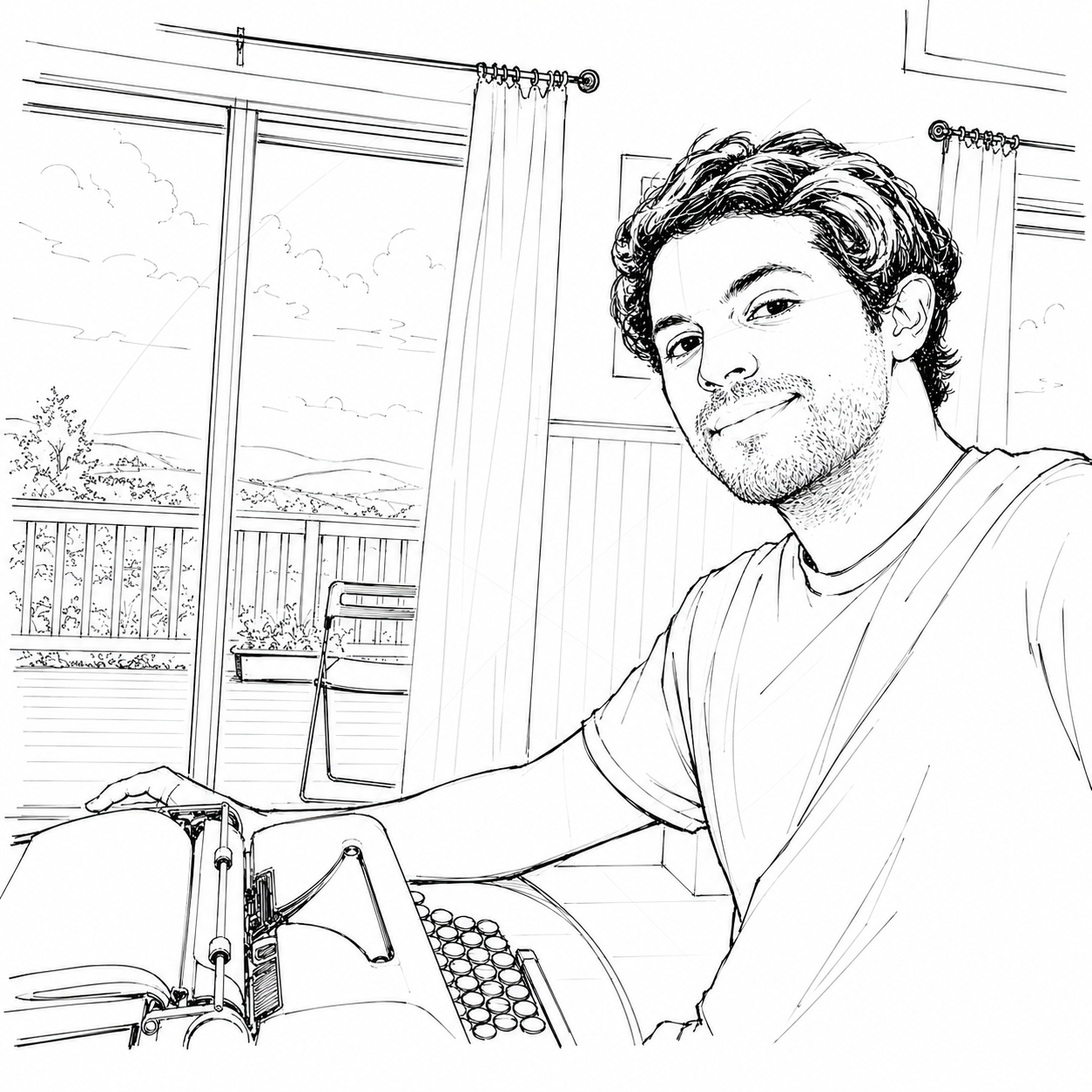
Architect-turned-writer, founder of Essay Architecture. Building pattern languages, software, anthologies, and community for essayists.
Architect-turned-writer, founder of Essay Architecture. Building pattern languages, software, anthologies, and community for essayists.
Essay Club ↗
Architect-turned-writer, founder of Essay Architecture. Building pattern languages, software, anthologies, and community for essayists.
Architect-turned-writer, founder of Essay Architecture. Building pattern languages, software, anthologies, and community for essayists.
Essay Club ↗
Architect-turned-writer, founder of Essay Architecture. Building pattern languages, software, anthologies, and community for essayists.
A conversation with Tommy Dixon
Why essays see what algorithms can't (the themes in The Best Internet Essays 2025)
I remember flipping through TIME’s 1999 Year in Review in elementary school, thinking some all-seeing committee had seen it all, reporting on the celebrities, wars, and gadgets that would one day make a history textbook. It wasn’t just a recap of the year, but a pivot into the millennium. It…
read essay →I just did some research on David Foster Wallace’s decline (albeit, through Gemini 3.0, so there might be some hallucinations). The surface level understanding is: 1) his medication stopped work; 2) they gave him electroconvulsive shock therapy, 3) he hung himself. But I never quite knew the gruesome and heartbreaking details of his “medical episode” (as described by his wife to his agents).
It was like a biochemical meltdown: he was struck with tremors and convulsions. He completely lost his appetite, stopped eating, lost 60 pounds, and his parents moved in to try to cook him familiar foods from childhood. Probably the worst: he could hardly speak, which is something like hell for who might have been the most articulate writer of his generation. He describe his situation as “the bad thing” and “the black hole with teeth.” Often, he couldn’t make basic decisions, and had extreme paralysis in deciding which room to occupy. He could barely comprehend the complex literature he’d been reading, and devolved into self-help books and basic spiritual texts to help him through the situation.
After, I think, 16 months of this, he decided to kill himself; he convinced his wife to leave to get groceries, who agreed because he seemed unusually well, but then organized his manuscript (the Pale King), wrote a two page letter to his wife, and hung himself on the porch. I imagine he assumed his new condition was permanent, and maybe it was, but I can’t help but think that maybe, in 5-10 years, it could have restabilized, but that is easy to say when you’re not in it (a year of this might feel endless/excruciating).
I wouldn’t be surprised if a few of these details are fake (AI-hallucinated). It nonetheless is a more detailed version than the caricature, and it’s possible that a wrong sketch of the details is more true in essence and tenor than an accurate meme-level compression. Perhaps one day I’ll really read into this to make sense of the whole episode. I think now I’m at a place where I don’t quite believe my original understanding, nor the new one, so overall I’m skeptical and unlodged, which is maybe better?
(PS: apparently the details all do check out with D.T. Max’s biography, Every Love Story is a Ghost Story.)
As Brian the FIOS technician worked on the house outside, I sat on the porch to inspect and make myself available for questions, also while reading DFW’s “Everything and More: A History of Infinite.”
I just moved to a new apartment, just a town over, but with much more space, and so I've been in the process of corralling all my possessions into smaller and smaller boxes and then hiring men with trucks to lug everything. I've been unable to work for the last few days, both because of packing logistics, but also because this new unit is not already wired for Internet, unless I want to split the bull with my landlord, which is a no-go.
Brian was yelling back and forth with his assistant up in a cherry picker, connecting loose wires into the Verizon hive mind, and in that moment, as I read DFW write about layers of abstraction, I thought about the layers of abstraction in this very event. I've built a whole career on the Internet, and really, I could barely explain the fundamentals of it to a child. To some degree, not even Brian or his technician could do this, and fixing wires is their job. Could the guy up in the cherry picker explain the physics of data transfer or electricity? . You can exist within one layer without knowing anything about lower or higher layers. Here's how I'd map it: L1) the science of harnessing materials and natural forces to wield power, L2) building infrastructure to scale and deliver that power, L3) knowing how to edit/patch that infrastructure (Brian and his co-worker), L4) the general user of that infrastructure, and then L5) one who is able to navigate the social puzzles the emerge when millions of people use that infrastructure.
I can't operate outside of L4-L5. It is rare for someone to be competent at every layer of abstraction. Electricity has no understanding of “Verizon.” Brian might know very little about physics, but when you watch someone do their job at L3, you see the mystery of mastery at a non-adjacent layer. I can barely explain to you the infrastructure of the Internet, but I wish I could, and learn I should.
Notes from the Bronx Zoo
The Zoo is a place where you can replace your stick-figure representations with direct perception. It’s easy to overlook everything: “oh look a rare bird,” and “cool, a giraffe.” But you can also stare intently at the facial hair of a gorilla up close for 2-3 minutes with complete focus and marvel at how strange it actually is.
I looked it up, and I’m surprised there’s no term for the uncanny that emerges from looking at non-familiar animals up close. It’s most obvious with cockroaches perhaps. That’s an obvious biophobia. Squirrels, dogs, and horses are good example of acclimated animals that we are accustomed to. But there’s a feeling of grotesque when you see a human-looking eye on a mammal as strangely-formed as a rare hog—familiar parts in an unfamiliar whole. Maybe the grotesque comes from imagining a human being transfigured into it.
Maybe the “evolutionary uncanny” is when nature reprises parts (eyes, lips, or hands) into whole that seems uncanny or frightening.
Throughout my time at the zoo, I had trouble putting the right words to what I was feeling, and I couldn't help but coin the phrase, "all of God's retarded creatures." This is obviously absurd and inflammatory, especially with the adjacent G-word and the R-word; I can’t say I even agree with it, but it speaks to the alienation and distance that language creates from nature (and the hubris of a linguistic creature).
This taps into an idea in DFW’s “Consider the Lobster” essay. Despite him saying how we should be more conscious of how we boil lobsters alive, he closes by confessing that he feels that animals are less morally important than humans and he’s not sure why. This has been an open loop for me. I have a positive regard for animals, but I know people in my life who exist on both extremes (ie: my wife sees dogs on par with humans, and my grandfather thinks dog == rat).
At some point while wandering the Bronx Zoo, I found myself thinking that nature is this force that rapidly mutates and complexifies life in order to find a "breakaway pattern." I am, obviously, as I write this, an inheritor of that pattern, and you, by nature of reading this, are an inheritor too. And so when I look at the rhinos, I don’t see cute or powerful animals, but sadness over a breed of mind trapped in a tankish form-factor. A human-centric way of seeing animals is that they're failed mutations in search of a perfect form, a being that can transcend itself.
It gets me wondering, “what is it like to be a Rhino?” This is the basic question of consciousness, and when you really imagine the felt experience of an animal (especially a caged one), it can feel uncomfortable, even alien. There are physical, sensory, and of course cognitive differences across species, and within a species—it all gets me wondering how primary language is to the human experience. Is it the thing? Without speech, there is no civilization; even if we are "trapped" by or language in some sense, we also owe our being to it.
Does DFW’s feeling that humans are the most morally important species comes down to linguistic supremacy? And is this generally true, or is it hubris?
Other notes: