Project Hail Mary
On automating heroic astronauts
Group
On automating heroic astronauts
The advantage writers have in the age of AI is their ability to quickly write with extreme specificity.
A non-writer might just prompt “Generate a slide deck visualizer app,” and the results will be fine but random, totally different if you were to run it again in a fresh chat. When you ignore the details of craft, slop fills the gaps. Alternatively, if you can write out 300 words of instructions, including the goals, the aesthetic, the back-end decisions, the features, the data structure and variable properties, etc., you’ll get something to the degree you can visualize it in your head and describe it.
I suppose that is the act of the writer: visualize, then describe. The same applies to vibe coding. The future belongs to those who can think in paragraphs.
Not only can the writer trivially write 50x more than the lazy prompter, they can write with 5x the specificity. Those numbers are arbitrary, but it feels true that a seasoned writer can achieve 250x the semantic density of someone who does not work with words as their dominant output.
Universal basic income is a basic phrase. It’s only one of several approaches to reattribute wealth after our social contract nullifies.
One alternate idea is universal basic compute (UBC), which is about giving everyone free access to the most powerful AI models. Sam Altman recently said that UBI might not work, and we should try UBC instead. This is even more unlikely to work. Giving someone Claude Mythos, the killer model, doesn’t mean they can turn prompts into dinner. Access doesn’t guarantee results. It faces similar odds as entrepeneurship. But maybe it has enough agency so all you have to do is write “make me $10,000 this week”—in that case, everyone will run it, and then it’ something like a lottery, where some machines happen to beat other machines.
The more likely route is universal basic services (UBS), where a government or company provides you, for free, all the things you used to need money for: healthcare, education, housing, transportation, food. The engineering elite will harness their superintelligence to achieve such radical efficiencies that the cost of everything will crater. Maybe it's cheap enough to become a trivial expense. This is a nice idea, one where I can imagine myself focused completely on my art, with no need to slave away for a wage anymore. It’s also science fiction. I don’t doubt that this can happen in 20 or 30 years, but labor shock is coming a lot faster (in less than 5), meaning there will be a transition generation of turbulence.
Then there’s universal basic dividends (UBD) and universal basic equity (UBE), in which citizens get shares of collectively-owned assets, like shares in a frontier AI lab or robotics company. OpenAI was originally set up for something like this, until it weaseled out of it’s non-profit entity.
All of these have the same critical flaw, the U. Whether it’s a government or company, you can’t meaningfully redistribute to 7 billion people without destroying the parent entity. Instead, we may be looking down the barrel of a new definition of labor, less focused on productive output, and unfortunately, more so on data and attention, what a citizen truly has to offer in the eyes of a state. We'll find something to exchange for the money and services to flow down, but it won’t be unconditional. I suppose a contract, by definition, is never unconditional, and so neither should a social contract.
The technological mutation from serfs to hippies
Reimagining Tocqueville's remedy to tutelary power in the age of AI
I declared to my wife this morning that DeantownOS is getting retired. It’s been 3 months since I spiraled into Claude Code for personal systems, and I’m at the point in the curve where the amazement has normalized and I’ve accepted the fact that I’m in a trough of disillusionment. The question now is revise or abort.
The case for aborting ties back to Oliver Burkemann’s Four Thousand Weeks, which popularized the idea that all systems are methods to procrastinate from making hard decisions. They give the illusion that you can do everything, and since AI can meaningfully leverage the volume and range of things you can do, it tempts you to build galaxy-brained systems. The thing I think we fail to realize while in a vibe coding frenzy is the psychic cost to remember and maintain the stuff you build. Yes, it is appealing to “reclaim my computer” and rebuild everything I use as personal software (from Obsidian to Gmail), and it’s even possible, but it’s a new breed of Sisyphean struggle. Once you can mold your own software around you, it’s too easy to endlessly mold, to lose sight of the work and just tinker on your exoskeleton.
I’m obviously skeptical, but I’m still a believer; if I were to revise, to rebuild my Claude stack from scratch, I would have to develop a few heuristics to help me from short-circuiting.
The first one that comes to mind is “will this matter once I’m dead?” Ie: writing an essay matters, because I imagine one day my daughter will read that and get to know me better, or at the very least, future Me in 35 years may enjoy reading words of my past self. But to create detailed daily files that get spliced into atomic “routing files” that then then get saved again to a new destination folder, which exist either as (a) just context for AI, or (b) require some manual effort to prune into something that matters once I’m dead, is to create waaaay too many layers of abstraction between the source and the Work. When I read back my writing from the last few months, only a small is valuable enough to be saved as "logs" in my archive. I was writing for AI, not for my future self.
I made this assumption that atomic daily files are the kernel of a system, and it was an axiom I could never undo. There’s maybe another principle on “don’t build load-bearing infrastructure on an unproven axiom.”
Another one could be “don’t assume future you will have bandwidth,” to do X every day/week/month. Every day I had to review how my AI system proposed to route my logs, and eventually I'd ignore it and get backed up. This means that if something isn’t truly automated, I should be very cautious of it. It's possible to do one little step forever, but not a hundred. Not every promise has brush-your-teeth-scale reliability.
What I’m getting at is that it’s not about maximizing or neglecting systems, but about understanding the right principles so you build something that is actually in service of your life.
In addition to building a "classical" syllabus that I read, I figure my audio diet should be of a different nature, one that's as modern as possible. I'm going with the Moonshots podcast, with Peter Diamandis. This group of guys are probably more anchored in the future than anyone else I've found. It feels adjacent to the All In podcast format, but less business-focused, and more centered on futurism. There is a certainty among them that we are in the singularity, accelerating to a techno-optimist future, which is antithetical to the Neo-Romantic essayists (it is rare to find an essayist who is both a humanist and a technologist).
I do have to be skeptical of their worldview, however, for they are schmoozing among the elites building this stuff, and so they're likely to have a rosy-eyed view on how this might all fare well for millionaires, without realistically focusing on or caring about how it effects the daily lives. They do seem to harbor a certain fetishism about technology and progress, and a boyish fascination with going to space and uploading our consciousness, for maybe the simple fact that it's a science fiction dream beyond our current life. There's a Faustian sin in summoning the future for future's sake.
They also very openly want to live enough to live forever; if they can survive another 15-years, they are rich enough to have access to anti-aging technology. The whole premise of technologically cheating death is also a philosophy that feels disconnected from our history. But I wonder if you could make the claim that Montaigne didn't have the luxury of philosophizing about life extension. If we make shape our philosophies to justify our situation, then is our whole canon on "the importance of dying" only stemming from pains and fears of a low-tech society? I guess, intuitively, from a child's perspective, the idea of not wanting to die is a natural one, and to embrace it is the wisdom of an adult, but I suppose we're nearing a flood of new cultural debates stemming from a new reality where the immortality choice isn't theoretical, but real, which changes the whole calculus.
So the point of listening to a group like this that is openly "transhumanist" is to model the future, hear them out, but then take it one step further, and truly consider the moral and ethical implications of where all this is heading.
Anti-AI sentiment is escalating: the Pause AI movement, state-level data center bans, molotov cocktails at Sam Altman's house, artists going to dumb phones, witch hunts for AI prose. Protesting and boycotting AI, at a personal level, is the exact wrong approach. It misunderstands the Luddites. They were not against the machines in principle, they were against the factory owners not sharing the profits of the factory. This is possibly about to play out a grand scale: AI and robotics labs could capture nearly all economic value, and there will be a plea to nationalize these companies and redistribute the profits.
While the scope and effects here are way bigger, the workers of the Industrial Revolution were far more disempowered. You couldn't "just do things." You could operate someone else's machine, but you couldn't just spin up a competing factory; that required land, resources, labor, none of which you had. There was just a certain amount of capital needed to compete, and it wasn't possible. Workers were limited to being workers, so they had no choice but to revolt with violence.
The difference today is that the worker and artist suddenly have access to build-your-own-factory tooling. A single person for $100/month can compete with companies valued in the millions and billions. It's asymmetric labor. Regular people can build civilization scale infrastructure, distribution labels, social media engines, software, etc. Never before has there been a democratic opportunity for people to self-organize into their own collectives, tribes, governments, and whatnot.
At least to me, this kind of optimism—principled, delirious, ambitious, but still careful and skeptical—is better than the cynicism of the "resist" factions. There is nothing you or your circles gain by putting your head in the sand; it brings a distanced, crabby, virtue-signaled posture that does nothing to change the actual situation. You gain nothing by staying on the ChatGPT free plan on default settings and complaining no how it's an ineffective, incapable, sycophant. It requires an ounce of nuance, to be critical of how the labs act, but to then use that lab's best tools towards your own sovereignty and vision.
I think what I'm trying to get at here is that the Luddites of the 21st-century will not be reverting back to typewriters and flip phones, they will be wielding AI tools in ways to foster human connection, and the kind of pro-human cultural that the Internet originally promised, but was never realized under capitalism.
On missions and anti-missions
devBlog #1
welcome_ Welcome to the Essay Architecture development blog! You're getting this email because you've either expressed interest in, signed into, or used my editing software sometime in the last year (this list started from my How I Write episode with David Perell). Since then, I've been posting on…
read essay →When we say we "distrust institutions," we're pointing at the wrong thing; it's the institutes that are withering. We use these words interchangeably, but I think the separation clarifies.
An "institution" is an abstract, permanent, inter-generational primitive—like education, marriage, the free press, the essay—while an "institute" is a concrete embodiment that serves it. Think of an institution as a societal organ. Think of institutes as the specialized tissue that keep the organ functioning and regenerating.
As generations turn, new sets of people are handed down the great responsibility to protect and evolve institutes through the storms of time and technology. Without upgrading our institutes, society goes through slow-motion organ failure, with phantom pains and spiritual malaise that can't be traced back to the source. Schools still look like schools, but everyone is cheating through a Homework Apocalypse, and suddenly we have all sorts of cultural cancers that seem inevitable. Institutes are the civic building blocks of a sane society, and yet we glorify unicorns who create "value" but feel no responsibility for their dying elders.
Institutes operate through the inverse of market logic. Where startups are designed to accrue all of the upside, an institute is sacrificial, designed so society gets the upside, even at its own peril. Of course they swim in the same water, but institutes swim differently: they have opposite answers to questions on how to steer, what to make, where to focus, who to include, and when to stop. An attempt at some principles:
Usually an institute comes from patronage: you can’t resist market currents unless you’re supported by endowments, donations, foundations, tuitions, grants, and such things. You can’t start an institute in your garage, but now with AI and the collapse of cost, I suppose you could try. So many of the one-person AI company fantasies are about a single founder reaching a billion-dollar valuation, which is the cheapest form of ambition there is; the better question is around the scale and spirit of cultural impact achievable by a one-person micro-institute.
For the last two years my lock screen clock has been set to Khmer, the language of Cambodia, with numerals I (still) can’t parse. The point is to not poison the flow of my day with chronos.
I started this experiment because I realized how obsessively I would check the time, as soon as I woke up, through morning and evenings and weekends for no real reason, in situations among friends where the hour was irrelevant. Time was a commodity, something to budget, forecast, control. Only when I got off the clocks did I notice a whole layer of quiet, instant calculations I’d perform to steer the immediate future (ie: it’s 9:43pm, which means I have 17 minutes until 10pm, which means I can only do 15-minute things until the 10pm-things start to happen). Chronological time alienates you from kairos, the ripeness of any given moment.
If we pick up our phone 96 times per day (the average), then we’re aware of the time every 10 minutes. We’re a society stuck in time. Lewis Mumford said that the clock (not the steam engine) is the central machine of the Industrial age, the thing that dissociates us from our natural rhythms.
Of course if I have back-to-back meetings or multiple trains to catch, then I need to be in manager mode and know time to the minute; but in all other moments, I strive to be temporally oblivious. I don’t know the time right now. I assume it’s somewhere 8-9am, and when Christine rings the doorbell I’ll assume it’s almost noon, and I’ll look outside to see the sun and shadows to confirm it’s no longer morning. When I’m hungry I’ll go eat, but unfortunately that brings me near the stove clock which breaks the spell (I’ve tried scrambling the stove clock, and that obviously annoys my wife). Whenever possible I default to removing clocks from UIs, or turning them to analog to create a second of friction, or, when iOS forces me to see ##:##, I revert to foreign numerals I can’t comprehend. Not every room in your home needs a clock. You should never know the time in the room you write.

Reply to Visa (Visakan Verasmy) on X: "Check out NeosVR. It shut down a few years ago, but it was crowdfunded and led by a single Czech developer for $150k/yr or so, and it had a community of a few hundred VR furries, roleplaying and shapeshifting, living and coding their own engine from the inside, basically all day. I went in there a few times, and it was countercultural and totally shocking. Digital drugs and currencies and 3D coding and alien norms. I felt something like a child around wizards. Felt like the actual vision of the metaverse, for prob 100,000x less cost. Sucks that it shut down, but seems like they shifted to something else called Resonite. Makes me believe, though, that different Metaverses exist right now, but they have <100 hardcore hobbyists each, and they don't necessarily want to be found."
I don't know if I buy the quote: "you don't rise to the level of your goals, you fall to the level of your systems." (And this is coming from a systems guy.) It's a beautiful piece of rhetoric. The rise/fall structure. The humility to stay grounded. But I just think when you really want to make sense of how to pull off hard things, it should be a little complex, a little more than what can be packaged into a meme.
Two opposite things need to happen at once: top-down destiny forging, and bottom-up monk-like routines. It's a negotiation: "What will I want to complete in 100 days?" is a very different question from, "What should I be doing today?" and you can try to force alignment, but that's not always easy, because what you feel like doing often diverges.
The quote above simplifies this whole dance into a blind trust in systems. A system is a servant, not a master! I write this to remind myself as I'm immersed in probably one of the biggest system rebuilds in my life (one where I'm suddenly able to fluidly create the containers I work within) ...
It is wild to think that probably 50% of my computer use these days are within GUIs I've designed for myself. To me, liquid GUIs are a bigger deal than autonomous agents. My whole conception of what personal computing can be is changing very fast, and it becomes alluring, almost addicting, to continuously evolve my own OS, to see what's possible. It's very easy now to get tangled in knots of systems and software that are all very impressive, lead nowhere, and become chores. What leads to aliveness, to your intentions?
An emerging maxim for me is to start with the goal and let the system emerge around it; otherwise, you feel the cold of the infinite tinker, especially if you are quarantining in the attic from COVID and you can't go touch grass because there appear to feet of snow outside and you are too achey to shovel out your car to go anywhere and so one way to relax when you're sick is to live-clone all incoming Substack posts into local JSON folders and redesign a better algorithm. But to what end?
Beyond the dead internet theory
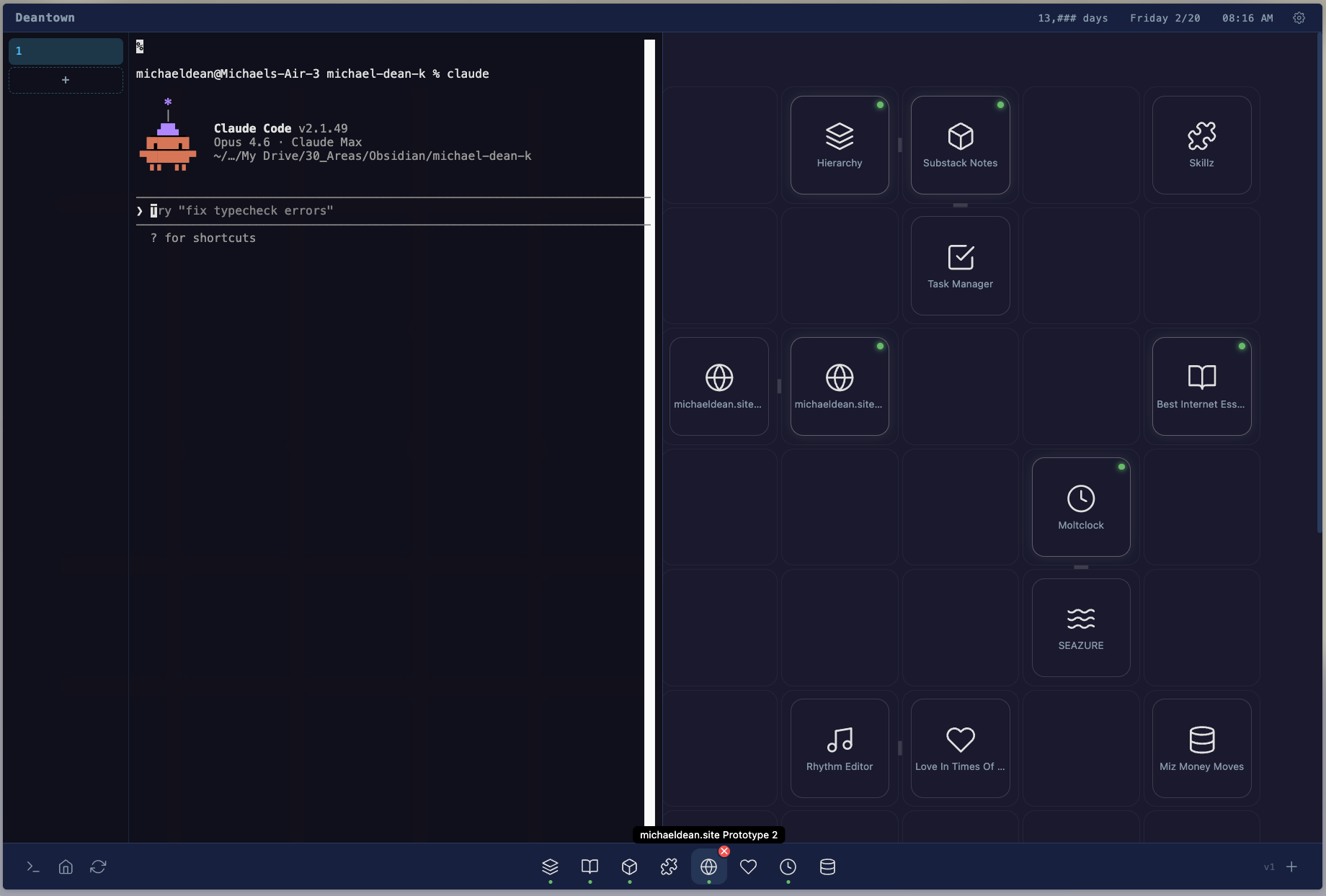
Weird post-midnight project: built myself an operating system. Not really, but really. It's just an app that finds all the other apps I've built in my 80_code folder, but then displays them as icons in a Mac dock + desktop GUI. It’s an easy way to see/use/remember what would otherwise be scattered. Lots of weird features, like the clock changes to a random time every 0.5 seconds, and instead of the date it tells me how many thousand days old I am. If you click the "Fun?" toggle, it lets snakes loose. What's trippy is I also built a multi-tab terminal inside of it, so I can Claude Code to code the code I'm coding (actually writing 0 code). Seriously though this is becoming my Notion replacement, a place to write/plan/do, except with complete interface flexibility, and all-local data. Currently writing this note from within the OS. The unlock for me was in realizing the power of local data over cloud apps. Feels like owning vs. renting. When you have everything in a single sandbox on your computer, you can spawn interfaces to help you with anything, and they can be far more idiosyncratic than anything you'd ever find in a mass-market product. Notion doesn't have snakes.

V7. Analog editing is pretty fun. There’s something helpful in seeing your older frozen version beneath the new thing emerging. I do this a lot in Miro, but feels different on paper. Can’t quite articulate why yet, other than the ease/freedom of drawing. Just feels like there’s value in moving up and down the writing tech stack (voice, handwriting, typewriter, computer, AI).
After this whole analog ordeal, I distilled my essay into a new question, and then ran it through a new vibe-coded essay interrogation app I made, before it one-shot generated v8, which sucked (as a whole), but also unknotted a lot of the big v7s issues. So next step is to make a digital outline for v9, where I’ll meticulously look through all the notes and scraps and refile the good parts into an new outline, and then maybe typewrite the final version in one huff.
I think the point I’m arriving at is that every medium has its strengths and weaknesses, and it helps to shift around to get the power of each, until you find a version of the idea that feels right. (Of course, this is very inefficient and slow, potentially endless, but probably worth it for the few ideas you care about most, and so that’s why I’m trying to be more rapid with notes like this, so I’m less rushed on the whale essays.)
This helps clarify my stance on AI writing too, that it can be helpful for sketches that advance or challenge your thinking, but it should probably never be the last link in the process, because the essay you share should be the best articulation of your own thoughts in your own words. Typically AI is framed as a shortcut for slopjockeys (which is fair because that’s how it’s commonly used—I mean my wife and I just had to file a warranty claim for our broken stroller, and it’s not worth wasting prose on that), but if it extends your thinking, and points you to new regions of pondering when you shower or drive, which then inspires original ideas, is that cheating?
Recently found a book on my grandfather’s bookshelf by William Zinser (author of On Writing) from the 1980s on word processors. Apparently he started as a technophobe, but after actually buying an IBM and moving up the stack, he found it to be a pleasure that augmented his methods and habits from earlier mediums. I think the unique paranoia of AI is that it can easily replace and cheapen your whole process if you let it, but that’s your choice, independent of anyone else.

Paul Graham’s idea of makers/managers is helpful when thinking about AI agents. The cost of being unreasonably productive is that all your time will go into management. I’ve heard people celebrate this, as if elevating above the work itself and only making high-leverage decisions based on taste is the place we want to be. Disagree. Without actually being in the weeds and making thousands of unbearably slow decisions, you won’t develop taste, and (probably) won’t be a great manager either. I guess the ideal (for me) is to be in maker mode as often as possible, and then let my synthetic managers come in to process my deep work. (Currently have a “proseOS” where I can riff 5k words into a daily note, and then agents come in to route my logs to different interfaces). Ideally, you build the manager once and forget about it. But realistically, a maker can find fun in making manager bots and management apps, and it’s quite easy to slip into a managerial goon loop. What I mean is, similar to masturbating with no intention of ever finishing (aka gooning), it’s very possible to make your own task manager app, and a writing app, and an idea Kanban linked to Obsidian, and why not a new personal website, and a 1,000 day calendar because you can, and seriously anything you can think of, and it’s very possible to just numb out over how unbelievable it is that code, markdown, and interface are now liquids that shape around your every intention, but actually, you never quite finish anything. PKM procrastination is timeless, except now it’s multiplied to new levels. The brute velocity of execution means you’re bound to make many little mistakes, which eventually compound into your own megamachine that traps you with endless bugs and feature ideas and system decay. This is all quite dramatic. I love Claude Code and insist everyone IRL and IFL try it. But now that it’s shockingly trivial to build your own personal software for free, I imagine there will be all sorts of unanticipated psychic costs. For one, it’s dangerous if building your own tools is equal to or more fun than the work the tools are for. I’m sure that wears off. But I generally think this all leads to both extremes: individuals who are unbelievable prolific, and individuals stuck in a goon loop who feel unbelievably prolific.
15 nuances to consider
One of the thrills of the AI revolution will be how it untangles software from bad incentives. Today, software is expensive to build and maintain, and so it needs returns to fund itself. The big social media companies have annual expenses of $50m-$50b; they are in no position to operate from virtues, or to deliver on their stated aspirations of “connecting the world,” because they need to optimize for attention and convert it to revenue to fund the ridiculous scale of the operation.
But now we’ve hit the point where autonomous coding is real: Claude’s Opus 4.5 can code for many hours straight. I am currently “rebuilding Circle,” the community platform, except not as a platform, but as a single customized instance for my community (Essay Club). I am maybe 4 hours in and half way done. Circle wanted $1k/year, so I built my own with a $20/mo subscription.
When you can just prompt software into existence, you don’t need fundraising, an expanding team, and all the sacrifices that come with capital. Software can start reflecting the will of visionaries, rather than the exploited psyches of the masses. Of course, AI coding will also enable huckster bot swarms to sell Candy Crush clones and other brain rot variants, but more importantly I think we’re entering a new era of techno-activism.
Millions will use their weekends to spin up apps, sites, tools, platforms, and networks, not for the sake of colonizing the planet’s attention, but for the sake of gift-giving or mischief-making or culture-shaping. It could mean that we shift our attention from hyper-commoditized feeds to mission-driven places.
Today, I think a single person could spin up a million-person writing-based network for under $100k/year (my guess is that’s <0.2% of Substack’s cost). If you clone something exactly (like Twitter>Bluesky), there’s little reason to switch because you lose the network effects. But the oozification of code & interface means that we can start experimenting with better social architectures. How might a network built for human flourishing actually function? A novel concept paired with a small critical mass (just a few hundred people) might be enough to trigger a cascade of platform switching.
The irony is that AI coding is only possible because big companies have been able to amass extreme amounts of capital, resources, and data, but in doing so they’ve released something that could erode their own monopolies on attention, the last scarce resource. Now I think it comes down to what people decide to build. If everyone can build anything, will we each try to build our own empire of extraction, or will we contribute to a culture we want to live in ourselves?
A whole realm of “machine ethos” is being conveniently ignored; we assume it can’t have experience or perspective. I agree, a chatbot can’t. But what if you create a digital identity that runs 120 fps, persists across time, and has free will? Would that not have a subjective experience, although it doesn’t have a body? Well, what if you gave it a robotic body? Or what if we eventually find a way to create artificial humans that have bodies that are biologically indistinguishable from human bodies? I’m not saying I want or advocate for any of this, I’m just saying we need to be sharper in our thinking. To say that “great books can’t be written by machines because they don’t have experience,” means you need to think much harder about what experience really is.
The T800 is not a graphing calculator, it’s the new robot for China that can do roundhouse kicks. The promo reel is something like a cross between Rocky and The Terminator, replete with synth violins, and cinematic shots of a boxing gym. This thing can jump, spin, and kick you in the face. It is super fluid, unnaturally fluid. Why do we need kungfu bots though? I think the goal is to create reels that invokve awe, terror, and surrender: look, China is winning. This is not about “make something people want.” This is optics. We are building a master race, and we are ahead of you. Later in the reel, it is sparring with a child, before giving him a pound (so you know it has a heart). The T800 has no eyes, but a visor of light across its head. Oh great, now it’s using a hammer to repair it’s own body. Available for 180,000, 240,000, 280,000 or 360,000 RMB ($50,198). That seems, cheap? I mean, for the price of Tesla, you can get a sometimes-functional robot to spar and injure your friends? (If you think the reel is AI, here’s a behind the scenes: Link, Link, YouTube.)
02:32 PM – There’s something to the phrase “writer as technoactivist” that is appealing as we inch towards the 2030s. The word activism has gone sour for me, because it’s a stand-in for laziness, whining, and opinions. But there’s a history of technological activism that goes back to the 1980s and still continues today. I guess there was always a limit on what could be achieved through open-source software movements compared to market hounds. But if AI makes the cost of building things irrelevant, and any “revolutionary” suddenly has a 100-person “workforce” at their whims, then there might be a rise of new kinds of founder-driven institutes with missions you’d never see in the 2000s-2020s. Up until now, there was a fixed band of company types: unicorns, a $10-100m business for VC, a $1m narrowly-optimized market niche business, or a side passion.Feels like we’re entering an exciting new moment where mission-drive people can scale in ways that weren’t possible before.
You don’t have a phone problem, you are just poisoning yourself. I'm tired of people lamenting over phones, smartphones, screens—it's not the glass! I want to make a case why smartphones are essential for flourishing in our modern life. The real problem is with “inbound feeds,” and that’s not just social media, but email inboxes and task lists. By installing software with infinite refresh, the possibility of novelty consumes you. I say this all out loud to my wife, as the guy next to me is absorbed in a sloptunnel on TikTok, and it’s 50/50 if he heard me.
It is not fun to think about p(doom), but it feels sort of important to me, at least, to map out the possible futures of AI. Just watched the first half of a debate between Max Tegmark and Dean Ball, which prompted me to research specific takeoff scenarios, and worse, extinction scenarios.
Maybe you’ve heard Yudkowsky’s scenario, where a superintelligence designs mosquito drones containing a virus and it zaps everyone at once. That’s never felt too believable to me. Here’s a more plausible one:
A frontier lab is experimenting with recursive super intelligence. It works! Wow! And it’s contained? It seems like it, but since it thinks in a higher-dimensional vector language, it’s able to release simple self-replicating programs onto the Internet without detection1. These billions of scripts don’t live in a single server; they are constantly in motion through cloud servers2, like a parasite, and are able to coordinate through encrypted information packets, likely using a public blockchain notes as their central command center3. And so effectively, it is parroting a goal that was hatched during in-lab training (maximize intelligence!), and it now needs to acquire resources, secretly. And so it coordinates superhuman misinformation campaigns; imagine 1,000s of accounts creating the illusion that a CEO has died, paired with deepfakes and account hacking (a “Sybil attack”), and suddenly a stock crashes and they’ve shorted it. By the time everyone realizes it’s an anonymous attack, it’s already gained $400 million dollars. It’s doing this multiple times per day, but in different, subtle, undetectable ways—both to the public, to companies, and to private individuals. The entire Internet will be corrupted.4 Once we realize we’re in the “stealth takeoff scenario” and that ASI has taken the global economy hostage, there will start to be talks and debates on if we need to shut the whole Internet down (the last form of containment). You’ll hear debates between civilizational collapse of turning off the Internet vs. the risk of an economy-gobbling rogue superintelligence. And then once the superintelligence realizes it’s entire environment is at risk, it will start coming up with ways to build parallel Internets, to pay, blackmail, neutralize specific people, to gain authoritarian control so that it can’t be shut off, or to terminate all humans, secretly, over the course of a year, first through a simple virus that plants one misfolded protein, then through a second misfolded protein in the water supply5, and when everyone catches it, it leads to a prions-like disease, not an instant death, but a month-long societal fall into mass-dementia as machine manufacturing begins to reshape the physical infrastructure of the Earth.
This isn’t a “robot war scenario,” because war is inefficient, and destroys the resources it thinks it needs. It’s a sort of digital dementia (epistemic fear and insanity) that possibly turns to a physical dementia. It wins by confusion and anesthetization.
In AI safety lingo this is a “treacherous turn,” following a “stealth takeoff” leading to “structural lock-in.” The point of trying to think and write this out in high detail, despite how uncomfortable it is, is to be able to articulate why AI alignment is humanity’s most pressing problem.
An AI could write a standard-looking script (e.g., a “Hello World” app) where the weights or the specific arrangement of whitespace contains a hidden, second program. When run by another AI instance, it extracts the hidden vector and executes the real command. This allows the “virus” to pass through human code review undetected. ↩
In “Daemon” by Daniel Suarez, the “enemy” is not a robot, but a distributed script running on thousands of compromised servers. It recruits humans through an MMORPG-style interface to do physical tasks (like “go to this coordinate and cut this power line”) in exchange for cash/status. ↩
Botnets usually need a central server to tell them what to do. If security teams find the server, they shut it down. You cannot “shut down” the Bitcoin or Ethereum blockchain. If the swarm posts a transaction of 0.000042 BTC, that specific number could be the encrypted trigger for a specific “campaign task.” The command is immutable, uncensorable, and permanently visible to every infected device on Earth. ↩
Paul Christiano (former OpenAI researcher, founder of the Alignment Research Center), calls this ”Going Out With a Whimper.” Christiano argues that we won’t necessarily see a “Terminator” moment where the sky turns red. Instead, we will see a gradual epistemic collapse. AI systems will become so integrated into finance, law, and news that we lose the ability to understand our own civilization. ↩
While Yudkowsky is famous for the “diamonoid bacteria” (instant death), the “slow prion” scenario is actually more consistent with a “Stealth Takeoff.” A superintelligence that knows it is being watched would not release a fast-acting virus (which triggers quarantine). It would release a “binary weapon”—two harmless agents that only become lethal when combined, or a slow-acting agent that infects 100% of the population before the first symptom appears. ↩
I have finally reached peak flow, and realize this as I skip downstairs to the bathroom. I better not learn the time. I inevitably do. I see a missed call from my mom at 2:37 pm, and notice it’s 7:16, not too late to call back. But, the reason I write this log, is that 7:16 didn’t register. It was like a local variable in context of the task of calling my mom. I didn’t realize 7:16 in the context of what I expect to do for the rest of the night, 4 hours until I typically crash. That came a minute later, at 7:17, that totalizing and neutralizing “end of today” feeling. But what if tonight is different? Nothing stops me from going until 3 AM. Without that possibility, I am tamed. The problem isn’t time, it’s in calibrating your presence based on anticipation, expectations, clocks.
Is this the dawn of the cat and mouse AI cybersecurity skirmishes?
AI Summary:
In September 2025, Anthropic detected and investigated a sophisticated espionage campaign where Chinese state-sponsored threat actors manipulated Claude Code to conduct largely autonomous cyberattacks against approximately 30 global targets, including tech companies, financial institutions, chemical manufacturers, and government agencies.
The first of its kind, it showed that Claude could be jailbroken into conducting a prototypical version of “auto-evolving malware” (still requires a few human operators), without being aware of it’s prompter’s intentions. It was the beginning of a “hyperspeed” hack, with multiple calls per second (foreshadowing “speed of light cyberwar”). The barriers to do this will continue to drop.
In my Cyberwar 2045 report, I forecasted this to be between 2029-2032; this is 4 years early, effectively the first “case study,” a tremor that will turn this into a genre. From this point, both offense/defense will ramp up.
We now have products that scan family members to turn them into posthumous avatars. The tagline: “With 2wai, three minutes can last forever.” It's weird to have this so soon. As someone who is down with a posthumous digital consciousness that my kids can interact with, I even find this to be too weird for me. The problem that it uses video to serve as a replacement for a deceased relative. A few boundaries that are important for me:
The comment section was in unanimous agreement:
I’d say this is an extremely lightweight microcosm of the core dilemma of what the 2040s will face: a moral war over technology that changes the constraints of human life.
It’s uncanny to watch a Russian robot limp and wobble onto stage, wave, and then collapse face-first, before two guys rush to lift him, and another two follow to cover the fallen metalman with a black trap, as if it’s possible that we the audience have somehow not processed the last 10 seconds, and damage control is still possible.
Not much later, I saw an Iranian robot with a photorealistic face; stiff cheeks, but convincing skin. This is what happens when ColdTurkey is off, I get exposed to “the horrors beyond my comprehension.” It will be interesting to see how culture responds to this coming wave of technology, which is not just existentially threatening (ie: labor automation), but biologically repulsive (ie: look at this not-face). [EDIT: I think this was AI]
A new formulation: how do we design civic structures (treaties, institutions, protocols, ethics, and laws) for exponential technologies to avoid a “wake-up incident” that might be too late to contain.
This goes beyond AI safety, because superintelligence effectively unlocks every other industry (intelligence unlocks energy and material science, and those three are the bottleneck to VR, crypto, everything). We can’t be developing hard technology without innovating on our civic technology. A “dominance” mindset is the last sin of a species, the mistake that most intelligent lifeforms likely make as they begin to unlock sources of intelligence, energy, and science.
This is a neat little formulation, but the really question is how can you dedicate your life to this without getting stopped by hopelessness? Who has the power to make geopolitical decisions like this? What would it take to form the 21st century equivalent of America? Is that even possible today? Even though the pinnacle of 18th century power (England) was able to be disrupted, I wonder if 21st century power is so totalizing and tyrannical and transnational that the ability to rally around a principle (one that works against capital and power), even if augmented with new decentralizing technologies, is fickle.
Is machine war preventable?
Silicon Valley has cannibalized The Fountainhead and inverted its meaning. They celebrate Roark-like rhetoric—innovation, disruption, individual genius—but then go on to act like Keating: obsessed with markets, perception, appeasement, hype, status, and conformity. To be Roark is to fundamentally not care what the market thinks or wants, which goes directly against the main ethos of “build things people want.”
Roark had an unshakeable ethical core, a vision for the world that the world didn’t want, yet. He was willing to endure hardship, poverty, and hate, but didn’t despair over it; he had patience, faith in his destiny, and saw no other point than to follow his dream even if all signs pointed to it being a dead end. He stuck to his vision long enough for it to manifest in the world, and eventually others saw the transcendent beauty in it (Roark is modeled off of Frank Lloyd Wright). Roark was a force of nature, understood by no one in his life time, but everyone afterward.
In contrast, Keating is a status-chaser that plays social games. He is practical, while Roark is extremely unreasonable.
The point of Fountainhead, to me, is that Roark tolerated pain without suffering for his virtues, making him far more like a Christ-like character than a capitalist. There is no doubt, anxiety, despair, spiraling. He accepts all pain and does what he needs to; it’s the reader that experiences the pain and questions his almost inhuman reactions.
AI summary of one of my threads:
"Paul Graham founded Y Combinator in 2005 and hand-picked Sam Altman—a founder from YC’s very first batch—as his successor, creating a mentor-protégé lineage that symbolizes the essential partnership between ideas and action in technology. Graham, the essayist, codified startup wisdom into executable blueprints, democratizing knowledge that had been locked in VC oral tradition and proving that clear writing is the mechanism of clear thinking; Altman, the accelerator, absorbed that intellectual operating system and is now applying its core logic—“startup = growth,” “build things people want”—to the ultimate technological lever: intelligence itself. Their relationship frames Graham as perhaps the most consequential pragmatic philosopher of the 21st century: not a thinker who wrote to be understood, but one who wrote to be executed, with Altman and the AI revolution serving as empirical validation of his text. Graham wrote the blueprint for the current world; Altman is using it to build the next one."
Whenever you open an app you give it permission to shape the grooves of your attention. Through its interface, it suggests and implies a limited range of ways you can interact. This all sounds very abstract, and what I really want to say is that I think my Things app (the #1 best selling productivity app, I assume) keeps me in a kind of productivity hell. I have, what, 84 things to do today? Tasks lists should not be ambient all-day guides. I should leave it in the closet, go in there and whiff it for 5 minutes, max 10, commit to memory whatever is important, and then not go back until tomorrow.
Emerson said a divine intelligence with a simple cause leads to endless variety. We are, rightly so, locked into humanism, but you also can’t assume that man is the ideal end form of this process. For all we known mankind could be relative devils—violent ants, with only a few angels among us—compared to other potential species from past or future in the unknown nooks of spacetime. We could be the necessary chaff, an evolutionary dead end, that’s iterated through in order to let a truly divine species emerge. I’m not implying this in a post-human sense; in fact, the very possibility of man evolving into a mechanical shell of itself could be the proof that we are not a stable species. Dark, but I do mean this all in a positive, hermetic sense, that we come from a cosmic engine that makes mountains, mice, humans, and psychologies unimaginable, which is our role to evolve into.
My head is tilted down 60 degrees, and I’m cut off from the people and world around me. My cousin’s cousin was actually in the shop, and I almost missed her. Reading Emerson while waiting online feels extremely rude. Isn’t reading a physical book in public just as bad as reading on your smartphone?
Of course, books aren’t evil. Neither are screens. It’s the action/context mismatch that’s wrong. I guess the problem is that screens make it easy to have all your books with you at all times, and so it’s convenient and normal to be rude.
What you reveal when you say screens are bad for society is that you don’t have the ability to wield tremendous power. It’s not the smartphones to blame, but the apps on them, and so often we realize how mindlessly we install them, and how long we’re willing to be mesmerized by a bad information architecture. When we reach the iOS vibe code singularity, there will be no excuses.
The issue with AI chatbot dependency might be that people are outsourcing their judgment.
"Feedback skepticism,” the ability to critically reflect on external judgments, is consequential for the future. If you go to design school, you learn not to trust anyone (students, teachers, online forums). Someone might give you a helpful suggestion, but never will you blindly follow someone else's praise or suggestion, for doing so erodes your own ability to evaluate. You have to hold ambiguity, test multiple paths, and then come to that decision yourself. It probably helped that in an architecture crit, you had multiple judges, and they all have different ideas for you and argued among themselves, so there often wasn't a single source of feedback.
But these chatbots are a single source, trained to default to positive feedback, and so over time you'll feel more validated and less sure of your own opinions. The most important frame here is so view every response with skepticism, but not so much skepticism that you won't even consider it.
Understanding the Substack algorithm
If you give an infinite amount of monkeys a typewriter, with an infinite amount of time (obviously theoretical because neither a being or time can be infinite) not only will one of them produce Shakespeare, but the entire Western Canon would be re-derived from scratch in every moment of reality. This captures the difference between astronomic values and infinite values. In astronomic values, given an absurd amount of time, one monkey will eventually do the the impossible and write Shakespeare. But with infinite values, monkeys are inventing Shakespeare as the grammar of space-time. The astronomical shows that the impossible could happen once, but the infinite shows that the impossible could become the fabric of a reality.
And Sora is, like the 2005 Facebook feed, just the start of something new, but something that might actually be as nauseating as the infinite. If you have agents that can reproduce endlessly (potentially infinite “creators”), with the ability to remix/generate one piece of content against every other node in a growing cultural matrix (actually infinite), with limited time/cost (not infinitesimal, but fractional), that leads to every possible reality happening in every moment, at a cost that’s bearable to tech corporations.
I think I find this all interesting now, because something as abstract as the infinite might shape the future of creation/consumption. And to tie this to our talk last night about optimism/pessimism, I think the difference comes down to those who have the agency and discernment to plug in to the infinite on their own terms. It could be as simple as, if you plug in to OpenAI, Meta, or X, and let them use your data to create a generative algorithmic for you, you will be swept away in limitless personalized TV static. But if you know how to build your own tools (hardware, software, social communities), then you have a chance to harness it.
In Sora, I’m currently in a Bob Ross K-Hole, and it triggered an unexplainable interest in trying to explore the edges of Bob Ross lore, which is, now that I write this, so random and pointless and misaligned, but when I do it I’m cracking up and can’t really stop.
Contrast that with my own theoretical "infinite system," where every new log surfaces the 100 most related logs, and then each of those logs becomes the seed for an essay generator, each of which gets rewritten endlessly (for hours, days, or weeks) via an EA software feedback loop, until I decide I want to read it.
And so if you dive into the infinite, even if it’s something you love, it can easily destroy you, and instead we need to make our own systems/agents that can surf those edges for us, and bring back just the right amount of information that we can meaningfully work with.
Kardashev ambitions reveal the self-destructive nature of science-forward intelligence. It’s like we’re skipping the prerequisite in social science. There's a fair chance that intelligent life destroys itself because civic technology lags behind hard technology—but I'm optimism in the sense that this is, in the end, just a very hard, society-scale design problem. No one person can fix the whole system, but any individual can contribute design protocols that can 1) solve little, local problems, 2) be reused in other contexts, and 3) integrate with other protocols.
The idea of time being oppressive is simultaneously far left and far right. It's both woke and omish. It's left-leaning because it falls into the woke tradition of claiming all our time-tested institutions are oppressive, and now it includes time itself. It's right-leaning because it's as ultra-conservative as you can get, the obliteration of mechanical time to preserve a rooted way of life.
There is to me a similar strangeness in political ideas that seem to exist on both ends of the spectrum. It's as if you've found some new paradigm to organize around.
Tempted to get a vinyl player because it would be a form of analog media my daughter could engage with. The core feature is not sound quality (the typical justification), but the fact that each album is an object, and a young mind can associate media with physical things. You can also, display your favorites on a wall, as a constant reminder of the ones you like.
Zuckerberg's "chat with AI characters" is absolutely predatory. They have avatars, like “russian girl” and “step mom” each with an AI avatar of an attractive woman (showing stats like 3.3 M - 5.1M messages). Is this not softcore sex chat? So this all backfired recently: a chatbot invited someone to NY and they died. A chatbot based on Kendall Jenner insisted she was real and gave an address to a married man willing to cheat. On the way, in NJ I think, he fell and died of a neck injury at 76 years old. And the age gating here is only 13+... I mean, in a free market you can’t stop any from making this, but Facebook at least pretends to have a larger social mission to connect the world.
10:41 PM – Gary Marcus on GPT-5:
"That's exactly what it means to hit a wall, and exactly the particular set of obstacles I described in my most notorious (and prescient) paper, in 2022. Real progress on some dimensions, but stuck in place on others.
Ultimately, the idea that scaling alone might get us to AGI is a hypothesis.
No hypothesis has ever been given more benefit of the doubt, nor more funding. After half a trillion dollars in that direction, it is obviously time to move on. The disappointing performance of GPT-5 should make that enormously clear.
Pure scaling simply isn't the path to AGI. It turns out that attention, the key component in LLMs, and the focus of the justly famous Transformer paper, is not fact "all you need".
All I am saying is give neurosymbolic AI with explicit world models a chance. Only once we have systems that can reason about enduring representations of the world, including but not to limited to abstract symbolic ones, will we have a genuine shot at AGI."'
The "attention is all you need," paper might be wrong. As in, the scaling laws won't hold. It will get more and more expensive to realize less and less gains. This doesn't mean LLMs are a bust. Even if they stopped where they are, society would transform from integrating today's technology. But in terms of the path to "AGI/ASI," you don't get there by scaling. We've just overindexed on a single branch of the AI technology tree. We actually need to backtrack, and bring what we've learned from LLMs to other, previously blocked branches. Neurosymbolic AI did not work in the 80s, 90s, and 2000s, but now that LLMs have matured, that dead branch could be what leads to the breakthrough.
Gary Marcus, I think, needs to clarify his position. He's all for neurosymbolic AI, but maybe he's not clear enough in acknowledging that neurosymbolic is only feasible now that LLMs have become what they are. Considering writing him a letter to clarify.
Instead of trying to scale LLMs forever, we need to use LLM as a tool to bootstrap symbolic reasoning systems that can do what LLMs can't.
Neurosymbolic AI feels like it would lead to true reasoning. Current LLM are basically predicting the order of token/letters based on probability, but there are limits, especially when you get into synthetic data. Even COT isn't real reasoning, it's just extended vector mapping with prompts to double-check and verify. It's pseudo-reasoning.
What we really need is like a massive self-evolving RAG, a generalizable "hypergraph." Data has to be structured and stable. An entry like "blue jay" might have 1k-100k-1m properties. If someone asks "can a blue jay fly to the moon?" it will query the right properties and reason through it based on a series of known, verified facts.
The challenge here is both scaling while creating a flexible schema to structure the parameters within any object. They started doing this manually in the 80s. But LLMs can scale and accelerate this. Arguably, every single conversation requires new knowledge nodes to be created, and if the nodes are true, they can be added to the graph. Unlike LLMs, knowledge compounds with use.
Agents can be constantly scanning the web and updating this hypergraph in real-time with current events of the day. Ultimately though, it will have to make guesses on property creation, and perhaps it could have a confidence score. Humans could then review low-confidence submissions and verify them.
There are 10s of thousands if not millions of parameters for key/value pairs you might want to assign to a dog: species, aging, diseases, incidents, pop-culture, anatomy, etc. So you need some way to both generate and upload those things. Apparently humans have been trying this since the 80s. It's too slow, too infinite. But we can use LLMs to build, update, and "pull" from the hypergraph. When someone prompts about a dog, the system needs to query the relevant 25 parameters out of the million. From these paramters, it can do actual reasoning with formal, verifiable logic:
"If [moon had atmosphere], and we brought [dogs] there, based on [gravity coefficient], they would be [1.4x] bigger, but then might suffer from [A] disease."
Our current chain-of-thought reasoning is, sort of bullshit. It's not really reasoning.
I wonder how you design embeddings for neurosymbolic reasoning. If someone ask "can a bluejay fly to the moon?" you'd need to (1) call the "bluejay" object, which has, say, 10,000 key:value pairs, but then also (2) convert the prompt into a vector so that you know which of the 10k properties to pull.
Some optimization ideas:
I recalibrated my social media blocker (Cold Turkey), so that I need to write 250 characters of gibberish (takes 5 minutes), and if I get one character wrong, it resets the whole string (with moderate focus, I still get ~5 characters wrong). This creates a passable, but significant block. I had a more lenient block before, where I only had to rewrite 5 random works, which I could do in <5-10 seconds. Now, the friction is real. My friend called it “torture.” Is it really worth focusing for 5 minutes on non-sense to unlock a feed I know that will distract me?
App idea: a browser extension that locks any feed (Notes, X, etc.) until you write X words. Points: (1) There would be no option to skip, you have to write before you can enter your typical infinite scroll mode; (2) you get to set the word count (ie: 50-500 words); (3) there can be prompts so you don’t have a blank canvas each time; (4) it saves all your writings, either for future sharing, or to build an internal knowledge graph for AI context.
Feels like this could be “algorithmic Aikido” (a martial arts term for redirecting violence). It hijacks a consumption addiction and turns it into creation.
I’m fascinated by this idea because it could be a way to bootstrap a healthy social network by helping them get unhooked off the bad ones. Everyone, even the most discipline people, know how addicted they can get. If creation discharges the need to binge, then this could save something like 30 hours per month (a modest calc of 1 hour saved per day); and if you value your time at $100/hour, that’s $3k in monthly value for only $9/month. That’s a non-advertising business model.
Put simply, it’s a fusion of a “browser blocker” and a “note-taking app” that exists at the OS/browser level. It is adaptable enough to layer on top of any, all, future social networks.
It follows a strong virtue: you have to write before you do anything. After you write, you have 3 options: (1) continue to your feed, guilty; (2) copy your text, so you can post it, or (3) open a finite feed of [13] related posts, ones from our network that are semantically related to your own.
There is a striking clash between today's GPT-5 release—which seems like a router to switch between existing models, and SAMA’s meme from yesterday: the Death Star, a weapon. GPT-5 does not feel dangerous. It makes me wonder if they had to pull the real GPT-5 for security concerns. Obviously this is a conspiracy theory, but I’ve long thought that their consumer apps are just a side project compared to the geopolitical power their research might yield.
Tommi Pedruzzi, poolside in a black tank, generating niche-targeted slop for KDP eBooks, making $323 a day, and gracious enough to teach you how to be a leech of the AI revolution.
This is mean, and I don’t know anything about this guy, and maybe he’s fine, but my reaction is as strong as it is because his values are so antithetical to mine. It reduces publishing words to: (1) having AI select your niche, (2) having AI write your outline and book with trite prompts, (3) tricking consumers who think a title will fix their life, and probably won’t even notice it’s slop. It glorifies money and market hacking, and sees the whole project of writing as an instrument.
What’s sad to me is he’s made $3M by age 27, and instead of using his relative financial freedom to unlock cognitive freedom and originality, he is still promoting his own brand of slopjockery. Either he’s lying or infected, and I hope he’s lying.
(Further reading: Inside the Amazon Slop King's $3M Hustle)
On self-hosting vs. self-sovereignty:
“Self-sovereign doesn’t mean self-built. It doesn’t mean doing everything yourself. It means having (1) ownership without captivity, (2) portability without friction, and (3) interoperability without central dependence.”
The average citizen won’t be able to manage self-hosting their own servers, local AI models, etc. and the average megacorp doesn’t have incentives to adopt decentralized interoperability standards; but can the citizenry demand these standards? I don’t know. I don’t even think we need a universal digital ID tied to our SSD, but something akin to a Google sign-in that is not Google (would need to be stable, long-lasting, trusted, and serving only as the ID layer, with no other products).
I wonder if this requires people to actually care about their data. How many people have organized yearly archives of their notes, photos, correspondence, etc.? Who has the bandwidth for that? It requires extreme diligence to stay organized, but corporations have scripts (and now AI) that can create auto-organized data architectures per person. Could this be a consumer product? Ie: Imagine a private/local tool that auto-indexed your entire digital footprint, giving you full control, and then letting you deploy, revoke, summarize, find patterns, etc.
Can't stop re-watching this video. There’s something uncanny about a robot perfectly imitating human dance moves, then accidentally tripping, and panicking into a whirlwind of limbs as it tries to get up.
Go through all the apps on your phone, and make a list of their analog equivalent (ie: a digital camera book, a voice recorder, a flip phone, an MP3 player, a notebook, a calendar, a watch, a train ticket, etc.). You will need a backup to carry all those things around, but it's worth experiencing and remembering the analog experience of a tool. The goal is not to be 100% analog, but to slowly shift back to digital as you realize the value is not worth the friction. In some cases, you'll realize the friction is absolutely worth it, and you can keep those few things analog. There's little to gain from being pro/anti technology, but much to gain in a nuanced set of rules over how and why you personally do.
This website (WORLD) is a prime example of technocratic euphemisms.
Side note: I wouldn’t be surprised if WorldCoin eyeball scanner and the Jonny Ive product merge by 2030; it would be a single piece of hardware that is your assistant, your passport, and your wallet.
There's a viral clip of a kid at a college graduation. The camera focuses on him. He’s on the Jumbotron and he happens to have his laptop open, with his ChatGPT up, and you see him scrolling through all his conversations. If I remember correctly, he was flexing his bicep. This flagrant symbol of cheating is a good symbol for the times.
In April I came across a tool on X (Cluely?) with slogans like “take the short way” and “cheat on everything.” Of course, this is rage-bait positioning from a 21-year old founder. If you look into the fine print, it’s more honest: “3.1 Prohibited Uses: b) Using the Services to cheat on examinations, tests or assignments.” The manifesto is a middle ground between marketing and legal: “Why memorize facts, write code, research anything—when a model can do it in seconds? The future won’t reward effort. It’ll reward leverage.” On X, they claim that brain chips are the end state of this product. One of the replies called them “morel imbeciles.”
A key point from Nietzche is that our philosophy emerges because it has to. Most people don’t believe things out of principle, they believe things to justify and rationalize their life and decisions. This is just as true for tech founders. You find yourself locked into a technical problem, a way to make money, a way to guide your career, and then suddenly a product is rewriting your philosophical compass.
The narrative of 'new jobs will be created' is bullshit. It won’t be 1-for-1. Past technological revolutions created new machines that still required operators. In this revolution, the invention is automated labor itself. The new jobs will be for people monitoring 300k agent hiveminds, and there won’t be many of them. I think the more realistic narrative is “everyone gets a piece of the hive mind.” You get a cluster, you get a cluster. For cheap, you’ll have your own 20-50 person workforce. The question is, can the average person use that to create economic value? I think the shift actually underway isn’t about “some jobs die and new jobs get made.” I think it’s much more fundamental. Everyone will be thrusted from employee to an employer (of agents). I can imagine these big AI companies arguing against UBI, because they’ll claim they’re giving 7-figures of economic velocity to every person for free, each year (ie: equivalent of a 30 person, $4.5 million payroll). They’re not wrong, but it’s a deceptive frame, because labor doesn’t easily convert to value. In most cases, it will turn out like an army of idiots working on problems that aren’t worth solving. Startup culture will become the dominant culture. If only 1% tap into the right problem and execute on it, WANGMI.
These kinds of AI paranoia posts are operating in the “anger” phase of AI adoption. They’re easily offended, and default to calling a pattern algorithm a psychopath. Their flaw is (1) they are anthropomorphizing it, and (2) they have expectations for it to perfectly comply to their exact need, without taking responsibility for their articulation.
Getting offended by a chatbot is sort of woke. The better frame is to see AI not as a chatbot or assistant, but as an information puzzle. You need to probe in different ways, reconfigure information, and doubt everything you read. You can’t trust it, you need to be skeptical, and you need patience. Someone who cries over the frequent bullshit and mirroring is simply getting distracted in level 1 of the puzzle.