Notes on the permanent underclass
The technological mutation from serfs to hippies

Architect-turned-writer, founder of Essay Architecture. Building pattern languages, software, anthologies, and community for essayists.
Architect-turned-writer, founder of Essay Architecture. Building pattern languages, software, anthologies, and community for essayists.
Essay Club ↗
Architect-turned-writer, founder of Essay Architecture. Building pattern languages, software, anthologies, and community for essayists.
Architect-turned-writer, founder of Essay Architecture. Building pattern languages, software, anthologies, and community for essayists.
Essay Club ↗
Architect-turned-writer, founder of Essay Architecture. Building pattern languages, software, anthologies, and community for essayists.
The technological mutation from serfs to hippies
A few months ago I saw a YouTube video titled something like, “A child born in 2025 is more likely to get killed by AI than graduate college.” What a ridiculous claim. I assumed it was clickbait and didn’t click, but it has jingled around my head enough to the point where I think I can make sense of it’s argument:
The average p(doom) of an AI engineer is 16%, meaning there’s a 1 in 6 chance of human extinction (put another way, companies have morally rationalized the need to play Russian Roulette—if we don’t do it the bad guys will—, without acknowledging that if they survive and win, they get the consolation prize of comandeering the whole economy).
40% of US adults, age 25-34, today, have a bachelor’s degree. If there’s massive job automation and employment, a college degree would be both unaffordable and an unreasonable cost if it were. It’s not unthinkable that <15% of next generation gets a college degree, which makes that sensational claim, weirdly, plausible.
I still think it’s a shaky comparison, confusing two different types of probability, and assuming extreme ASI turbulence. But as someone with a daughter born in 2025, it has gotten me to think about how the societal backdrop to her upbringing could be especially weird. Our circumstance already gets slightly weirder with each generation. Except, maybe next loop will be an unavoidable and disorienting flurry of change that will confuse parents and rewrite all of the conditions for the typical coming of age moment (all the teen movies will be sci-fi, the popular memoirs could be written by transhumanists who have upgraded in unimaginable ways, like they no longer need to sleep because of a new pill, or they can control the genitals of their peers with an app, who knows).
And so now, I find myself drawn to a 2045 forecasting project. Trying to predict the future is typically a huge waste of time (unless you’re gambling and win), which is why I’m going to have AI write the whole thing. This is a rare exception where a writing project makes little sense for a human to do. All I’m going to write are the upfront origin documents, and then Claude Opus 4.5 will read 25,000 sources, write a million words or so, and then organize it all into an interactive, oatmeal-looking website called 2045predictions.com (got it).
Before I run it, here’s something I’m currently thinking through:
What is the omega state? When I look at the popular AI forecasts from 2025, it reads to me like they have a pre-determined end state, only to then use detailed forecasting to make it seem convincing. The AI-2027 forecast seems like they came to their conclusion from very detailed calculations on how a hivemind of 200,000 autonomous coders would evolve month-by-month, but I also suspect that they picked the year 2027 because the following year, 2028, is a US election year, and they want the next administration to take AI safety far more seriously (instead of just insisting we have to beat China). I don’t think there’s anything wrong with this. You kind of have to start with an omega state. The future is so boundless that you need to begin with a guess, a bold outline on the general direction of things.
Here’s my omega: let’s assume humanity survives, and let’s assume technology does unlock hyperabundance that leads to a post-scarcity world, HOWEVER, it’s not utopian because it simultaneously unlocks a new cascade of moral, social, and spiritual crises, dilemmas that will test the timeless primitives of humanity (sex, life, death, consciousness, religion, home, etc.). This omega state makes sense for me because (1) we already know that ethical dilemmas scale with technology, and (2) according to the Strauss-Howe generational theory (from the same guys who coined “milennalis,” “Gen-Z,” etc.), this already tends to happen every 80 years (the length of a human lifespan). A new techno-political order creates a spiritual crises that generates an Awakening, a new value system that shapes society for the next century or so. You know what’s 80 years before Kurzweil’s “singularity” of 2045? The counter-cultural revolutions of the 1960s. What I’m getting at is that the 2040s might have echos of the 1960s, where demographics are divided on core issues and LSD is replaced with consciousness-altering machines (Terence McKenna said that computers are drugs, you just can’t swallow them yet).
We currently define the singularity as “the moment when a computer is smarter than all humans combined,” but that effectively means nothing, and it’s far more useful to have some guesses on how we all might freak out about that happening.
I imagine there will be two kinds of agent companies: 1) for modular services (ie: generic SaaS coderbots for $1k/month), but also, 2) for replicating identity. In a world where everyone gets access to swarms of modular agents that move at unimaginable speeds, I think those with a “replica” will have the edge. A replica is like a centralized manager entity—one that has your corpus of principles, lessons, memories, ideas, taste, libraries, etc.)—to coordinate between all the agents.
If this comes true, it brings new leverage to writing out your thoughts in detail. Maybe for every 10k words I write, my agent swarm is 2x more aligned to my specific goals. However, it also inverts the norms of data privacy. There’s a trade-off: the more you use writing for distribution and audience-building, the more clonable you become. It’s causing me to think harder about when a piece of content is public/gated/private.
So if models, apps, and infrastructure become too cheap to matter, then the only thing left that’s scarce is personal data / personal perspective. You’d think Notion/Google are positioned to solve this, but it’s interesting to watch people use Cursor as their PKM system because it’s so easy to connect personal context with an array of models.
So here’s why I think AI is going to take everyone’s job. There’s the classic and comforting belief that “humans’ adapt.” That’s been true. There’s been some technological breakthrough that makes an old class tools useless, and so a whole generation pivots to a new class of tools. But AI is an innovation in tool and worker. AI, when it gets cheap, commoditized, and agentic enough, will be a supply shock to the labor market.
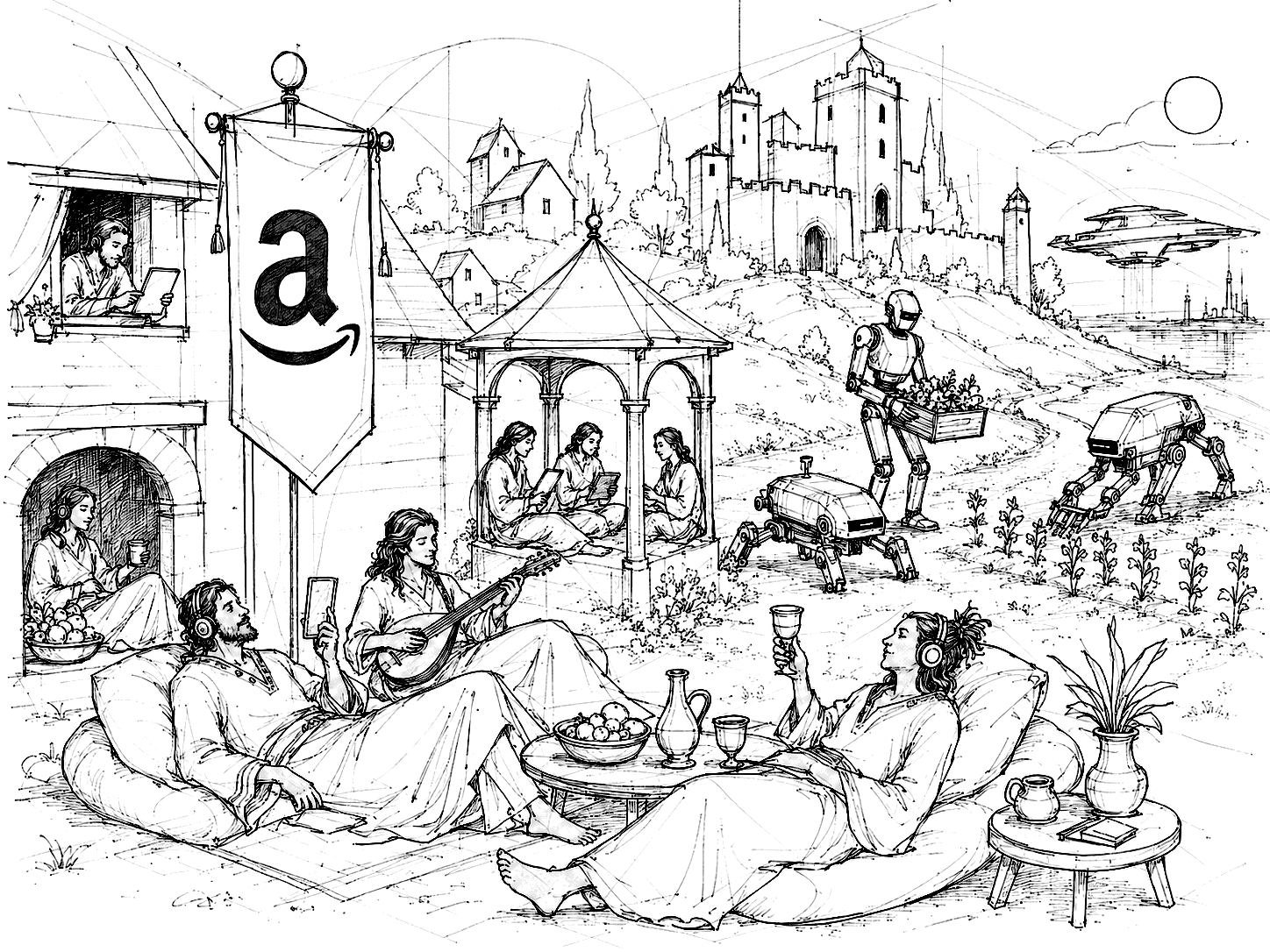
This might happen in addition to unimaginable productivity and abundance (if not destruction), and many utopians are calling for a “post-scarcity world” where everyone gets UBI. This will be a techno-luxury marxism. We won’t have economic value, but we’ll get paid to exist? We won’t understand how the machinery of culture works. It’s the next frontier of infantilism, and our parents aren’t human.
This leads to a leisure revolution and simultaneous meaning crisis. No one will be able to “escape from freedom” anymore. We’ll look back at full-time jobs as a form of slavery, and yet also, be paralyzed by a fear of the infinite possibilities in our lives. Best case, the average middle class person has no other option but to learn to become an artist.
This is of course a cartoon vignette, but fuzzy futurism is useful to the degree that it gets you to adapt to the present. Maybe that won’t come true, but if you assumed it true, how would you act today, and does that actually serve you in today’s timeline?