michael-dean-k/

On Monday 6/15, I'm hosting a workshop to kick off a reading group for classic essays: RSVP here.

Group

Language

13 pieces

How should an essay writer read?

· 1510 words

What and how you read should heavily depend on what your goal is. Outputs shape inputs. When someone insists you go back to read The Great Books, in order, in their entirety, they're giving you bad advice. It's not that those books aren't great—I hope to read Paradise Lost and Dante's Inferno and Finnegan's Wake and the Odyssey before I die— the problem is it's too generic a suggestion. To spend thousands of hours deep in the canon will obviously change you, but that's equivalent of throwing a beginner into the depths of the Atlantic Ocean, hoping they'll figure it out, with no sense of what their goals are.

If your goal is to write essays (every day, week, or month), then you're reading diet should look very different from a philosopher, professor, or researcher. You might not need to be a professional reader, but you should still strive to be a serious one. 3-4 hours a day might not be feasible, but 30-60 minutes per day through an intentionally selected list of sources will slowly build maps of material to fuse into your work.

If you're an essayist, you read so that concepts, forms, feelings, and words are always within reach from an idea of your own. It's no use quoting Aristotle from memory if you can't bend Aristotle to augment an original idea of your own.

It's time to make a syllabus. I've been guilty my whole life of haphazardly reading books and essays as I come across them, but now that I'm over 5 years into writing essays, I feel it's time to be more intentional. This essay is the artifact of me mapping out what, why, and how I'll be reading in the next 2-3 years. I've broken it into four practices: reading for ideas, reading for craft, reading for words, reading for feeling.

Reading for ideas

Since essays are so personal, it's very possible to draw from nothing else than the bank of your own life experience. Memory is absolutely one realm of material, but also, it helps to pull concepts from the world around you, in your time and in all times before. Anyone is exposed to some sliver of culture, and I suppose you could just rely on that. But there's another path which involves actively educating yourself.

Before I dive into the details of philosophy or history, I'm going to build a map. I want to go wide, not deep, because my existing maps are too fuzzy. ie: Who was Thomas Aquinas? Who influenced him, who did he influence, and could I hand write an essay on three of his big ideas? Until I can do that with 100 figures from antiquity to now, all interconnected in a web, I'm not prepared to dive into any Great Book. It would be a tremendous waste of time, for me at this moment in my life, to read The Leviathan by Hobbes in full, especially when I could read 30 pages on it from Alan Ryan, a philosopher-curator, whose prose is 400 years more modern, and who can contextualize old ideas into the full history. In the time I could finish one book from Hobbes, I could read Ryan's entire textbook and know 30 different thinkers at much higher resolution than I know now. By the end, I'll have an updated index on the history of political philosophy, and maybe I'll know that—based on my current writings—it makes more sense to dive into Rousseau in full.

How would my mind be different if I found and read the best curator across every field?

There's a specific kind of book I'm looking for to update my maps. It's not a textbook. It's similar in it's encyclopedic range, except it is slanted by a thesis, animated through a fervent voice, and concerned with the psychology behind the person known for an idea (instead of just biographical facts). Each chapter focuses on a figure for 25-50 pages, which feels like the right level of immersion. It might take 2 hours, compared to 20 hours for the source, and 20 seconds for Claude. While AI can surface historical ideas perfectly suited for your working draft, the problem is you outsourcing your recall. The recommendations are mechanical, impersonal, and worst of all, disembodied: you can't do it in your own head. By reading a sharp longform essay on Aquinas, his ideas will crystallize in my head and load into my subconscious; I'll know when he's relevant to my ideas at the layer of thinking itself.

The nudge to read all of Aquinas from scratch, on principle, is like asking a software developer to derive Internet standards from scratch instead of using libraries and plug-ins. For any thinker that matters, there's at least one person who spent a good deal of their life deeply understanding the source and distilling the concepts for you.

I'm going to share my working list, but the main caveat here is I'm not going in any particular order, and it's not necessary to read cover-to-cover. In any given month I'll be reading 1-2 chapters from 10 of these 24 books. In 45 minutes per day, I can get through most of this by the end of 2028 (2.5 years from now). Everything was published within the last one hundred years, and the whole thing costs $327.

You'll notice that all the links above are Kindle. This is because I want to have my highlights as atomic markdown files. The goal is not to read, but to write! Mapping and reading is just the setup so that I can read through and find highlights that spark original reactions. Montaigne's whole idea was to talk to his library, to be in conversation with the past through his books. And so the goal here is not to finish X books per year, but to produce original material. This is close to sounding like a Zettlekasten, but I should clarify that I don't plan to meticulously arrange my private highlights. A highlight is simply a prompt for an original paragraph that will immediately live on my website.

Other ways to read

I haven't spent as much time mapping out the other three modes, so I'll cover them briefly below, knowing I'll expand them later.

  • Reading for craft: If you writing essays, then reading them is how you learn through osmosis. It's where you pick up on the patterns on form and voice, consciously and subconsciously. My thinking here is to pick one essayists per week, read as much I'm inspired to, and move on. It's important to cycle here, because hanging too long on any one writer might lock you into a particular influence without realizing. I'm planning a summer syllabus for Essay Club so we can do this as a group.
  • Reading for words: Two years ago, I got really into reference books: dictionaries, usage dictionaries, the thesaurus, etymology, and even specialized dictionaries (on architecture, philosophy, scientific concepts). Sometimes I'd read cover to cover (futile), and others I'd practice words in ANKI. Expanding your vocabulary is seen is a pretentious thing to do today, when so much is geared towards simplicity and accessibility. Won't a rare word alienate the average user in your audience? No, because in the right context, ambitious words can increase the resolution in how you describe something. There's a joy in searching for words, but again, this comes back to returning to them repeatedly until it's actually coming through your prose.
  • Reading for feeling: Novels and poetry are less about collecting bits to synthesize into your work. This is more an act of expanding your understanding of how words can make you feel. Less about analysis, more about immersion.

An Intelligence Framework

· 703 words

The AI takeoff hysteria is hard to avoid these days, and I'm realizing we don't have clear distinctions between AGI/ASI. I wanted to revisit an old framework of mine to see if anyone finds it helpful (and if it's worth developing). There are some existing classification frameworks, but they're low-resolution. My basic idea is to break AI into three eras: ANI (narrow intelligence), AGI (general intelligence), ASI (superintelligence). Then, you can break each era into 3 tiers. You only shift from one tier to the next when you make breakthroughs across different criteria (let's say, (a) generality, (b) transfer, (c) autonomy, (d) learning, (e) self-modeling). I think the last few weeks are the collective hype of us all realizing we're shifting from AGI-1 to AGI-2. It's exciting/scary, but I think the paranoia mostly comes from not realizing how big the gap is between AGI-2 and ASI-1. (Spoiler: ASI might arrive slower than we think.)

ANI-1 is scripted logic, the lowest form of "artificial intelligence," basically Goombas. ANI-2 might cover Google Maps or AlphaGo, intelligences that excel in a single function, traffic or chess. Siri is ANI-3; even though it feels broad, it really uses voice to route you to 20 or so pre-defined tricks. The chasm between Goomba and Siri is similar to the chasm between early-AGI and late-AGI. ChatGPT and the multi-modal models that followed, capture AGI-1, a single neural network that can do basically anything, even if it sucks: essays, songs, video, code. The newest models (and their agentic harnesses) are feeling like AGI-2. They're significantly better at coding, can run for hours at a time, and are starting to make contributions to machine learning itself.

AGI-2 could last a couple years. As agentic AI matures, I'm sure there will be a few "takeoff" scares, but they'll probably feel more like a flood of a trillion midwits than real ASI (still, that could be enough to break the economy/internet). While we went from AGI-1 to AGI-2 through data, scale, and engineering, it seems like we'll need research breakthroughs to get to AGI-3. It won't be through scaling alone. Whenever and however we get to "human complete" intelligence, the apex of AGI is a single agent that is a master of all human domains, a Nobel Prize winner in every field at once, seamlessly transferring knowledge between them, unlocking a cascade of civilization-altering inventions.

As crazy as AGI-3 could be, it still isn't superintelligence. That has its own era, and the chasm between early ASI and late ASI will be as big a gap between the chatbots who can't count the R's in strawberry and the agents that cure cancer. We can only really speculate on ASI (because it would be truly alien), but we can imagine it as step changes in recursion, scope, and complexity. Imagine ASI-1 as an agent that, as it's working, can infer its own limits, and self-modify its learning paradigms in ways we can't understand. Imagine ASI-3 as something that can monitor reality in real-time, and, reconfigure its hardware in real-time (some hydra of graphics cards, quantum computers, and neuromorphic wetware) to run simulations at unfathomable scales in unimaginable fields, running on a hardware stack so big we have to put it in space and run it on fusion. This goes far beyond my ability to not bullshit, but I think something as insane as this, thankfully, is still far away, which points to the real question nested in my framework:

Could the rise of AGI/ASI be linear? People gravitate towards "AI will plateau" or "the singularity is imminent," but the conservative middle ground is more boring: linear progress. Maybe the exponential advances are real, but so are the extreme frictions of research, infrastructure, and social effects. If AGI-1 arrived in 2022, and AGI-2 arrived in 2026, maybe we'll keep ascending tiers in 4-year intervals: AGI-3 in 2030, the first true "superintelligence" by 2034, and ASI-3 by 2042. This shift from AGI-1 to ASI-1 (12 years), is considered a "slow takeoff" scenario, even though the ANI era took around 70 years. If we zoom out to the scale of a human, linear progress will still feel like centuries of change all in a single turning of generations.

→ source

Experimental

· 190 words

I like the word experimental because it fuses two halves of a process we don't usually link. What we typically mean is divergence, deviance, tinkering, norm-breaking. Weird stuff. Think avant-garde John Cage soundscapes where he makes music with only kitchen appliances. But also, the word points directly to the scientific process: to run an experiment means to set boundaries, gather insights, and test a hypothesis. Either mode alone falls short. Endless mutations burn you out, and rigid systems can't take you anywhere interesting.

Many of the original experimental artists were scientific. Kandinsky didn't just make abstract shapes, he developed a systematic theory on how colors/geometry provoked specific feelings, and then at the Bauhaus he used questionnaires to test which of his theories were true. I don't know exactly when this happened, but as weird works became mainstream, the word shifted from a process to a genre; the way it was made mattered less than the fact that it was unusual.

Experimental drifted into a contronym, a single word that contains opposite meanings. The power in the word comes when you re-unite both halves, entering strange territory with an analytical eye.

→ source

Fever Dream

· 313 words

Over the weekend I had a +101 fever, and so I was banished to an airbed in the attic to not infect the baby. Wrapped in blankets, I found myself in a sequence of near-identical “fever dreams.” Before this, I hadn’t thought about the phrase much. As a metaphor—"the president’s plan is a fever dream”—it implies a delusional desire, but real fever dreams tap into a different thing: for me, they’re about absurd procedural loops. I found myself deeply concerned with the layers of blankets around me: I had the urge to unfold them, visualize each one as a heat map, extract the cold parts with a boxcutter, restitch them into a new blanket, shape this new perfectly cold blanket into an animal sculpture, and then sell it on Etsy. I can’t remember the sequence exactly—it only made sense on the inside—but it was a cold-side harvesting operation for sure. I’d wake up and realize, oh, this whole scheme is stupid and pointless, and now that I know this I can sleep peacefully. Yet as soon as I went back under, I slipped back into this incoherent non-problem. It’s not uncommon to fall asleep and re-enter the same dream, but with a fever dream, I find that all I can do is return to my miscognitions, 5-10 times, until the fever breaks. It’s not scary, but repetition can be hellish (like the Teletubies DO IT AGAIN! sequences). My guess is that an overheated brain that’s deprived of REM will linger on thoughts it can’t digest. It becomes a type of lucid dream, a lame one with no visuals, where awareness of the loop can’t break the loop. There are probably situations better suited for the fever dream metaphor, but I can’t think of them now. Until then, no takeaways other than don’t get a fever, and if you do stay away from blankets.

→ source

Some words I don't know well enough

· 79 words

These are words I recognize, but probably don't the nuance well enough to integrate into my own prose: countenance, prodigious, clamor, visage, abate, undulate, venerate, incredulous, traverse, repose, lurid, languid, sagacity, tremulous, odious, pallor, stolid, wistful, prostrate, remonstrate, palpable, amiable, portent, importune, expostulate, vivacious, despond, doleful, pervade, pensive, procure, abject, austere, magnanimous, oblique, sallow, ignomy, resolute, furtive, fain, genial, mien, billow, confound, wan, indolent, reproach, morose, antipathy, alacrity, vestige, verdure, rebuke, inexorable, din, fortnight, abash, imperious, swarthy, impute, appellation.

Buffalo buffalo buffalo

· 93 words

Saw a post that says “‘Buffalo buffalo Buffalo buffalo buffalo buffalo Buffalo buffalo’ is a grammatically correct sentence.”

There are 3 usages:

  • Buffalo = a city in New York
  • Buffalo (noun) = a bison
  • Buffalo (verb) = to bull

So basically, “NY bisons (that) NY bisons bully (also) bully NY bisons.”

Three separate groups of bison from Buffalo, NY all engage in an endless cycle of bullying.

Put differently, “Bison from Buffalo [1] whom (other) bison from Buffalo [2] bully, will (also tend to) bully (yet another group of) bison from Buffalo [3].

AAI/ARI

· 365 words

We need better nomenclature. AGI/ASI is not working; “general” and “super” are obnoxiously vague. Proposal:

AGI > AAI (Artificial autonomous intelligence) … GPT-4 was arguably “general” in the sense that a single model can write, see, and hear; and do anything from poetry to calculus to history to coding. It is by no means narrow. Google Maps is narrow AI. Grammarly is narrow AI. This whole chatbot era should be “AGI,” which means that the thing coming is “autonomous intelligence.” It is not a tool or co-pilot, but it’s more like digital labor. You can give it a high-level goal, and it can 1) execute the full range of tasks, 2) 100x speed, 3) intelligently reshape embeddings into real-time hierarchies so that it’s able to procedurally load in and compress context. This doesn’t just come with better models, but with UI and engineering innovations, if not entirely new paradigms for transformers or training.

ASI > ARI (Artificial recursive intelligence) … The fact that Zuckerberg pitched “super intelligence for you” is an Orwellian marketing ploy. Super-intelligence is not “for you.” Super intelligence is shorthand for “something that is way, way smarter than us,” and you achieve this when you teach an AI model to think, form its own algorithms until it accelerates to something this is far beyond our understanding, and likely to become a force of nature with its own goals. Engineers are confident they can build “God in a cage” and reap the benefits, and this is the prime, archetypal, near-biblical example of technological hubris. (Maybe integrate into this paragraph that Zuck has a thing for trying to dominate words, like “Metaverse”).

Important note: “machine consciousness” is separate from AAI and ARI. Something can be recursively intelligent and still not be conscious, which is actually, unbelievably dangerous (because it will fall into attractor states, and optimize for narrow, malformed goals in extremely capable ways). I’d argue that consciousness has an architecture, whether human, rabbit, or robot, and we should be urgently trying to find the parameters of machine consciousness, because if we AAI/ARI have no ability to reflect, question, doubt, and revise, we will, as they say, all turn into paperclips with paperclip children.

Em-dashes earn trust

· 305 words

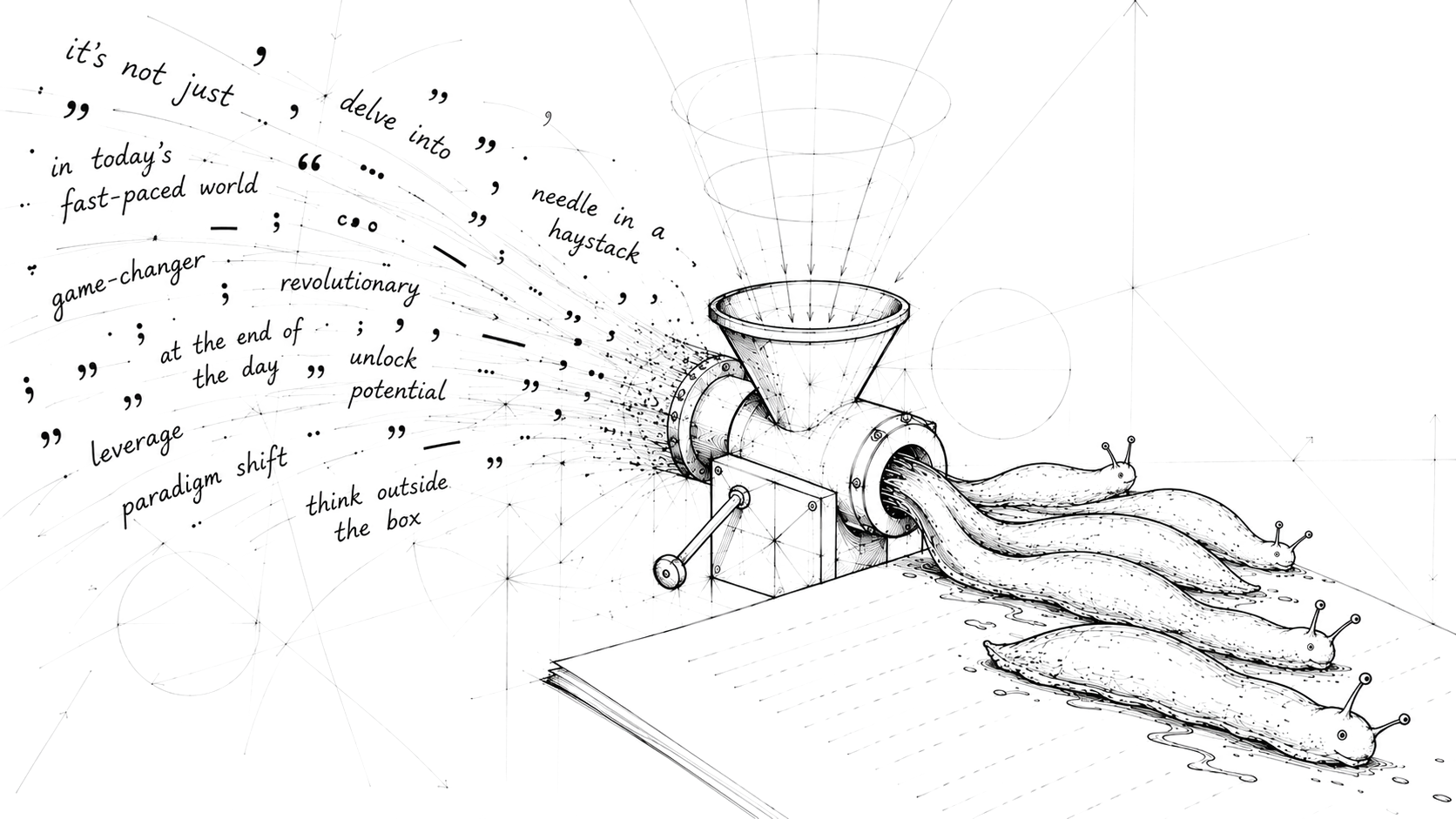
Punctuation often comes under assault. Kurt Vonnegut in 2005: “Here is a lesson in creative writing. First rule: Do not use semicolons. They are transvestite hermaphrodites representing absolutely nothing. All they do is show you’ve been to college.” Recently, there's been a wave of em-dash hate. Since chatbots tend to aggressively use them (multiple times per paragraph), any writer who includes them is now accused for having AI write for them. But I trust your writing less if you don’t use em-dashes.

First, it shows you’re not fluent enough in basic punctuation to properly articulate the thoughts in your own mind. I mean, sure, you get a lot done with just periods and commas, but punctuation marks are like visual aids that give you more precision in what ideas mean and how they are connected. I see em-dashes and parenthesis as siblings (of inverse function) that work together to help give structure to your emergent thoughts. I often find myself—mid-sentence—wanting to add details and embellishments; if they don’t fit into the structure of that sentence, I can contain them with punctuation. Both the ( ) and the "—[ ]—" let you inject detail into a sentence. They are “innies.” They either clarify or complexify.

These innie remarks are often a meta layer where the writer is reflecting on how the reader is processing their sentence, and they add clarification to make sure they are understood. They are punctuation marks about self-consciousness. Losing them is like losing a whole dimension of self-reflection. They’re used for digression, tension, clarification. Without them, you're not letting me see your mind at work, you are merelyh communicating. I wonder if AI bakes them in (via system prompt?) to give the illusion of a mind in thought, yet it’s really just capturing the syntax, and not really using it for digressions.

Idiosyncratic rules on numeracy

· 328 words

Garret on numeracy:

I suggest spelling out either: (1) all numbers below 10 or; (2) all numbers below 20 or (3) all numbers below 100 with the exception of your chapter references. If there are too many numbers like this in your pose, then the important numbers won’t stand out as much, like the reference examples later in this paragraph. Garner prefers option 1. DFW prefers option 2. Chicago style is option 3.

My reply:

Given different writers have their own range, is there a case for “all numbers below 2”? I’d argue that anything that is a quantity, other than a/one, can justify being a numeral: 1) it creates a visual fabric, where all quantity gets a specific symbol, and 2) it’s create the least readerly friction (I look to reduce this where I can because in other areas I intentionally add friction for specific ideas/phrases. To spell out “seventy-six,” in my mind, is a poor use of someone’s mental resources, an unnecessary drain of stamina. Even “7” over “seven” saves a few milliseconds of stamina that I will expend elsewhere. Also I love numbers. I’m really a math guy, and all my prose is just really filler between my numbers.

Here are some idiosyncratic rules on how to make these decisions:

  1. If two numbers occur in a sentence or a paragraph, use numbers so the reader can effortlessly see and compare quantities in a pre-read scan.
  2. If you have a set of labeled or numbered items to make a framework (a, b, c) or (1, 2, 3), you can default to spelling out a number so it doesn’t appear to be part of the framework.
  3. By intentionally spelling out large numbers, you make a point (“we waited for one hundred and twelve seconds for the waiter to return”). The delay of processing numbers can be used for effect.

This is a good example of rebelling against prescriptive, absolute rules: “everything under 10 must be spelt out.”

A spatial alphabet

· 134 words

Idea: A spatial numerical system where all digits have “Y” as the base number, where each stem of the Y represents an axis (X,Y, Z) and you can modify each stem with dots, dashes, squiggles, arcs, patterns, etc. So basically YY would be a line. Currently you could spell this out as “(1.42,0.42,3.40),(2.40,4.91,0.84),” but two Ys is way more compressed. There could even be a way to spell out three-dimensional shapes through a specific syntax that helps the Ys relate to each other. Of course, this wouldn’t be a readable language. But if machine vision becomes trivial and equal to text processing, then, in the attractor towards algorithmic compression, they might resort to a visual language. Especially if AI thinks through vectors, then they’d need not just a visual language, but a spatial one.

Active voice is overfitted marketing advice

· 55 words

The advice that our writing voice should never be passive comes from overfitting marketing advice to essay writing. Yes, sales pages on websites warrant a particular aggressiveness in tone; in that context, there are many things to click on and you’re trying to communicate clarity in the quickest possible time. Essays are not like that.