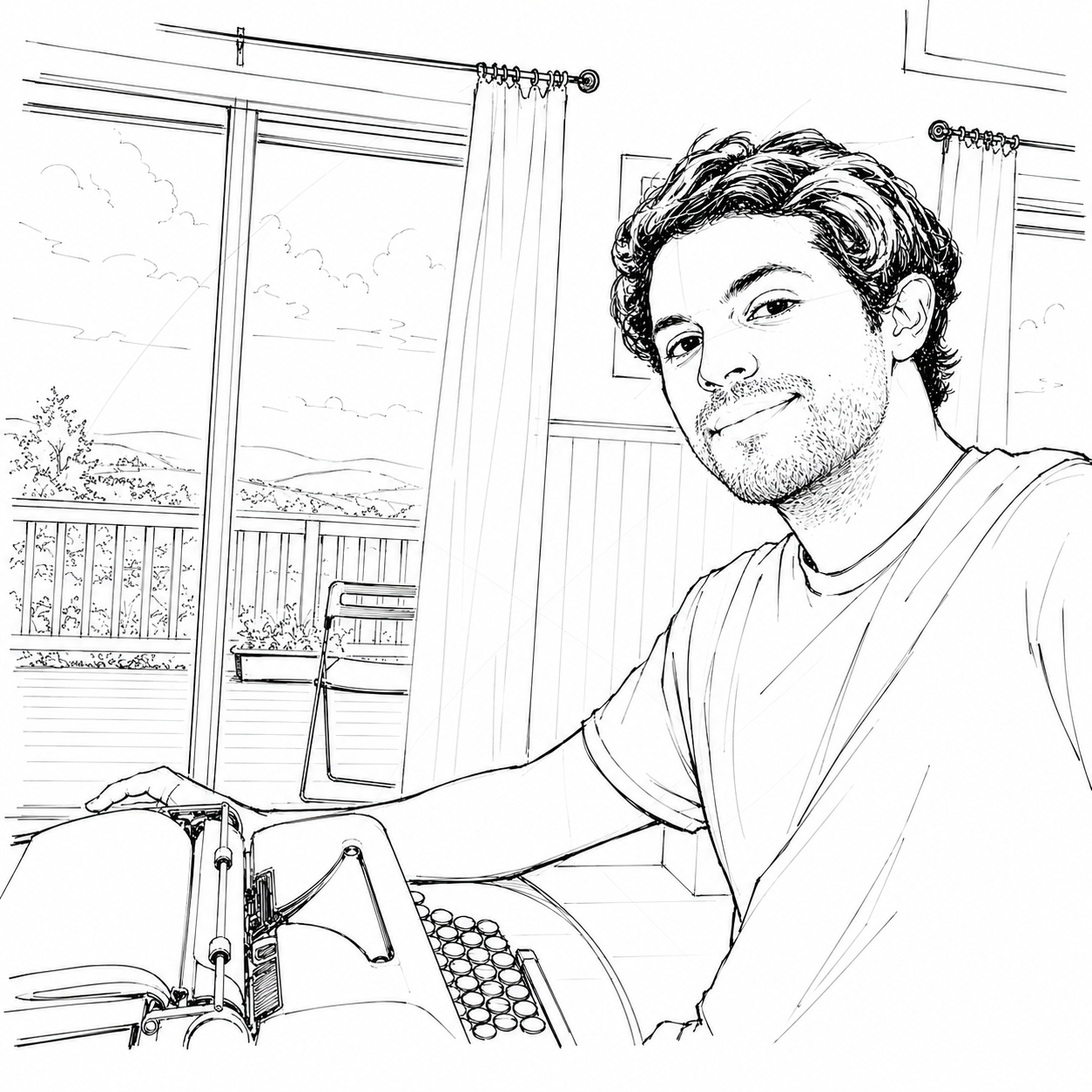
Writing blindfolded
What is automatic writing? There is allure, appeal, mythology, and history behind this term, which involves surrealists, beats, and sometimes random non-writers getting possessed at their keyboard, whether by Muse, by Enochian, by Lumerian, or by an unspecified spirit. Certainty, there are some techniques to get you there.
Last night, after a many-month drought, I broke out the typewriter along with an exercise book, "The Practice of Poetry," (Behn and Twichell). The second exercise spanned a 10-day stretched: each day I'd write whatever came to my mind, and, most importantly, I would not read it. Instead I'd stash it away in a drawer, only to come back to it after ten days, and only then would I read analytically, extracting accidental, emergent, resonant phrases that I could recombine into a poem. (Every time I finished, I am extremely tempted to read, because that's what I've always done after created anything, but denying yourself of that any editing or judgment forces you to ask yourself if the process itself was enjoyable.)
The details are slightly more specific than that, but there was no guidance on how to enter the forbidden realm of the Muse (or whatever you call it). No technique for the imagination. And so last night, on Page 1, I was quite in my head, quite analytical, quite my normal self, and felt quite uninspired. Afterwards, I reflected why this happened: I wasn't touching the "imagination," which I should probably define.
"Imagination" might not be the word here, but to me there is a dream-like mode of internal seeing, where I don't just see imagery, and it's not just hyper-realistic, but it's "self-evolving." Whether it's a scene filled with bustler's moving or a grotesque face, whether I am stationary or in motion, it takes on a life of it's own. It's also hard to pin down: it shapeshifts and flows into the next image, and the next and next and next, so afterward I'm left with a weird sense of what-in-the-world-was-that?, and I can loosely remember some scattered images, but it's mostly gone. I'm left with the post-trip spins of a rollercoaster or moving boat. I've always wondered, how might I capture the raw logs of these experiences? (They usually happen before bed or while meditating, and so I don't enter the realm with any intentions or techniques of rememberance.)
Whatever that is, I want to access it at the keyboard. That was my only goal this morning, and I got close. I figure, in addition to those streams of consciousness (which I will eventually read, and maybe share), I should write about the technique that seems to unleash it.
The main insight I'm left with is that you have to see, not read. Reading is very naturally part of writing. As I'm writing now on my laptop, I see each letter clearly formed—f-o-r-m-e-d—and I'm fully aware of where the sentence started, as well as the grammatical affordances ahead of me. Often I pause and re-read the last sentence or paragraph, and sometimes the whole piece, so I can get a sense of what's been said and what's left to say. This kind of analytical literacy is on the opposite end of the spectrum from poetic sight. I don't know if I can simultaneously read and hallucinate—this makes me curious to look up trip reports of people attempting to read/write on mushrooms/acid.
And so to really see as you write, a few things help.
First, my typewriter is slightly broken. After pressing a key, the carriage (?) lifts, and the metal prong pushes the ribbon onto the page, but the ribbon stays up after I unpress they key, blocking my view of the words being formed. This annoyance proved to be quite helpful. I should not be conscious of letters, words, or misspellings in this process.
Additionally, watching the back of your hands to make sure you're anchored over the right keys takes up bandwidth. When you watch yourself type, you expend attention that should be completely focused on conjuring sight, and so I just looked up. There is some NLP lore about how looking up triggers visions. Up and to the right is remembering past scenes. Up and to the left is inventing visual scenes. Or maybe it's reverse; I still cannot spot a liar... But once I did see a hippie in Mount Shasta meditate with his eyelids open and his eyes rolled completely up into his heads, so I could only see two white balls; it was creepy, but afterwards he explained in some not-entirely-convincing-but-still-plausible way how his specific patterns of eye-fluttering release DMT from his third eye that helps him see things... All that aside, you can hopefully type without looking. This is slightly harder on a typewriter, because when I pull the metal bar to jump to the next line, I lose my position. It's possible that Page 2 and all future pages will be completely illegible.
If I'm not reading words or watching my hands, then why have my eyes open? I did not have a blindfold nearby—I assume I have one in my apartment, and will try this tomorrow—but I did close my eyes. This lets me attempt to focus my attention purely on the "inner light" (inner sight), and my hands translate.
Halfway through, I started speaking out loud—in a slow, semi-dramatic British accent—to prosify what I saw. I don't know if this is for affect or actually useful. One theory is that spoken word is a bridge between sight and typing: I can easily narrate what I see, and I can easily type what I say. I can't doubt the tongue's ease of turning images into a prose; compared to the prose of fingers, the tongue feels one layer closer to the source, the original way we learned to speak, the way people spoke before writing was invented. And so this means the eyes are "seeing," the tongue is "prosing," and at this point, the hands have been demoted to a mere stenographer at the mind circus.