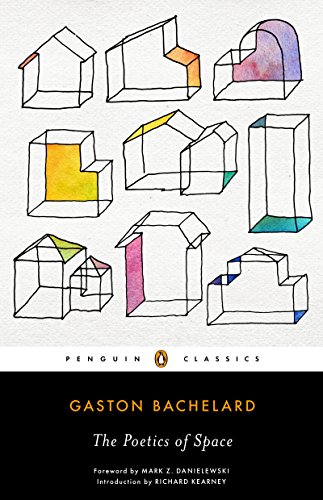
For you without imagination, who can matter-of-factly claim that you’re not the creative type—mind you, not proudly claim; for an imagination of ruin must burn beneath defiances against personal invention—then best put this book down and seek out instead some almanac of entertainment free from all such catalytic risks to a mind just mad enough to make out of one world another world.
Location 66
michael-dean-k/
Architect-turned-writer, founder of Essay Architecture. Building pattern languages, software, anthologies, and community for essayists.
Recent Essays
Highlights (50)
“The lock doesn’t exist that could resist absolute violence, and all locks are an invitation to thieves. A lock is a psychological threshold.”
Location 72Improbable discoveries wait at every border.
Location 77Discovery—not “hostile space”—concerns Bachelard. In the same way that Steve Erickson’s Days Between Stations and Thomas Pynchon’s Against the Day revive the sands of time as a medium intent on voyage, Bachelard gently addresses those settings we live in, and finally die in, with the lightness of why we live in the first place. Suddenly a chapter on miniatures offers a reflection on a hermit who while “watching his hour-glass without praying . . . heard the catastrophe of time.” The matter of prayer seems incidental to the anecdote, and yet throughout these pages there arises something meditative. Call it a calculus of emotional continuity or a music that only the grieving can know because they chose to carry on: what warms the hearth long after catastrophe has razed both hearth and home.
Location 79The Poetics of Space is one of those books in the tradition of Edmond Jabès’s The Book of Questions, Harold Bloom’s The Anxiety of Influence, Anne Carson’s Eros the Bittersweet, and Lewis Hyde’s The Gift. Whether portraiture of Sarah and Yukel; the designs poets inscribe upon each other; Sappho; the Kula exchange of necklaces and armshells, each of these aforementioned books becomes so much more: an indispensable guide for anyone set on becoming an artist.
Location 85The approval of architects seems the most obvious and at the same time the most odd. Despite the mention here of everything from floorboards to molding, names such as Isidore & Anthemius, Ictinus & Callicrates, da Vinci, Mansart, Gabriel, Soufflot, Garnier, Bartholdi, let alone Eiffel, Van Alen, Wright, Gaudí, Le Corbusier, or Pei, never appear. Instead the authorities vitalizing this work are Desbordes-Valmore, Caubère, Wahl, Caroutch, Poe, Barucoa, Morange, Clancier, Éluard, Milosz, Sand, Lafon, Duthil, Bosco, Monteiro, Proust, Spyridaki, Cazelles, Hartmann, Thoreau, Laroche, Guillaume, Bourdeillette, Richaud, Seghers, Supervielle, Wartz, Péguy, Rouffange, Vigée, Mallarmé, Bousquet, Goll, Ganzo, Shedrow, Valéry, Alexandre, Puel, Rouquier, Blanchard, Albert-Birot, de Boissy, Breton, Hugo, Bureau, Cadou, Patocchi, Rimbaud, Masson, Daumal, Vallès, Jouve, Guéguen, Baudelaire, Tardieu, Michaux, Pellerin, Barrault, Tzara, Rilke. Poets one and all. And why not? Just as stanza means “verse,” it also means “room.”
Location 91A young woman I’d met one night in a roomy loft on Varick Street responded to my sonnets with news that in Italian her name meant “death”—A
Location 99After all, here is a thinker who urges the reader to discover an excess of association: “And how should one receive an exaggerated image, if not by exaggerating it a little more, by personalizing the exaggeration? . . . in prolonging exaggeration, we may have the good fortune to avoid the habits of reduction.” At every turn Bachelard encourages personal engagement: “A house that has been experienced is not an inert box. Inhabited space transcends geometrical space.” Or here: “Sometimes the house grows and spreads so that, in order to live in it, greater elasticity of daydreaming, a daydream that is less clearly outlined, are needed.” What would that have been like? To have had such a teacher who applauded you for letting your thoughts run wild? Encouraged you to live beyond gutters and margins, frames and apps, the limits of map and page? Well, this is that education.
Location 104Above and beyond dwellings or even the inspirations of water and fire (see his Water and Dreams; The Psychoanalysis of Fire), image and language are central to Bachelard. He reveres image for its impact and the ecstasy it provokes just as he believes it is “the property of a naïve consciousness; in its expression, it is youthful language.” (We can only imagine with what reservation he would observe our present-day addictions to jpegs and gifs.) Language, on the other hand, recalls time just as it suspends the ordination of time: We find ourselves experiencing in words, on the inside of words, secret movements of our own. Like friendship, words sometimes swell, at the dreamer’s will, in the loop of a syllable. While in other words, everything is calm, tight . . . Words—I often imagine this—are little houses, each with its cellar and garret . . . To go upstairs in the word house is to withdraw, step by step; while to go down to the cellar is to dream, it is losing oneself in the distant corridors of an obscure etymology, looking for treasures that cannot be found in words. For language is both image and text. The one tool we have capable of transcending both. Or as Bachelard so succinctly puts it, evoking childish delight over a discovery at the beach set against the immensity of ocean:
Location 118What an inspiring pleasure then—with all this attention to paths and interiors leading to greater intimacies—to at the same time be reintroduced again and again to the outside. To suddenly discover D’Annunzio’s hares awake at dawn, running across “silvery frost” only to pause, ears alert, and by gaze alone “confer peace upon the entire universe.” And along with our own dreams of peace, ever beside such “animal peace,” to discover soon enough trees, many trees, beautiful trees.
Location 131Though a philosopher himself, he calls the philosophy of his day a “cancerization of the linguistic tissue.” And yet in the final chapters he lets slip (a confession really) how if he “were a psychiatrist,” he would recommend a poem by Baudelaire to treat “anguish.” His squabble then is not with the purpose but rather the approach of a still-young profession. And of course, why not…
Location 136As comfortable as Bachelard might be at a table of chemists and physicists, he could just as easily join a conversation between the ghosts of Carl Jung and James Hillman. His distaste is for what impedes in the name of dogma. He values the imagination because he recognizes that understanding without imagination is doctrine without growth. And without growth, what chance is there to engage the complexity that bounds us? Culture gives us our collective dreams—on stage, on screen, online—but daydreams grant us each the collective possibility of oneself. Bachelard wants his readers to find the courage to pursue that private and very personal becoming no matter how strange and unfamiliar the outcome may prove—if only because he recognizes that what must allways deny us in the…
Location 141Bachelard often praised imagination for its power of…
Location 150Far from remaining satisfied as a philosopher of science, when he got there he went on to embrace the life of the imaginary in all its forms: poetic, visual, psychological and elemental. There were many mansions in…
Location 152For many years now, readers of all stripes have been attracted to Bachelard’s poetic haunts: artists and architects, philosophers and analysts, writers and scholars, each finding what resonates with his or her own professional and personal interests. For some it is the phenomenology of roundness, for others the experience of insideness and outsideness, for others again the dream power of childhood or the collective unconscious: the way, for example, his favorite image—the tree—amplifies from root and bole to leaf and branch, offering nests to all sorts of imaginary dwellers. Bachelard paints a vast canvas, his sense of perspective ranging from the most intimate interior to the most…
Location 156So much of our experience today is processed by digital communication networks and social media, leaving little room for inner spaces of reverie and meditation—the sorts of places that Bachelard cherishes and celebrates in his poetic revisiting of basements and attics, nests and shelters, closets and stairwells, cupboards and chests. The Poetics of Space is about hide-and-seek places where the mind can go on holiday for a while and think about nothing—which means everything. Havens where the soul can pause, in silence, and free itself to dream. And let things be. Now more than ever we have need for intimacy, secrets, sites of interiority and contemplation where we can practice what Baudelaire—one of Bachelard’s favorite…
Location 166This book invites us to become readers and writers of our lives. And Bachelard is both. He is an author who loves reading, and no reader can enter the imaginary realms he opens up without falling in love with the world again. To follow Bachelard on his poetic meanderings is to be led through homescapes and landscapes of reverie and repose. It is to wander meditatively through new fields and forests of imagination where we revisit our experience as if it were the first day of creation. Rilke, another Bachelard favorite, has the artwork summon the reader with the words “Change your life.”1 Such change occurs, for Bachelard, when we re-enter the dwelling of the soul and intensify the transformation of being: “Our soul is an abode. And by remembering ‘houses’ and ‘rooms,’ we learn to ‘abide’ within ourselves.”
Location 177His famous turn toward poetics began in the late thirties when Bachelard decided to supplement his work on scientific epistemology (almost thirteen volumes) with an exploration of the life of art and creation. He had become increasingly dissatisfied by what he called the “growing rationalism of contemporary science” and was eager to investigate the “ecstasy of the newness of the image.”3 This meant breaking with the strict habits of scientific research—which placed new discoveries always in the context of acquired bodies of evidence—so as to expose oneself to the novelty of the poetic instant. Because “the poetic act has no past,”4 we must be fully attentive to the image at the very moment it appears, both as itself and as a vibration of the psyche. A new methodology was called for. The notion of attention was key. Bachelard was concerned as much with the “material” image that stirs us in our depths as with the “formal” image that we produce in response. Bachelard offers a poetics of both matter and form, whereas Aristotle had originally defined poetics in terms of formal properties of plot (muthos) and imitation (mimesis). Poetics comes from poiesis, meaning “to make,” and for Bachelard this is a two-way process: we are made by material images that we remake in our turn. We are inhabited by deep imaginings—visual and verbal, auditory and tactile—that we reinhabit in our own unique way. Poetics is about hearing and feeling as well as crafting and shaping. It is the double play of re-creation.
Location 186For Plato and many medieval philosophers, imagination was construed primarily as a mimetic act of mirroring, representing, copying. This approach was often associated with deceit and illusion, with confounding original realities with secondary substitutes. By contrast, for Kant and the romantics—including German idealists and existentialists like Sartre—imagination was hailed as a productive force in its own right, the source of all true meaning and value. Bachelard resisted both extremes. For him imagination was at once receptive and creative—an acoustic of listening and an art of participation. The two functions, passive and active, were inseparable. The world itself dreams, he said, and we…
Location 200Hence Bachelard’s refusal of Jean-Paul Sartre’s argument in The Imaginary (1940) that perception and imagination are two radically opposed modes of intentionality. Where Sartre spoke of imagination “unrealizing” the world and replacing it with a solipsistic consciousness, Bachelard celebrated imagination’s power to realize the unrealized potential of the world. Where the Sartrean imagination involved a radical negation of things—issuing in an essential “poverty of being”—Bachelard saw imagination…
Location 208For Bachelard the cosmos, no less than the human psyche, is brimming with the…
Location 213Imagination is a laboratory of the possible inviting us—through reverie and poetry—to give a future to the past. And it is not just a matter of a private past (though Bachelard’s memories of his hometown of Bar-sur-Aube ghost his work) but of a shared reservoir of resonances…
Location 216Bachelard is in his element in poetics, and his poetics is of the elements: water, fire, air and earth. The list of his works on the “elemental imaginary” is hugely telling in this regard, ranging from Water and Dreams, Air and Dreams, Earth and the Reveries of the Will, Earth and the Reveries of Repose right up to his final works, The Flame of a Candle and Fragments of a Poetics of Fire. The term “element” does double duty for Bachelard as both a material and metaphysical substance. Elemental space is something we dwell in with body and soul. It is to be found—shaped and formed—in the “material paradise” of…
Location 218Though primarily inspired by phenomenology, he was discreetly drawn toward Eastern philosophies and even mysticism, evident in his continuous pursuit of a “philosophy of repose” over against the Angst that ghosted much European culture during his lifetime. He stated this preference as early as his Dialectic of Duration in 1936 and as late as The Flame of a Candle in 1962. Yet, as a modest phenomenologist—with the ingrained discipline of a laboratory scientist—Bachelard steered away from explicitly spiritualist or religious language as much as he did from political discourse (or any language that risked becoming tendentious). Instead, he made a sustained effort to think always from the beginning—focusing on the micro-phenomenon of the poetic image “at the moment of its emergence” in the reader’s waking consciousness. In this sense his writing and thinking are deeply democratic, available to everyone regardless of ideology or creed. It requires no academic degree to appreciate the genesis of the image in the individual consciousness. His imagination is capacious, nothing deemed ineligible if it stirs being into language and language into being. No reader is excluded: professional or amateur, expert or lay. Anyone who can read poetry can read Bachelard—a philosopher of the infinite in the infinitesimal, of the mystical in matter. Daydreams and fantasies are grist for poetic reverie as much as masterpieces by Dante or Baudelaire. “When we dream, we are phenomenologists without realizing it,” Bachelard tells us.7 We are born poets whether we like it or not, though what we do with it is our singular responsibility.
Location 229It is here that Bachelard inaugurates the distinctions between a “phenomenology of soul” (intuition) as opposed to a “phenomenology of mind” (analysis) and between “superlative” imagination and “comparative” reason (poetic words, he notes, are not comparisons but transformations). And it is also in this work that he sharpens the crucial difference between harmonic values (indeterminate reverberation) and empirical facts (determinate observation).
Location 243Bachelard’s poetics of space equally entails a poetics of time. The temporality of the image is, he insists, that of the instant. Here we are concerned with epiphanies that riddle the continuity of time. Bachelard claims that every true poetic image breaks with linear clock time, introducing a dimension of verticality in depth and height.8 Where prosaic…
Location 248Echoing Coleridge’s definition of poetry as the “balance or reconciliation of opposite or discordant qualities,” Bachelard maintains that the poetic instant is…
Location 253The poetic imagination thus substitutes simultaneity for succession. It calls for a radical transmutation of values in a gesture Bachelard calls “rapture” or “ecstasy.” A genuine poetics of space explodes the continuum of the world’s time, as happens in the reading or dreaming of a great fantasy. Just think, for example, of how the creative revisiting of a childhood room can provoke a sense of “involuntary memory” that renders the recalled image timeless and essential—the past suddenly transformed into a miraculous present, as in the Proustian remembrance of the mother’s bedtime kiss. But for Bachelard the imagination even surpasses the limits of the personal past, embracing…
Location 256For this reason, he insists, images are more demanding and rewarding than ideas. They give logos to perception. So that, as he says, we can devote our reading being to an image that confers being on us. In fact, the image that is the pure product of “…
Location 265Bachelard adopts what he calls a phenomenological attitude of “daily crisis” that allows consciousness to be exposed to the moment’s gift.11 Resolved to let images speak for themselves, he resists all determinist models of explaining consciousness in terms of prior infantile, historical or behavioral events.
Location 271the poetic daydream cannot content itself with the rudiments of a story; it cannot be tied to a knotty complex. The poet lives a daydream that is awake, but above all, his daydream remains in the world, facing worldly things. It gathers the universe together around and in an object.13
Location 277hermeneutic thinkers like Ricoeur with the claim that the image is a four-way relationship between author, reader, text and world.
Location 289Contrary to the formalist ideology of the absolute text (closed in on itself), Bachelard celebrated the interactive function of imagination as a symbolizing process involving someone saying something to someone about something. Poetics, for Bachelard, is not a matter of anonymous floating signifiers; it signals a relational dynamics between beings, involving vital dimensions of intimacy, secrecy, desire and repose. Imagination is at its best when it is incarnate, elemental, opening out into time and space, even when the space is elsewhere—before being, beneath being, beyond being, more than being. For Bachelard, images are not merely seen but lived. They are not just vision, but the cosmos itself as it expands and amplifies from the minute to the magnified, creating a “concordance of world immensity with intimate depth of being.”15 Images touch us at the deepest place of existence and remake the world again and again. Baudelaire—oft cited by Bachelard—expresses this with his notion of “correspondences” that transform vast expanses into the intensity of our inmost being. Correspondences institute “transactions between two kinds of grandeur”—inner and outer.16 They draft peace treaties between self and world. “In the realm of images, there can be no contradiction.”17
Location 290The ultimate task of a phenomenology of imagination is, Bachelard concludes, to capture images at their inception, as they begin anew. In this the phenomenologist and the poet are one, for they both know that imaginative contact with the outer world renews our inner being.
Location 302Bachelard invites each reader to join company with his walking companions—Rilke, Lautréamont, Mallarmé, Poe—on such grand imaginary journeys. Once you have entered the poetics of space there is no going back. The home you revisit is never the same again.
Location 307The long day-in, day-out effort of putting together and constructing his thoughts is ineffectual. One must be receptive, receptive to the image at the moment it appears: if there be a philosophy of poetry, it must appear and re-appear through a significant verse, in total adherence to an isolated image; to be exact, in the very ecstasy of the newness of the image. The poetic image is a sudden salience on the surface of the psyche,
Note: Similar to the philosophy of prose? It’s about capturing new thought as it occurs, which is the very case against AI. But also, writing is not just the process of the image? Poetry maximalism downplays editing and craft
Location 425Very often, then, it is in the opposite of causality, that is, in reverberation, which has been so subtly analyzed by Minkowski,1 that I think we find the real measure of the being of a poetic image. In this reverberation, the poetic image will have a sonority of being. The poet speaks on the threshold of being. Therefore, in order to determine the being of an image, we shall have to experience its reverberation in the manner of Minkowski’s phenomenology.
Note: Less about A+B=C logic, but following emotional power and association
Location 438the poetic act itself, the sudden image, the flare-up of being in the imagination, are inaccessible to such investigations. In order to clarify the problem of the poetic image philosophically, we shall have to have recourse to a phenomenology of the imagination. By this should be understood a study of the phenomenon of the poetic image when it emerges into the consciousness as a direct product of the heart, soul and being of man, apprehended in his actuality.
Note: Process, not patterns
Location 448how can an image, at times very unusual, appear to be a concentration of the entire psyche? How—with no preparation—can this singular, short-lived event constituted by the appearance of an unusual poetic image, react on other minds and in other hearts, despite all the barriers of common sense, all the disciplined schools of thought, content in their immobility?
Note: Image as revelation and transmission of self
Location 461The poet, in the novelty of his images, is always the origin of language. To specify exactly what a phenomenology of the image can be, to specify that the image comes before thought, we should have to say that poetry, rather than being a phenomenology of the mind, is a phenomenology of the soul. We should then have to collect documentation on the subject of the dreaming consciousness.
Note: To write in images
Location 478the soul—as Rouault’s painting proves—possesses an inner light, the light that an inner vision knows and expresses in the world of brilliant colors, in the world of sunlight, so that a veritable reversal of psychological perspectives is demanded of those who seek to understand, at the same time that they love Rouault’s painting. They must participate in an inner light which is not a reflection of a light from the outside world. No doubt there are many facile claims to the expressions “inner vision” and “inner light.” But here it is a painter speaking, a producer of lights. He knows from what heat source the light comes. He experiences the intimate meaning of the passion for red. At the core of such painting, there is a soul in combat—the fauvism, the wildness, is interior. Painting like this is therefore a phenomenon of the soul. The oeuvre must redeem an impassioned soul.
Note: What is inner light literally? Assumed as a metaphor previously, but is it the act of seeing closed-eye visions?
Location 496A consciousness associated with the soul is more relaxed, less intentionalized than a consciousness associated with the phenomena of the mind. Forces are manifested in poems that do not pass through the circuits of knowledge. The dialectics of inspiration and talent become clear if we consider their two poles: the soul and the mind. In my opinion, soul and mind are indispensable for studying the phenomena of the poetic image in their various nuances, above all, for following the evolution of poetic images from the original state of revery to that of execution.
Note: Revery then execution
Location 503In itself, revery constitutes a psychic condition that is too frequently confused with dream. But when it is a question of poetic revery, of revery that derives pleasure not only from itself, but also prepares poetic pleasure for other souls, one realizes that one is no longer drifting into somnolence.
Note: Reverie as an internal reason to write
Location 508To compose a finished, well-constructed poem, the mind is obliged to make projects that prefigure it. But for a simple poetic image, there is no project; a flicker of the soul is all that is needed.
Note: Project vs flicker
Location 510we feel a poetic power rising naïvely within us. After the original reverberation, we are able to experience resonances, sentimental repercussions, reminders of our past. But the image has touched the depths before it stirs the surface. And this is also true of a simple experience of reading. The image offered us by reading the poem now becomes really our own. It takes root in us. It has been given us by another, but we begin to have the impression that we could have created it, that we should have created it. It becomes a new being in our language, expressing us by making us what it expresses; in other words, it is at once a becoming of expression, and a becoming of our being. Here expression creates being.
Note: The paradox that all readers have unique experiences yet also all readers have similar experiences. I imagine poetry diverges more among readers than essays.
Location 531Thus the poetic image, which stems from the logos, is personally innovating. We cease to consider it as an “object” but feel that the “objective” critical attitude stifles the “reverberation” and rejects on principle the depth at which the original poetic phenomenon starts. As for the psychologist, being deafened by the resonances, he keeps trying to describe his feelings. And the psychoanalyst, victim of his method, inevitably intellectualizes the image, losing the reverberations in his effort to untangle the skein of his interpretations. He understands the image more deeply than the psychologist. But that’s just the point, he “understands” it. For the psychoanalyst, the poetic image always has a context. When he interprets it, however, he translates it into a language that is different from the poetic logos. Never, in fact, was “traduttore, traditore” more justifiably applicable.
Note: Not the analytical understanding of an image, but the immediate feeling of it
Location 539When considered in transmission from one soul to another, it becomes evident that a poetic image eludes causality. Doctrines that are timidly causal, such as psychology, or strongly causal, such as psychoanalysis, can hardly determine the ontology of what is poetic. For nothing prepares a poetic image, especially not culture, in the literary sense, and especially not perception, in the psychological sense.
Note: No causality between image and reaction
Location 547Through this creativeness the imagining consciousness proves to be, very simply but very purely, an origin. In a study of the imagination, a phenomenology of the poetic imagination must concentrate on bringing out this quality of origin in various poetic images.
Location 551Here the phenomenologist has nothing in common with the literary critic who, as has frequently been noted, judges a work that he could not create and, if we are to believe certain facile condemnations, would not want to create. A literary critic is a reader who is necessarily severe. By turning inside out like a glove an overworked complex that has become debased to the point of being part of the vocabulary of statesmen, we might say that the literary critic and the professor of rhetoric, who know-all and judge-all, readily go in for a simplex of superiority.
Note: Evaluation vs feeling [e]
Location 563It is within us, mere readers that we are, it is for us, and for us alone. It is a homely sort of pride. Nobody knows that in reading we are re-living our temptations to be a poet. All readers who have a certain passion for reading nurture and repress, through reading, the desire to become a writer. When the page we have just read is too near perfection, our modesty suppresses this desire. But it reappears, nevertheless. In any case, every reader who re-reads a work that he likes knows that its pages concern him. In Jean-Pierre Richard’s excellent collection of essays entitled Poésie et profondeur (Poetry and Depth), there is one devoted to Baudelaire and one to Verlaine. Emphasis is laid on Baudelaire, however, since, as the author says, his work “concerns us.”
Note: Reader to writer
Location 570