michael-dean-k/

On Monday 6/15, I'm hosting a workshop to kick off a reading group for classic essays: RSVP here.

← all books
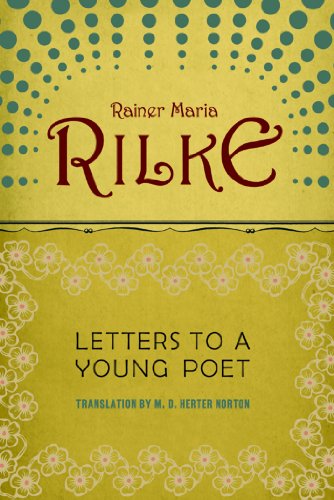
Letters to a Young Poet cover

Letters to a Young Poet

Author
Rainer Maria Rilke and M. D. Herter Norton
Highlights
33
Responses
0
First highlight
Jun 1, 2026
Last highlight
Jun 2, 2026

Highlights (33)

With nothing can one approach a work of art so little as with critical words: they always come down to more or less happy misunderstandings. Things are not all so comprehensible and expressible as one would mostly have us believe; most events are inexpressible, taking place in a realm which no word has ever entered, and more inexpressible than all else are works of art, mysterious existences, the life of which, while ours passes away, endures.

Note: density of ideas here: on essays as the bridge between poetry and criticism; the ineffability of conscious experience; the immortality of art.

From generation to generation, a corpus of perennial mysteries holds ineffable. Timeless pillars of the human experience, never understood. Of course, with our sciences and our histories we also have silos of observable, stable facts. Things to sink our teeth into---a confidence that most things are known and it is simply a matter of having the discipline to binge through archives to learn exactly what happened as it did. But when we get into the realm of emotion, experience, consciousness, the substrate that most dictates the qualities of our life, from birth to grave, most of that has never really been captured in a resolution adequate enough to resonate with our unspoken, unarticulated inner feelings. And the mysteries are not just timeless; our situation mutates at a rate that our great-grandfathers probably could not conceive. It is urgent to see through the mysteries of our weirdening present. Urgency ... this is the difference between the mystic and the artist. The mystic is immersed in a world of ineffable wonder, at all times, and see no need to capture it into a bottle, for it is infinite, and it is their moment-to-moment relationship to it that matters. Why make a song or painting or essay? Those float in the ether, available to everyone, at any time. Let them find it themselves. But the artist is the fool who bottles lightning, for their own sake and preservation, but maybe also to share it with those who are not looking. To mystic sees. The artist sees and captures, maybe shares, but doesn't care about its reception. They bear no responsibility of interpretation. How could they control that, anyway? This is precisely one of those things that you have to have the wisdom to know that you cannot control. But beyond mystics and artists are the Ben Franklins, people who think in terms of civic systems, who strive to build new architectures for people to interact and be within. Of course, megamachines exist. All day, we shift in and out of civic systems, yet not ones that care about mystics, artists, or the inner lives of anyone else. They are mostly extractive. Can we not build better things? The builder is an underlooked role, because all our psyches are underpinned by a particular machinery, half-emergent, but half-designed. And so there's value in traversing up and down the stack of mystic/artist/builder. You cannot just build, for the specialist builder is a mercenary, employed by capitalists with no vision or virtue. But a self-contained solo-builder can build infrastructure, even if it's local and quaint and modest, guided by his own principles, his own experience. You cannot build anything worthwhile unless you embody the lens of the artist, making for making's sake, and the mystic, seeing for seeings sake, because only from those gaseous states can they crystallize a purpose that's worth building for.

[e]

Location 54

You ask whether your verses are good. You ask me. You have asked others before. You send them to magazines. You compare them with other poems, and you are disturbed when certain editors reject your efforts. Now (since you have allowed me to advise you) I beg you to give up all that. You are looking outward, and that above all you should not do now. Nobody can counsel and help you, nobody. There is only one single way. Go into yourself. Search for the reason that bids you write; find out whether it is spreading out its roots in the deepest places of your heart, acknowledge to yourself whether you would have to die if it were denied you to write. This above all—ask yourself in the stillest hour of your night: must I write? Delve into yourself for a deep answer. And if this should be affirmative, if you may meet this earnest question with a strong and simple “I must,” then build your life according to this necessity; your life even into its most indifferent and slightest hour must be a sign of this urge and a testimony to it. Then draw near to Nature. Then try, like some first human being, to say what you see and experience and love and lose.

Note: agree that the motivation to write can only be found within yourself, and tapping into that rare, elusive source can guide your more than the best guide, but also the idea of completely cutting yourself off from external opinions is a dramatic plea of a dramatic artist. an artist is not an island. nor are they an ocean, where all voices enter into them equally. its their job to cultivate relationships with few friends and acolytes, very discerningly, to find those who can be honest with you, and reveal how those words of your render in their own minds and souls. the goal is not to let their reactions guide you in any definitive way, but to have the rare gift of watching another process your prose is to let them stir new and original evolutions inside you.

- I agree with the second half of Rilke's paragraph. Your foundation should always be tied to your intrinsic anchor. You need to go into yourself and understand why it is you write, connected to the purpose of your life and death. You need this almost nuclear drive, an unstoppable force such that you can't imagine stopping writing throughout any point of your life. Every day in every hour there is something to seeing your reality as something to be captured into words because the insights that flitter by you are something like keys. In the moment you might not understand exactly the meaning of them but through collecting and reflecting, the process of reading and writing and reading and writing does something to help you transcend the limits of your ego. I disagree with the first half of his statement as in nobody can help you. This is, of course, a romantic idea that all the answers are in you but it's also a very egotistical one that you can exist on your own without any sort of contact from the external world. If all you're doing is journaling, it is fine but if you share your work, what this means is that you're really converting yourself into text for someone else to experience. That is the act of sharing, writing as an art. You become an experience that is communicated in some kind of way and so it's your responsibility to understand how it is being interpreted. Right there is no peer or editor or person or peer who, upon giving you feedback, you should question yourself or what you're going for. It's important to understand the reactions of others but then do with that what you will. Do not bow or conform or twist or bend because someone has power over you or someone has a status or whatever it is. In many cases it helps. Of course it can destabilize you and get in your head and all that is a sign that you don't have enough confidence in what you're going for. The ideal state is that someone gives you feedback, whether they try or not to correct it. It's really up to you to say, 'Ah I understand why they misunderstood so I can say the same thing again in a different way that is just as honest if not more honest.' 

[e]

Location 62

save yourself from these general themes and seek those which your own everyday life offers you; describe your sorrows and desires, passing thoughts and the belief in some sort of beauty—describe all these with loving, quiet, humble sincerity, and use, to express yourself, the things in your environment, the images from your dreams, and the objects of your memory. If your daily life seems poor, do not blame it; blame yourself, tell yourself that you are not poet enough to call forth its riches; for to the creator there is no poverty and no poor indifferent place. And even if you were in some prison the walls of which let none of the sounds of the world come to your senses—would you not then still have your childhood, that precious, kingly possession, that treasure-house of memories? Turn your attention thither. Try to raise the submerged sensations of that ample past; your personality will grow more firm, your solitude will widen and will become a dusky dwelling past which the noise of others goes by far away.—And if out of this turning inward, out of this absorption into your own world verses come, then it will not occur to you to ask anyone whether they are good verses.. Nor will you try to interest magazines in your poems: for you will see in them your fond natural possession, a fragment and a voice of your life. A work of art is good if it has sprung from necessity. In this nature of its origin lies the judgment of it: there is no other. Therefore, my dear sir, I know no advice for you save this: to go into yourself and test the deeps in which your life takes rise; at its source you will find the answer to the question whether you must create.

Note: the heart of personal writing

Location 72

Perhaps it will turn out that you are called to be an artist. Then take that destiny upon yourself and bear it, its burden and its greatness, without ever asking what recompense might come from outside. For the creator must be a world for himself and find…

Note: artist as sacred vocation

Location 84

to feel that one could live without writing: then one must not…

Note: all or nothing devotion vs. the democratic essay

Location 87

I do only want to advise you to keep growing quietly and seriously throughout your whole development; you cannot disturb it more rudely than by looking outward and expecting from outside replies to questions that only your…

Note: agree that you have to anchor your growth to something beyond external vaidation. thats different then feedback and encouragement from a fellow artist

Location 90

in the deepest and most important things, we are unutterably alone, and for one person to be able to advise or even help another, a lot must happen, a lot must go well, a whole constellation of things must come right in order once to succeed.

Note: challenge of guidance

Location 103

Irony: Do not let yourself be governed by it, especially not in uncreative moments. In creative moments try to make use of it as one more means of grasping life. Cleanly used, it too is clean, and one need not be ashamed of it; and if you feel you are getting too familiar with it, if you fear this growing intimacy with it, then turn to great and serious objects, before which it becomes small and helpless. Seek the depth of things: thither irony never descends—and when you come thus close to the edge of greatness, test out at the same time whether this ironic attitude springs from a necessity of your nature. For under the influence of serious things either it will fall from you (if it is something fortuitous), or else it will (if it really innately belongs to you) strengthen into a stern instrument and take its place in the series of tools with which you will have to shape your art.

Note: notes on tone: to note write with a uniform irony, or any blanketes emotion; as you shift to serious matters, consider several tones, maybe ome of which is irony, and see what fits best

Location 106

Of all my books just a few are indispensable to me, and two even are always among my things, wherever I am. They are about me here too: the Bible, and the books of the great Danish writer, Jens Peter Jacobsen. I wonder whether you know his works. You can easily get them, for some of them have come out in very good translation in Reclam’s Universal Library. Get yourself the little volume of Six Stories of J. P. Jacobsen and his novel Niels Lyhne, and start on the first story in the former, called “Mogens. “ A world will come over you, the happiness, the abundance, the incomprehensible immensity of a world. Live a while in these books, learn from them what seems to you worth learning, but above all love them. This love will be repaid you a thousand and a thousand times, and however your life may turn,—it will, I am certain of it, run through the fabric of your growth as one of the most important threads among all the threads of your experiences, disappointments and joys.

Note: contrasting the bible with atheism?

Location 112

Now Niels Lyhne will open up before you, a book of glories and of the deeps; the oftener one reads it—there seems to be everything in it from life’s very faintest fragrance to the full big taste of its heaviest fruits. There is nothing that does not seem to have been understood, grasped, experienced and recognized in the tremulous after-ring of memory; no experience has been too slight, and the least incident unfolds like a destiny, and fate itself is like a wonderful, wide web in which each thread is guided by an infinitely tender hand and laid alongside another and held and borne up by a hundred others. You will experience the great happiness of reading this book for the first time, and will go through its countless surprises as in a new dream. But I can tell you that later too one goes through these books again and again with the same astonishment and that they lose none of the wonderful power and surrender none of the fabulousness with which they overwhelm one at a first reading.

Note: a book to capture nuance and destinies of life [e]

Location 126

In your opinion of “There should have been roses . . .” (that work of such incomparable delicacy and form) you are of course quite, quite unassailably right as against the writer of the introduction. And let me here promptly make a request: read as little as possible of aesthetic criticism—such things are either partisan views, petrified and grown senseless in their lifeless induration, or they are clever quibblings in which today one view wins and tomorrow the opposite. Works of art are of an infinite loneliness and with nothing so little to be reached as with criticism. Only love can grasp and hold and be just toward them. Consider yourself and your feeling right every time with regard to every such argumentation, discussion or introduction;

Note: a poet's ideology; can a poet not fuse with a critic? what about TS Eliot? [e]

Location 138

Everything is gestation and then bringing forth. To let each impression and each germ of a feeling come to completion wholly in itself, in the dark, in the inexpressible, the unconscious, beyond the reach of one’s own intelligence, and await with deep humility and patience the birth-hour of a new clarity: that alone is living the artist’s life: in understanding as in creating. There is here no measuring with time, no year matters, and ten years are nothing. Being an artist means, not reckoning and counting, but ripening like the tree which does not force its sap and stands confident in the storms of spring without the fear that after them may come no summer. It does come. But it comes only to the patient, who are there as though eternity lay before them, so unconcernedly still and wide. I learn it daily, learn it with pain to which I am grateful: patience is everything!

Note: the time scale of an artist; endless patience; agape; no expectation; unconditional; trust that some insights will blossom with time [e]

Location 145

(But this again is one of the hardest tests of the creative individual: he must always remain unconscious, unsuspecting of his best virtues, if he would not rob them of their ingenuousness and untouchedness!)

Note: danger of cognizing patterns instead of state; a graduation from ome to the other; internalize patterns through deliberate practice, then focus on channeling the source

Location 158

Because he loves as man only, not as human being, for this reason there is in his sexual feeling something narrow, seeming wild, spiteful, time-bound, uneternal, that diminishes his art and makes it ambiguous and doubtful. It is not immaculate, it is marked by time and by passion, and little of it will survive and endure. (But most art is like that!) Nevertheless one may deeply rejoice in what there is of greatness in it, only one must not lose oneself in it and become an adherent of that Dehmelian world which is so unspeakably apprehensive, full of adultery and confusion, and so far from the real destinies that cause more suffering than these temporal afflictions but also give more opportunity for greatness and more courage for eternity.

Note: on appreciating without mimicking

Location 162

If you will cling to Nature, to the simple in Nature, to the little things that hardly anyone sees, and that can so unexpectedly become big and beyond measuring; if you have this love of inconsiderable things and seek quite simply, as one who serves, to win the confidence of what seems poor: then everything will become easier, more coherent and somehow more conciliatory for you, not in your intellect, perhaps, which lags marveling behind, but in your inmost consciousness, waking and cognizance.

Note: mundane

Location 184

be patient toward all that is unsolved in your heart and to try to love the questions themselves like locked rooms and like books that are written in a very foreign tongue. Do not now seek the answers, which cannot be given you because you would not be able to live them. And the point is, to live everything. Live the questions now. Perhaps you will then gradually, without noticing it, live along some distant day into the answer.

Note: 12fp quote; live the question as the fusion between Feynman and essay as ethos [e]

Location 188

If you only recognize this and manage, out of yourself, out of your own nature and ways, out of your own experience and childhood and strength to achieve a relation to sex wholly your own (not influenced by convention and custom), then you need no longer be afraid of losing yourself and becoming unworthy of your best possession. Physical pleasure is a sensual experience no different from pure seeing or the pure sensation with which a fine fruit fills the tongue; it is a great unending experience, which is given us, a knowing of the world, the fullness and the glory of all knowing. And not our acceptance of it is bad; the bad thing is that most…

Note: sex as exaltation

Location 194

He can remember that all beauty in animals and plants is a quiet enduring form of love and longing, and he can see animals, as he sees plants, patiently and willingly uniting and increasing and growing, not out of physical delight, not out of physical suffering, but bowing to necessities that are greater than pleasure and pain and more powerful than will and withstanding. O that man might take this secret, of which the world is full even to its littlest things, more humbly to himself and bear it, endure it, more seriously and feel how terribly difficult it is, instead of taking it lightly. That he might be more reverent toward his fruitfulness, which is but one, whether it seems mental or physical; for intellectual creation too springs from the physical, is of one nature with it and only like a gentler, more ecstatic and more everlasting repetition of physical delight. “The thought of being creator, of procreating, of making” is nothing without its continuous great confirmation and realization in the world, nothing without the thousandfold concordance from things and animals—and enjoyment of it is so indescribably beautiful and rich only because it is full of inherited memories of the begetting and the bearing of millions. In one creative thought a thousand forgotten nights of love revive, filling it with sublimity and exaltation. And those who come together in the night and are entwined in rocking delight do an earnest work and gather sweetnesses, gather depth and strength for the song of some coming poet, who will arise to speak of ecstasies beyond telling. And they call up the future; and though they err and embrace blindly, the future comes all the same, a new human…

Note: sex as the wonder and myth of animalistic reproduction

Location 202

Therefore, dear sir, love your solitude and bear with sweet-sounding lamentation the suffering it causes you. For those who are near you are far, you say, and that shows it is beginning to grow wide about you. And when what is near you is far, then your distance is already among the stars and very large; rejoice in your growth, in which you naturally can take no one with you, and be kind to those who remain behind, and be sure and calm before them and do not torment them with your doubts and do not frighten them with your confidence or joy, which they could not understand. Seek yourself some sort of simple and loyal community with them, which need not necessarily change as you yourself become different and again different; love in them life in an unfamiliar form and be considerate of aging people, who fear that being-alone in which you trust. Avoid contributing material to the drama that is always stretched taut between parents and children; it uses up much of the children’s energy and consumes the love of their elders, which is effective and warming even if it does not comprehend. Ask no advice from them and count upon no understanding; but believe in a love that is being stored up for you like an inheritance and trust that in this love there is a strength and a blessing, out beyond which you do not have to step in order to go very far!

Note: the artist to co-exist

Location 225

Rome (if one does not yet know it) has an oppressingly sad effect for the first few days: through the lifeless and doleful museum atmosphere it exhales, through the abundance of its pasts, fetched-forth and laboriously upheld pasts (on which a small present subsists), through the immense overestimation, sustained by savants and philologists and copied by the average traveler in Italy, of all these disfigured and dilapidated things, which at bottom are after all no more than chance remains of another time and of a life that is not and must not be ours. Finally, after weeks of being daily on the defensive, one finds oneself again, if still somewhat confused, and one says to oneself: no, there is not more beauty here than elsewhere, and all these objects, continuously admired by generations and patched and mended by workmen’s hands, signify nothing, are nothing, and have no heart and no value;—but there is much beauty here, because there is much beauty everywhere. Waters unendingly full of life move along the old aqueducts into the great city and dance in the many squares over white stone basins and spread out in wide spacious pools and murmur by day and lift up their murmuring to the night that is large and starry here and soft with winds. And gardens are here, unforgettable avenues and flights of stairs, stairs devised by Michelangelo, stairs that are built after the pattern of downward-gliding waters—broadly bringing forth step out of step in their descent like wave out of wave. Through such impressions one collects oneself, wins oneself back again out of the pretentious multiplicity that talks and chatters there (and how talkative it is!), and one learns slowly to recognize the very few things in which the eternal endures that one can love and something solitary in which one can quietly take part.

Note: on relating to the past

Location 245

there is but one solitude, and that is great, and not easy to bear, and to almost everybody come hours when they would gladly exchange it for any sort of intercourse, however banal and cheap, for the semblance of some slight accord with the first comer, with the unworthiest. . . . But perhaps those are the very hours when solitude grows; for its growing is painful as the growing of boys and sad as the beginning of springtimes. But that must not mislead you. The necessary thing is after all but this: solitude, great inner solitude. Going-into-oneself and for hours meeting no one—this one must be able to attain.

Note: pure solitude, nuances [e]

Location 272

And when one day one perceives that their occupations are paltry, their professions petrified and no longer linked with living, why not then continue to look like a child upon it all as upon something unfamiliar, from out of the depth of one’s own world, out of the expanse of one’s own solitude, which is itself work and status and vocation? Why want to exchange a child’s wise incomprehension for defensiveness and disdain, since incomprehension is after all being alone, while defensiveness and disdain are a sharing in that from which one wants by these means to keep apart.

Note: solitude vs work

Location 277

only be attentive to that which rises up in you and set it above everything that you observe about you. What goes on in your innermost being is worthy of your whole love; you must somehow keep working at it and not lose too much time and too much courage in clarifying your attitude toward people.

Note: vitality

Location 283

Only the individual who is solitary is like a thing placed under profound laws, and when he goes out into the morning that is just beginning, or looks out into the evening that is full of happening, and if he feels what is going on there, then all status drops from him as from a dead man, though he stands in the midst of sheer life. What you, dear Mr. Kappus, must now experience as an officer, you would have felt just the same in any of the established professions; yes, even if, outside of any position, you had merely sought some light and independent contact with society, this feeling of constraint would not have been spared you.—

Location 290

It is the best of those of your poems that you have let me read. And now I give you this copy because I know that it is important and full of new experience to come upon a work of one’s own again written in a strange hand. Read the lines as though they were someone else’s, and you will feel deep within you how much they are your own.

Note: imaginal reading; also requires theory of mind of another (contradicts self reliance in first chapter)

Location 326

People have (with the help of conventions) oriented all their solutions toward the easy and toward the easiest side of the easy; but it is clear that we must hold to what is difficult; everything alive holds to it, everything in Nature grows and defends itself in its own way and is characteristically and spontaneously itself, seeks at all costs to be so and against all opposition. We know little, but that we must hold to what is difficult is a certainty that will not forsake us; it is good to be solitary, for solitude is difficult; that something is difficult must be a reason the more for us to do it.

Note: mastery as chosen difficulty

Location 331

For one human being to love another: that is perhaps the most difficult of all our tasks, the ultimate, the last test and proof, the work for which all other work is but preparation. For this reason young people, who are beginners in everything, cannot yet know love: they have to learn it. With their whole being, with all their forces, gathered close about their lonely, timid, upward-beating heart, they must learn to love. But learning-time is always a long, secluded time, and so loving, for a long while ahead and far on into life, is—solitude, intensified and deepened loneness for him who loves. Love is at first not anything that means merging, giving over, and uniting with another (for what would a union be of something unclarified and unfinished, still subordinate—?), it is a high inducement to the individual to ripen, to become something in himself, to become world, to become world for himself for another’s sake, it is a great exacting claim upon him, something that chooses him out and calls him to vast things. Only in this sense, as the task of working at themselves (“to hearken and to hammer day and night”), might young people use the love that is given them. Merging and surrendering and every kind of communion is not for them (who must save and gather for a long, long time still), is the ultimate, is perhaps that for which human lives as yet scarcely suffice. But young people err so often and so grievously in this: that they (in whose nature it lies to have no patience) fling themselves at each other, when love takes possession of them, scatter themselves, just as they are, in all their untidiness, disorder, confusion. . . . And then what? What is life to do to this heap of half-battered existence which they call their communion and which they would gladly call their happiness, if it were possible, and their future? Thus each loses himself for the sake of the other and loses the other and many others that wanted still to come. And loses the expanses and the possibilities, exchanges the approach and flight of gentle, divining things for an unfruitful perplexity out of which nothing can come any more, nothing save a little disgust, disillusionment and poverty, and rescue in one of the many conventions that have been put up in great number like public refuges along this most dangerous road. No realm of human experience is so well provided with…

Note: on individuality required for live, else immoral conventions

Location 336

Some day (and for this, particularly in the northern countries, reliable signs are already speaking and shining), some day there will be girls and women whose name will no longer signify merely an opposite of the masculine, but something in itself, something that makes one think, not of any complement and limit, but only of life and existence: the feminine human being. This advance will (at first much against the will of the outstripped men) change the love-experience, which is now full of error, will alter it from the ground up, reshape it into a relation that is meant to be of one human being to another, no longer of man to woman. And this more human love (that will fulfill itself, infinitely considerate and gentle, and kind and clear in binding and releasing) will resemble that which we are preparing with struggle and toil, the love that consists in this, that two solitudes protect and border and salute each other.

Note: on both equality and individuality in marriage

Location 381

Through my life there trembles without plaint, without a sigh a deep-dark melancholy. The pure and snowy blossoming of my dreams is the consecration of my stillest days. But oftentimes the great question crosses my path. I become small and go coldly past as though along some lake whose flood I have not hardihood to measure. And then a sorrow sinks upon me, dusky as the gray of lusterless summer nights through which a star glimmers—now and then—: My hands then gropingly reach out for love, because I want so much to pray sounds that my hot mouth cannot find. . . .

Note: first and only poem, climax, result of mentorship, from 2/17/03 to 5/4/04

Location 400

even this passing was hard for you and put you out of sorts. But, please, consider whether these great sadnesses have not rather gone right through the center of yourself? Whether much in you has not altered, whether you have not somewhere, at some point of your being, undergone a change while you were sad? Only those sadnesses are dangerous and bad which one carries about among people in order to drown them out;

Note: transformative sadness

Location 410

Were it possible for us to see further than our knowledge reaches, and yet a little way beyond the outworks of our divining, perhaps we would endure our sadnesses with greater confidence than our joys. For they are the moments when something new has entered into us, something unknown; our feelings grow mute in shy perplexity, everything in us withdraws, a stillness comes, and the new, which no one knows, stands in the midst of it and is silent. I believe that almost all our sadnesses are moments of tension that we find paralyzing because we no longer hear our surprised feelings living.

Note: sadness as a shock of new feeling undigested

Location 414

We must assume our existence as broadly as we in any way can; everything, even the unheard-of, must be possible in it. That is at bottom the only courage that is demanded of us: to have courage for the most strange, the most singular and the most inexplicable that we may encounter. That mankind has in this sense been cowardly has done life endless harm; the experiences that are called “visions,” the whole so-called “spirit-world,” death, all those things that are so closely akin to us, have by daily parrying been so crowded out of life that the senses with which we could have grasped them are atrophied. To say nothing of God. But fear of the inexplicable has not alone impoverished the existence of the individual; the relationship between one human being and another has also been cramped by it, as though it had been lifted out of the riverbed of endless possibilities and set down in a fallow spot on the bank, to which nothing happens. For it is not inertia alone that is responsible for human relationships repeating themselves from case to case, indescribably monotonous and unrenewed; it is shyness before any sort of new, unforeseeable experience with which one does not think oneself able to cope. But only someone who is ready for everything, who excludes nothing, not even the most enigmatical, will live the relation to another as something alive and will himself draw exhaustively from his own existence. For if we think of this existence of the individual as a larger or smaller room, it appears evident that most people learn to know only a corner of their room, a place by the window, a strip of floor on which they walk up and down. Thus they have a certain security. And yet that dangerous insecurity is so much more human which drives the prisoners in Poe’s stories to feel out the shapes of their horrible dungeons and not be strangers to the unspeakable terror of their abode. We, however, are not prisoners. No traps or snares are set about us, and there is nothing which should intimidate or worry us. We are set down in life as in the element to which we best correspond, and over and above this we have through thousands of years of accommodation become so like this life, that when we hold still we are, through a happy mimicry, scarcely to be distinguished from all that surrounds us. We have no reason to mistrust our world, for it is not against us. Has it terrors, they are our terrors; has it abysses, those abysses belong to us; are dangers at hand, we must try to love them. And if only we arrange our life according to that principle which counsels us that we must always hold to the difficult, then that which now still seems to us the most alien will become what we most trust and find most faithful. How should we be able to forget those ancient myths that are at the beginning of all peoples, the myths about dragons that at the last moment turn into princesses; perhaps all the dragons of our lives are princesses who are only waiting to see us once…

Note: address my fears of insanity and panic and OBE [e]

Location 443

Since you know that you are in the midst of transitions and wished for nothing so much as to change. If there is anything morbid in your processes, just remember that sickness is the means by which an organism frees itself of foreign matter; so one must just help it to be sick, to have its whole sickness and break out with it, for that is its progress.

Note: psychological fevers to clense ego [e]

Location 468