
michael-dean-k/

On Monday 6/15, I'm hosting a workshop to kick off a reading group for classic essays: RSVP here.

← all books
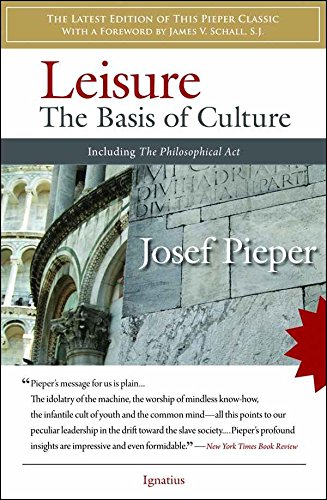
Leisure cover

Leisure

Author
Joseph Pieper and James V. Schall
Highlights
8
Responses
1
First highlight
Aug 11, 2026
Last highlight
Aug 20, 2026
Last note
Aug 21, 2026

Responses (1)

Two types of seeing

August 21, 2026 · 12:53 AM

Our soul is passive and receptive. We are, to be sure, awake and active, but our attention is not strained; we simply “look”—in so far, that is, as we “contemplate” it and are not already “observing” it (for “observing” implies that we are beginning to count, to measure and to weigh up). Observation is a tense activity; which is what Ernst Jünger meant when he called seeing an “act of aggression.” To contemplate, on the other hand, to “look” in this sense, means to open one’s eyes receptively to whatever offers itself to one’s vision, and the things seen enter into us, so to speak, without calling for any effort or strain on our part to possess them. There can hardly be any doubt that that, or something like it, is the way we become sensorially aware of a thing.

Location 211

There are many ways of seeing, yet this belittles rational observation.

I resonate with non-optimized receptivity too, a kind of "open perception"—but is discernment really such a sin? The Jünger quote introduces "aggression" as a phrase to slander reason, but actually, there are harsher words: interrogation. There is a mode of seeing where you take a single object, rotate it in every way, try to pick the locks of all the side doors, with the goal of understanding its hidden essence. This is the vision of the scientist, the cartographer, the taxonomist. Can they not have souls?

You can't perceive all of reality all of the time in such a rigorous way (that would be exhausting). There's delight in the mosey of undirected consciousness. Rather, these are two opposite modes: divergence and convergence. Passive attention gives you range, where focused and obsessive attention gives you depth. Without range, you'll fixate your mind on something stupid. Without depth, all your insights will be shallow.

Reason has its pitfalls and limits, but my sense is that post-Enlightenment thinkers have gone too far in trying to dethrone it, creating a schism between the thinkers and feelers. We are in trouble if our thinkers can't feel and feelers can't think.

Highlights (7)

leisure in Greek is skole, and in Latin scola, the English “school”. The word used to designate the place where we educate and teach is derived from a word which means “leisure”. “School” does not, properly speaking, mean school, but leisure.

Location 154

in order to gain a clear notion of leisure we must begin by setting aside the prejudice—our prejudice—that comes from overvaluing the sphere of work. In his well-known study of capitalism Max Weber1 quotes the saying, that “one does not work to live; one lives to work”, which nowadays no one has much difficulty in understanding: it expresses the current opinion. We even find some difficulty in grasping that it reverses the order of things and stands them on their head.

Location 158

The context of Aristotle’s words, and his other statement (in the Politics) to the effect that leisure is the center-point about which everything revolves,3 seems to indicate that he was saying something almost self-evident; and one can only suppose that the Greeks would not have understood our maxims about “work for work’s sake” at all. On the other hand it must be evident that we no longer understand their conception of leisure simply and directly.

Location 169

the Christian and Western conception of the contemplative life is closely linked to the Aristotelian notion of leisure. It is also to be observed that this is the source of the distinction between the artes liberales and the artes serviles, the liberal arts and servile work. And to the further objection that this distinction only interests historians, one might reply that everyone is familiar with at any rate one half of the distinction, from the fact that we still speak of “servile work” as unsuitable on Sundays and holidays. Though who nowadays stops to think that “servile work” and “liberal arts” are twin expressions, and form, one might almost say, the articulation of a joint, so that the one is hardly intelligible without the other? For it is barely possible to think of “servile work” with any degree of accuracy without delimiting the sense with reference to the “liberal arts”.

Location 175

The tremendous difference of point of view implied and our relative ignorance of the notion of leisure emerge more clearly if we examine the notion of work in its modern form, spreading, as it does, to cover and include the whole of human activity and even of human life; for then we shall realize to what an extent we tacitly acknowledge the claims that are made in the name of the “worker”.

Location 185

On the contrary, “worker” will be used in an anthropological sense; it implies a whole conception of “man”. Ernst Niekisch was using the word “worker” in this sense when he spoke of the “worker” as an “imperial figure”;4 and Ernst Jünger5 uses the same term to outline the ideal image that, according to him, has already begun to mold the man of the future.

Location 190

Intellectual activity used always to be considered a privileged sphere, and from the standpoint of the manual worker especially, appeared to be a sphere in which one did not need to work. Within that sphere, the province of philosophy and of philosophical culture seemed furthest from the world of work. But nowadays the whole field of intellectual activity, not excepting the province of philosophical culture, has been overwhelmed by the modern ideal of work and is at the mercy of its totalitarian claims.

Note: Not a realistic thing for mass interest; rich or mad “Knowledge work” [e]

Location 200